The Complete Buyer’s Guide to Acacia Wood Hardness and Durability
In the world of high-volume retail, "durability" is not just a marketing buzzword- (financial metric). For a sourcing manager at a global giant like Costco or Williams Sonoma, a product that warps, cracks, or fails in the hands of a consumer represents more than just a lost sale; it represents a cascade of returns, logistical nightmares, and brand erosion.
When it comes to wooden housewares, Acacia wood has surged to the forefront of global demand. But why? Is it merely the aesthetic appeal, or is there a hard, scientific basis for its performance? This guide dives deep into the technical specifications of Acacia wood, focusing on its Janka hardness, structural density, and long-term resilience in the global market.
Chapter 1: The Science of Strength – Understanding the Janka Scale
To discuss wood durability, we must first speak the language of the Janka Hardness Scale. This industry-standard test measures the force required to embed a 11.28mm steel ball halfway into a piece of wood.
1.1. Where Acacia Stands
Not all Acacia is created equal. The Acacia Mangium grown in the sustainable plantations of Northern Vietnam typically registers a Janka rating between 1,700 and 2,300 lbf (pounds-force).
To put this into perspective for a B2B buyer:
- Acacia (~1,750+ lbf): Harder than White Oak and significantly harder than Teak.
- White Oak (~1,360 lbf): Often considered the "gold standard" for flooring, yet Acacia surpasses it.
- Teak (~1,070 lbf): While famous for its oils, Teak is actually a much softer wood than high-grade Acacia.
- Rubberwood (~900 lbf): A common competitor that is nearly 50% softer than Acacia, leading to much higher rates of denting and scratching.
1.2. Why Janka Matters for Retailers
For a kitchenware line, a high Janka rating translates directly to surface resilience. When a consumer uses a heavy chef’s knife on an Acacia cutting board, the wood fibers resist deep scarring. This doesn't just keep the board looking new; it prevents deep grooves where bacteria can hide—a major selling point for health-conscious consumers.
Chapter 2: Density and the "Interlocked Grain" Advantage
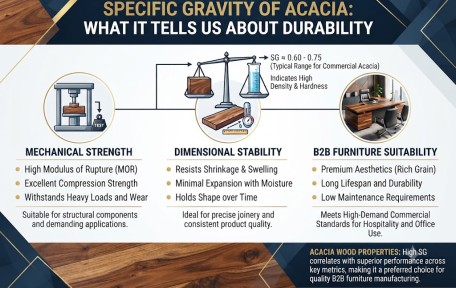
Hardness is only one side of the coin. The other is density. Acacia is a diffuse-porous hardwood, meaning its vessels are distributed evenly throughout the wood.
2.1. Specific Gravity and Weight
Vietnamese Acacia has a specific gravity of approximately 0.65 to 0.80. This high density gives the products a "premium heft." When a customer picks up a Simply Acacia bowl, they immediately perceive quality through weight—a psychological trigger that justifies a higher retail price point.
2.2. The Interlocked Grain Structure
Acacia is famous (and sometimes feared by amateur carpenters) for its interlocked grain. In this structure, the wood fibers grow in a spiraling, crisscross pattern rather than a simple straight line.
- The Durability Benefit: This interlocked grain makes the wood extremely difficult to split. While straight-grained woods might crack along the grain line when dropped or exposed to dry air, Acacia’s fibers hold onto each other like a woven fabric.
Chapter 3: Environmental Resilience – Fighting the Elements
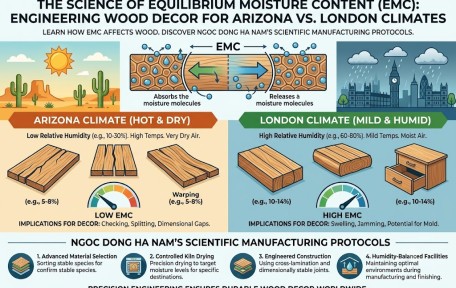
The journey from a factory in Ha Nam, Vietnam, to a kitchen in London or a dining room in Arizona involves extreme changes in temperature and humidity. This is where most wood products fail.
3.1. Moisture Stability (The 8-12% Rule)
At Simply Acacia, we utilize advanced Kiln-Drying (KD) technology to bring our wood to an equilibrium moisture content of 8-12%.
- Why this range? If wood is too wet, it will shrink and crack in the dry, heated air of Western homes. If it’s too dry, it can swell and warp in humid coastal cities. By hitting the "sweet spot" of 10%, we ensure the structural integrity of the wood across global climate zones.
3.2. Natural Resistance to Rot and Pests
Acacia is rich in natural tannins and resins. These compounds serve as the tree’s natural defense system, making the harvested timber highly resistant to wood-boring insects and fungal decay (mold). For a retailer, this means a significantly longer shelf life and lower risk of inventory loss during long-sea-freight transitions.
Chapter 4: Comparative Analysis – Acacia vs. The World
For a sourcing manager, choosing a material is a balancing act between Cost, Durability, and Sustainability. Let’s see how Acacia compares:
|
Feature |
Acacia (Vietnam) |
Bamboo (Laminated) |
Rubberwood |
Teak |
|
Janka Hardness |
1,750+ lbf |
1,300 - 1,400 lbf |
900 lbf |
1,070 lbf |
|
Construction |
Solid Hardwood |
Glued Strips |
Solid Hardwood |
Solid Hardwood |
|
Aesthetic |
Exotic, Rich Grain |
Uniform, Linear |
Pale, Minimal Grain |
Classic Golden |
|
Sustainability |
High (Plantation) |
High (Grass) |
High (By-product) |
Medium (Long growth) |
|
Cost Value |
Excellent |
Low |
Low |
Very High (Expensive) |
The Conclusion for Buyers: Acacia offers "Teak-level" aesthetics and "Oak-level" durability at a fraction of the cost, making it the most profitable material for mid-to-high-end retail collections.
Chapter 5: How Manufacturing Amplifies Durability
Even the hardest wood can fail if the manufacturing process is flawed. As a factory with 30+ years of experience, Simply Acacia applies industrial engineering to enhance natural durability.
5.1. The Lamination Engineering
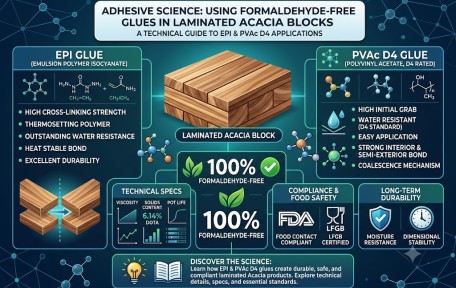
For large items like butcher blocks or oversized salad bowls, we use finger-jointing and edge-gluing techniques. By strategically orienting the grain of different wood segments, we "cancel out" the natural internal stresses of the wood, virtually eliminating the risk of warping in large-format products.
5.2. Food-Safe Finishing as a Protective Shield
We don't just finish our wood; we protect it. Using FDA-approved mineral oils or high-grade beeswax finishes, we create a hydrophobic (water-repelling) barrier. This prevents juices, water, and oils from penetrating the wood fibers, ensuring the product remains stain-resistant and structurally sound after thousands of washes.
Chapter 6: The B2B ROI – Why Durability Sells
In the age of social media, a single photo of a cracked bowl can go viral and damage a retailer's reputation. Sourcing high-durability Acacia from a Tier-1 factory is a risk management strategy.
1. Lower Return Rates: Products that don't crack don't come back.
2. Higher "Star" Ratings: On platforms like Amazon or Target.com, durability is the #1 mentioned factor in 5-star reviews for kitchenware.
3. Sustainability through Longevity: The most sustainable product is the one that doesn't need to be replaced every two years. Acacia's durability aligns perfectly with the "Slow Consumption" trend of 2026.
Chapter 7: Trusting the Simply Acacia Standard
At Simply Acacia (Ngoc Dong Ha Nam), our understanding of wood durability comes from three decades of shipping millions of units to the world’s strictest markets.
We manage a 12,000m² facility where technical precision meets artisanal care. Our IT-driven supply chain ensures that every log is traced, every kiln cycle is logged, and every finished piece is tested for moisture consistency. When you source from us, you aren't just buying woodware; you are buying an engineered solution designed to withstand the rigors of the global retail environment.
Final Verdict for Sourcing Managers
If your goal for the 2026 season is to reduce quality-related costs while elevating the aesthetic of your home decor category, Acacia wood is the objective winner. Its unique combination of Janka hardness, interlocked grain density, and environmental stability makes it the highest-performing hardwood available for mass-scale export.
Are you ready to see the data for yourself?
Contact Simply Acacia today. We can provide detailed technical data sheets, moisture content logs, and FSC™ traceability reports to help your team make an informed, data-backed sourcing decision.
Visit us at simplyacacia.com to explore our 2026 collection.