Resources/Blog

The Art of the Factory Inspection: What to Look for During a Site Visit
Key Takeaways
• On-site factory inspections reduce mass production defect rates from over 12% to under 1.5% by exposing the discrepancies between golden samples and assembly line realities.
• Moisture control is the ultimate risk-mitigation checkpoint: Acacia wood must register below 12% moisture, and natural fibers like bamboo or seagrass must register below 15% to prevent mold during maritime transit.
• B2B buyers must perform bottleneck analysis on the assembly line to verify if the factory's real throughput can meet the promised 45-day lead time.
• Physical compliance verification of BSCI, SMETA, and FSC certificates on-site prevents severe customs delays and intellectual property risks.
• Container pre-loading inspections using the 7-point check and high-absorption calcium chloride desiccants are essential to prevent container rain.
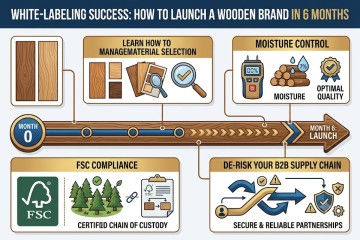
White-Labeling Success: How to Launch a Wooden Brand in 6 Months
Key Takeaways
• A successful 6-month wooden brand launch requires a highly structured 180-day timeline dividing product design, prototyping, kiln-drying, and compliance phases.
• Controlling wood moisture content between 8% and 12% is the single most critical factor in preventing warping, cracking, and product recalls.
• Sourcing from FSC-certified and BSCI-audited manufacturers in Vietnam ensures global compliance and mitigates supply chain disruption risks.
• Utilizing pre-vetted OEM designs and advanced CNC prototyping can reduce early-stage product development lead times by up to 50%.
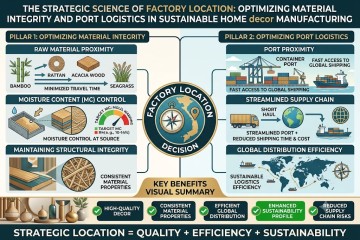
The Strategic Science of Factory Location: Optimizing Material Integrity and Port Logistics in Sustainable Home Decor Manufacturing
Key Takeaways
• Proximity to raw material sources (under 150 km) is scientifically critical to control the Equilibrium Moisture Content (EMC) of natural fibers like seagrass and water hyacinth, preventing fungal degradation.
• Locating manufacturing facilities within 120 km of deep-water ports like Haiphong reduces inland transit times to under 2 hours, minimizing exposure to fluctuating relative humidity and preventing container sweat.
• FSC-certified Acacia wood and bamboo require strict kiln-drying protocols to achieve an optimal moisture content of 8-12%, which is best maintained when processed close to harvesting sites to avoid atmospheric reabsorption.
• Optimized supply chain geography directly reduces Scope 3 greenhouse gas emissions, aligning B2B procurement with European Green Deal and corporate ESG mandates.
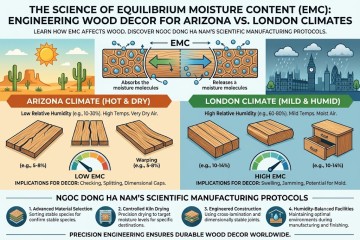
The Science of Equilibrium Moisture Content (EMC): Engineering Wood Decor for Arizona vs. London Climates
Key Takeaways
• Equilibrium Moisture Content (EMC) dictates that wood products must be manufactured to match the specific relative humidity of their destination climate to prevent structural failure.
• Arid climates like Arizona require wood dried to an ultra-low EMC of 4% to 7%, whereas maritime climates like London require a higher target EMC of 10% to 14%.
• Uncontrolled moisture exchange in wood causes anisotropic shrinkage and swelling, leading to severe warping, surface checking, and joint separation.
• Ngoc Dong Ha Nam mitigates climate risks using customized kiln-drying schedules, thermo-vacuum modification, and LFGB/FDA-compliant hydrophobic coatings.

Seasonal Sourcing Timelines: When to order for the Q4 holiday rush
Key Takeaways
• To avoid peak shipping surcharges and blank sailings, B2B buyers must place purchase orders for Q4 holiday home decor by mid-April.
• Acacia wood products require a non-negotiable 15-to-20-day kiln-drying process to reduce moisture content to 8-12%, preventing warping during winter.
• Vietnamese monsoon rains from May to October demand the use of indoor, temperature-controlled drying chambers to keep woven fiber moisture below 15% and prevent mold.
• Importers must verify FSC certification and BSCI/SMETA audits early to comply with EUDR and US Lacey Act regulations, avoiding customs delays.
• Using 2 to 4 kg of calcium chloride desiccants per container and double-wall corrugated cartons is critical to mitigating container sweat during ocean transit.
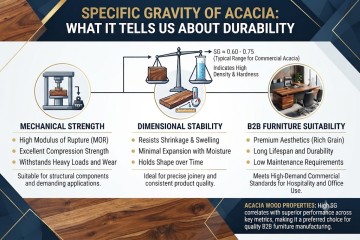
Specific Gravity of Acacia: What it tells us about durability
Key Takeaways
• Acacia wood exhibits a high specific gravity ranging from 0.47 to 0.74, which directly correlates to superior mechanical strength and indentation resistance.
• The low tangential-to-radial (T/R) shrinkage ratio of 1.5 to 1.8 ensures high dimensional stability, minimizing the risk of warping or cracking in fluctuating humidity.
• Acacia's mechanical performance, featuring a Janka hardness of up to 1,750 lbf and a Modulus of Rupture up to 137.5 MPa, makes it a highly cost-effective alternative to premium hardwoods like Oak and Teak.
• B2B procurement protocols must specify a target moisture content of 8-12% and D4-compliant bonding adhesives to guarantee long-term product durability in global markets.
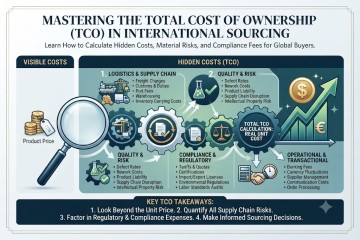
Total Cost of Ownership (TCO): Calculating Hidden Costs in International Sourcing
Key Takeaways
• FOB unit price represents only 40% to 60% of the true Total Cost of Ownership (TCO) in international home decor sourcing.
• Material-specific failures, such as incorrect moisture content in Acacia (target 8-12%) or untreated bamboo, can lead to retail rejection rates exceeding 15%.
• Strict compliance with EUDR, FSC, BSCI, and SMETA acts as a financial safeguard, preventing catastrophic customs seizures and brand damage.
• Optimizing packaging through nested designs and flat-packing can reduce volumetric shipping costs by up to 60%, directly lowering the landed cost.
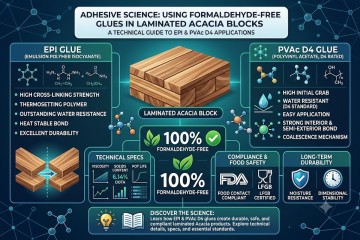
Adhesive Science: Using Formaldehyde-Free Glues in Laminated Acacia Blocks
Key Takeaways
• Formaldehyde-free adhesives, such as Emulsion Polymer Isocyanate (EPI) and D4-rated PVAc, eliminate toxic outgassing while achieving wood-shear failure rates exceeding 80% during mechanical testing.
• Laminated Acacia blocks bonded with NAF (No Added Formaldehyde) glues meet strict global standards including FDA 21 CFR 175.105, LFGB, and CARB Phase 2.
• Maintaining a wood moisture content of 8% to 12% during lamination prevents internal stresses and delamination under fluctuating environmental humidity.
• EPI adhesives form covalent urethane bonds with the hydroxyl groups in Acacia cellulose, providing superior water resistance compared to traditional urea-formaldehyde glues.
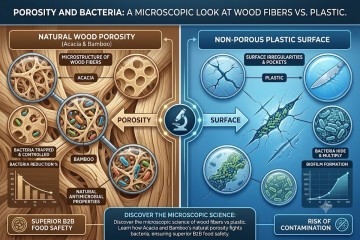
Porosity and Bacteria: A microscopic look at wood fibers vs. plastic.
Key Takeaways
• Wood possesses natural capillary action that draws bacteria deep into its fibrous matrix, depriving them of moisture and oxygen, resulting in rapid bacterial desiccation and death within hours.
• Plastic surfaces, while initially non-porous, rapidly develop microscopic scratches during standard B2B commercial use, creating highly sheltered reservoirs where bacteria form resilient biofilms that resist standard sanitization.
• Natural hardwoods like Acacia and engineered Bamboo contain natural antimicrobial extractives (tannins and quinones) that actively inhibit bacterial cellular replication, offering superior hygiene profiles for food-contact applications.
• Compliance with international standards such as LFGB, FDA, FSC, and SMETA is crucial for global B2B buyers to guarantee food safety, sustainable sourcing, and social compliance in high-volume supply chains.
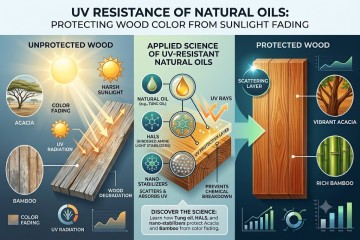
UV Resistance of Natural Oils: Protecting wood color from sunlight fading
Executive Summary
• Lignin photodegradation in wood (Acacia, Bamboo) is triggered by UV radiation (290-400 nm), causing visible color shifts (Delta E* >= 3.0) within 100 hours of direct sunlight exposure.
• Natural drying oils like Tung and Linseed oils with Iodine Values exceeding 130 undergo autoxidation and polymerization to form a dense protective barrier that slows down UV degradation.
• Synergistic formulations combining natural oils with organic Hindered Amine Light Stabilizers (HALS) and inorganic Nano-ZnO/TiO2 reduce color fading by up to 80%.
• B2B procurement specifications should require kiln-dried wood (8-12% MC) finished with FDA 21 CFR 175.300 compliant oils and verified via ASTM G154 accelerated weathering tests.
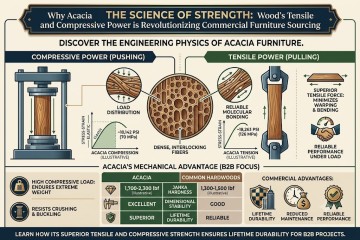
The Science of Strength: Why Acacia Wood Tensile and Compressive Power is Revolutionizing Commercial Furniture Sourcing
Key Takeaways
• Acacia wood possesses an exceptional Janka hardness rating of 1,100 to 1,750 lbf, outperforming traditional fast-growing hardwoods like Rubberwood and offering comparable durability to premium Oak and Teak.
• With a Modulus of Rupture (MOR) exceeding 120 MPa, Acacia furniture exhibits superior tensile strength, preventing joint failure and structural sagging under heavy bending loads in commercial environments.
• Acacia's high compressive strength parallel to the grain (50-65 MPa) ensures that load-bearing components like table and chair legs resist crushing and structural deformation over decades of use.
• Precision kiln-drying to an optimal 8-12% moisture content is critical to preserving Acacia's mechanical properties, preventing warping, splitting, and checking in variable global climates.
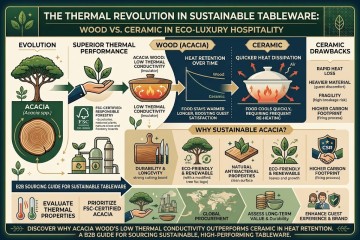
The Thermal Revolution in Sustainable Tableware: Why Wood is Outperforming Ceramic in Modern Eco-Luxury Hospitality
Key Takeaways
• Acacia wood possesses an exceptionally low thermal conductivity of approximately 0.12 to 0.16 W/m K, which is nearly fifteen times lower than that of traditional ceramic tableware.
• The microscopic cellular structure of Acacia wood contains millions of tiny trapped air pockets that act as a natural thermal barrier, preventing rapid heat dissipation.
• Using Acacia tableware in commercial hospitality environments significantly improves guest safety by keeping the exterior of hot food vessels cool to the touch.
• Sourcing FSC-certified and BSCI-compliant Acacia woodware from established manufacturers like Ngoc Dong Ha Nam ensures both environmental sustainability and superior durability over fragile ceramic alternatives.
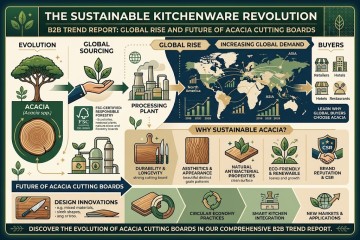
The Sustainable Kitchenware Revolution: B2B Trend Report on the Global Rise and Future of Acacia Cutting Boards
Key Takeaways
• Acacia wood has transitioned from a utility kitchen item to a high-margin, 'prep-to-table' design centerpiece driven by global B2B demand for sustainable luxury.
• Superior physical properties, including natural water resistance, self-healing wood grain, and FSC-certified sustainability, position Acacia above traditional hardwoods and plastics.
• Global compliance standards like FSC, BSCI, and SMETA are now non-negotiable baselines for international buyers securing reliable manufacturing partners in Vietnam.
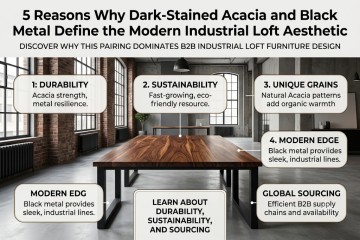
5 Reasons Why Dark-Stained Acacia and Black Metal Define the Modern Industrial Loft Aesthetic
Key Takeaways
• Dark-stained Acacia wood paired with matte black metal delivers a premium, high-contrast industrial loft aesthetic at a highly competitive B2B price point.
• Acacia wood boasts a Janka hardness rating of up to 2,300 lbf, making it exceptionally durable and resistant to warping when supported by a structural metal frame.
• Utilizing FSC-certified Acacia and powder-coated metal ensures compliance with global ESG standards and green building certifications like LEED.
• Ngoc Dong Ha Nam provides fully customizable, OEM/ODM manufacturing of Acacia and metal furniture, backed by BSCI and SMETA social compliance audits.

5 Design Strategies: How to Leverage Bold Acacia Wood Grains for High-End Maximalist Dining Collections
Key Takeaways
•Acacia wood is a premier material for maximalist dining collections due to its dramatic, high-contrast natural grain patterns that make every piece unique.
•The extreme density and natural oil content of Acacia wood provide superior scratch and water resistance, making it ideal for both residential and hospitality use.
•Integrating Acacia wood with woven natural fibers like rattan and seagrass creates the layered, multi-textured aesthetic driving 2026 interior trends.
•Sourcing FSC-certified Acacia from compliant Vietnamese manufacturers like Ngoc Dong Ha Nam ensures full compliance with global regulations like EUDR.

Elevate the Espresso Experience: Why Global Retailers and Hospitality Designers are Sourcing Kiln-Dried Acacia Trays for the Ultimate Coffee Station Setup
Key Takeaways
• Acacia wood is the ideal material for high-moisture coffee stations due to its natural water resistance, dense grain, and high durability against daily wear and tear.
• Ngoc Dong Ha Nam's rigorous 4-stage kiln-drying process stabilizes acacia wood to a 12-14% moisture content, preventing warping or cracking in diverse global climates.
• B2B buyers benefit from fully compliant supply chains, as all Simply Acacia products are FSC-certified, EUDR-compliant, and manufactured in BSCI-audited facilities.
• Customization via OEM/ODM services allows hospitality designers and retail brands to order bespoke sizes, shapes, and branding to perfectly match their aesthetic DNA.
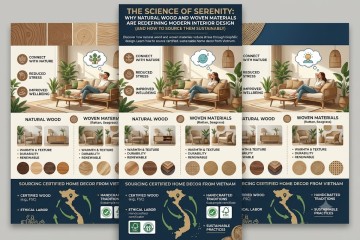
The Science of Serenity: Why Natural Wood and Woven Materials are Redefining Modern Interior Design (and How to Source Them Sustainably)
Key Takeaways
• Biophilic design using natural materials like Acacia, bamboo, and rattan is scientifically proven to lower cortisol levels and reduce heart rates by mimicking natural fractal patterns.
• Tactile interaction with authentic natural textures activates the parasympathetic nervous system, offering immediate cognitive and emotional relief compared to synthetic alternatives.
• Global B2B buyers can capture the rapidly growing wellness decor market by sourcing certified sustainable products that guarantee both environmental and social compliance (FSC, BSCI, SMETA).
• Ngoc Dong Ha Nam resolves common natural material supply chain risks, such as warping and mold, through advanced kiln-drying technology and strict quality control.

The Rise of Conscious Celebrations: How Acacia Wood is Shaping the Future of Sustainable Holiday Tableware
Key Takeaways
• Acacia wood offers a highly renewable and carbon-efficient alternative to traditional holiday tableware, meeting the growing global B2B demand for circular and eco-friendly products.
• The natural density and high oil content of Acacia wood provide superior water resistance and durability, making it ideal for high-use commercial hospitality and premium retail markets.
• Global buyers can mitigate regulatory and supply chain risks by sourcing FSC-certified and BSCI-compliant Acacia tableware from established manufacturers like Ngoc Dong Ha Nam.
• Modern holiday decor trends favor versatile, multi-functional designs that transition seamlessly from Christmas tablescapes to year-round dining, reducing seasonal retail markdown risks.

The 2026 Global Design Report: Raw-Edge Acacia and the Evolution of Modern Farmhouse Aesthetics
Key Takeaways
• Raw-edge Acacia boards have become the premier material choice for Modern Farmhouse aesthetics due to their unique grain patterns, exceptional durability, and natural, live-edge borders.
• Acacia is a highly sustainable hardwood with a rapid growth cycle of 7 to 10 years, making it a carbon-efficient alternative to slow-growing temperate hardwoods like oak and walnut.
• B2B buyers prioritizing the European and North American markets must source FSC-certified and BSCI-compliant Acacia to meet strict EUDR and ESG supply chain regulations.
• Advanced kiln-drying technology that stabilizes moisture content between 8% and 12% is critical to preventing warping and cracking in live-edge Acacia furniture.

The Rise of the Earthy Kitchen: Global Market Trends and the Sourcing Outlook for Wooden Bowls
Key Takeaways
•The global shift toward biophilic kitchen design is driving rapid growth in the wooden tableware market, which is projected to reach $8.6 billion by 2034.
•Acacia and Bamboo are the leading material choices for premium wooden bowls due to their natural water resistance, durability, and highly renewable lifecycles.
•B2B buyers can mitigate regulatory and ethical risks by partnering with manufacturers certified under FSC, BSCI, and SMETA standards.
•Integrating mixed materials, such as combining wood with woven rattan or seagrass accents, enhances product premiumization and increases average retail order value.