The Ultimate B2B Guide to Acacia Wood: How Its Janka Hardness Creates the Perfect Heavy-Duty Chopping Board
The Culinary World's Hidden Gem: Redefining Kitchen Durability
In the highly competitive world of premium kitchenware and home decor, global buyers and interior designers face a persistent challenge: sourcing materials that perfectly balance rugged durability, aesthetic brilliance, and uncompromising sustainability. The modern consumer is no longer satisfied with utility alone; they demand culinary tools that double as statement pieces in open-concept kitchens, all while leaving a minimal environmental footprint. Enter Acacia wood—a material that is rapidly redefining the standards of heavy-duty kitchenware.
For decades, traditional hardwoods like Maple, Walnut, and Oak have dominated the high-end chopping board market. However, as supply chains evolve and the demand for eco-conscious materials skyrockets, a new champion has emerged. Acacia wood is not just a trend; it is a scientifically superior alternative that addresses the core pain points of both professional chefs and domestic culinary enthusiasts. The secret to its rising dominance lies in a specific metric highly revered by timber experts and procurement officers alike: its impressive Janka Hardness rating.
As a Marketing Director and Sustainable Supply Chain Consultant at Ngoc Dong Ha Nam, I have witnessed firsthand how the shift toward high-performance natural materials is transforming retail catalogs worldwide. Global retailers who have integrated Acacia into their product lines are seeing elevated profit margins, reduced return rates, and enthusiastic customer reviews. But what exactly makes Acacia the ultimate choice for heavy-duty chopping boards? To understand its market appeal, we must first dive into the science of wood hardness and discover why Acacia sits in the absolute 'Goldilocks zone' of culinary materials.
Decoding the Janka Scale: How Acacia Outperforms the Classics
The Science of the Janka Hardness Test
To truly appreciate the value of an Acacia chopping board, B2B buyers must understand the Janka Hardness Scale. The Janka test measures the resistance of a sample of wood to denting and wear. It specifically measures the force required to embed a 0.444-inch (11.28 millimeters) steel ball halfway into a piece of wood. The resulting number is expressed in pounds-force (lbf). For procurement officers evaluating kitchenware, the Janka rating is the ultimate indicator of a chopping board's lifespan and performance.
The 'Goldilocks Zone' of Chopping Boards
When it comes to cutting surfaces, hardness is a delicate balancing act. If a wood is too soft (like Pine or Cedar, hovering under 900 lbf), it will easily succumb to deep knife gouges. These deep grooves are not merely cosmetic flaws; they become breeding grounds for dangerous bacteria, compromising food safety and leading to premature product failure. Conversely, if a wood is exceptionally hard (like Brazilian Walnut or Ebony, exceeding 3000 lbf), it will act like a stone surface, rapidly dulling expensive, high-carbon steel chef knives. This leads to profound customer frustration.
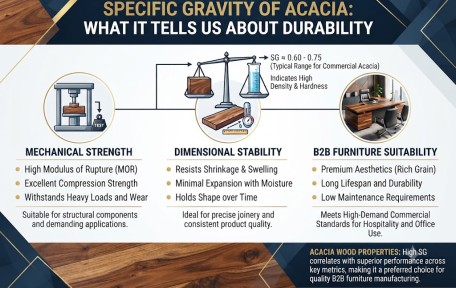
Acacia wood typically registers a Janka hardness rating between 1,700 and 2,220 lbf, depending on the specific species (such as Acacia mangium or Acacia koa). Let us compare this to the traditional titans of the chopping board industry:
- Hard Maple: 1,450 lbf
- White Oak: 1,360 lbf
- Black Walnut: 1,010 lbf
- Teak: 1,155 lbf
- Acacia: 1,750+ lbf
As the data illustrates, Acacia is significantly harder than Maple, Oak, and Walnut. This elevated Janka rating allows Acacia chopping boards to withstand the relentless, heavy-duty chopping of meat cleavers and the rapid slicing of Santoku knives without sustaining deep, bacteria-harboring scars. Yet, it remains yielding enough to protect the razor-sharp edge of premium cutlery. This precise equilibrium is what makes Acacia an engineering marvel for kitchenware, providing buyers with a product that boasts an exceptional lifecycle and guarantees long-term consumer satisfaction.
Beyond Durability: The Sustainable and Aesthetic Edge of Acacia
The Visual Impact: A Designer's Dream
While the Janka rating secures the functional argument, the aesthetic properties of Acacia capture the consumer's heart. For interior designers curating modern, rustic, or minimalist spaces, the kitchen is increasingly viewed as an extension of the living area. Chopping boards are no longer hidden in cabinets; they are displayed proudly on marble islands and open shelving. Acacia wood is renowned for its breathtaking, high-contrast grain patterns. Ranging from pale yellows to rich, deep chocolates, the natural chatoyancy of Acacia ensures that no two boards are exactly alike. This bespoke quality allows retailers to offer artisanal-level beauty at a scalable, commercial volume.
The Ethical Supply Chain: FSC, BSCI, and SMETA Compliance
In today's global market, a product's origin story is just as critical as its physical attributes. Modern buyers are heavily scrutinized on their Environmental, Social, and Governance (ESG) commitments. This is where Acacia truly separates itself from slower-growing hardwoods. Acacia is an incredibly fast-growing species, reaching maturity in a fraction of the time it takes Oak or Maple. This rapid growth cycle makes it an inherently renewable resource.
At Ngoc Dong Ha Nam, we understand that true sustainability requires rigorous verification. When sourcing Acacia products, B2B buyers must insist on Forest Stewardship Council (FSC) certification, which guarantees that the timber is harvested from responsibly managed forests that provide environmental, social, and economic benefits. Furthermore, manufacturing facilities must adhere to strict social compliance standards, such as the Business Social Compliance Initiative (BSCI) and Sedex Members Ethical Trade Audit (SMETA). By sourcing Acacia chopping boards that meet these elite international standards, brands protect their reputation, mitigate supply chain risks, and appeal to the rapidly growing demographic of eco-conscious consumers. The high Janka hardness ensures the product lasts a lifetime, while the sustainable sourcing ensures the planet does, too.
Elevate Your Product Line: Partner with Vietnam's Sustainable Sourcing Experts
Transform Your Kitchenware Portfolio Today
The evidence is clear: Acacia wood's superior Janka hardness, combined with its stunning visual appeal and rapid renewability, makes it the ultimate material for heavy-duty chopping boards. For global buyers, procurement officers, and home decor brands, transitioning to or expanding your Acacia product line is a strategic move that promises higher margins, exceptional durability, and unassailable eco-credentials.
Why Choose Ngoc Dong Ha Nam?
Sourcing premium natural materials requires a partner who understands both the art of craftsmanship and the rigorous demands of international trade. At Ngoc Dong Ha Nam, we have spent decades perfecting the supply chain for sustainable natural materials, including Acacia, Bamboo, Seagrass, Rattan, and Water Hyacinth. Our deep-rooted expertise in Vietnam's rich manufacturing landscape allows us to deliver world-class products that meet the highest global standards.
We do not just supply products; we provide peace of mind. Our unwavering commitment to FSC-certified timber, coupled with our strict adherence to BSCI and SMETA social compliance, ensures that every Acacia chopping board you source from us is ethically produced and of the highest quality. We empower your brand to tell a compelling story of sustainability, durability, and design excellence.
Are you ready to offer your customers the culinary world's most resilient and beautiful chopping boards? Contact the sourcing experts at Ngoc Dong Ha Nam today. Let us collaborate to design and manufacture a custom line of heavy-duty Acacia kitchenware that will elevate your brand, delight your customers, and stand the test of time. Reach out to our B2B consulting team to request a catalog, discuss custom OEM/ODM designs, and secure your sustainable supply chain for the future.
Frequently Asked Questions
What is the Janka hardness rating of Acacia wood?
Acacia wood typically has a Janka hardness rating ranging from 1,700 to 2,220 lbf (pounds-force), depending on the specific species. This makes it significantly harder than traditional kitchenware woods like Hard Maple (1,450 lbf) and White Oak (1,360 lbf).
Does the high hardness of Acacia wood dull chef knives?
No. While Acacia is highly durable and resistant to deep gouges, it sits in the 'Goldilocks zone' of hardness. It is hard enough to resist bacteria-harboring scratches but still yielding enough to protect the fine edges of high-carbon steel chef knives, preventing premature dulling.
Is Acacia wood a sustainable choice for large-scale B2B purchasing?
Absolutely. Acacia is a fast-growing tree that reaches maturity much faster than traditional hardwoods, making it a highly renewable resource. For B2B buyers, it is crucial to source FSC-certified Acacia to ensure the timber comes from responsibly managed forests.
How does Acacia compare to Bamboo for chopping boards?
While both are sustainable, they perform differently. Bamboo is technically a grass and is often glued together in strips, which can sometimes be hard on knives and prone to splintering if not manufactured perfectly. Solid Acacia wood offers superior water resistance, a richer aesthetic grain, and a natural hardness that provides a more traditional, premium cutting surface.
What international compliance standards should buyers look for when sourcing Acacia products?
Global buyers should look for Forest Stewardship Council (FSC) certification for environmental sustainability, alongside social compliance certifications like BSCI (Business Social Compliance Initiative) and SMETA (Sedex Members Ethical Trade Audit) to ensure ethical manufacturing practices.