
The Ultimate Handbook for Large-Scale Retail Sourcing
In the world of global retail, "Big-Box" sourcing is a high-stakes game where there is zero margin for error. When you are responsible for stocking 4,000+ stores across multiple continents, a 1% defect rate or a 10-day shipping delay doesn't just disrupt a category—it costs millions in lost revenue and erodes shareholder trust.
For giants like Walmart, Costco, and Target, the sourcing journey in 2026 has shifted from a search for the "lowest price" to a search for the "most resilient partner." This handbook provides a deep dive into the strategic pillars of large-scale sourcing, specifically focusing on the Vietnamese Acacia woodware sector, and how a Tier-1 manufacturer must operate to support the world’s largest retail ecosystems.
Chapter 1: The Infrastructure of Scale – Beyond the Workshop
Massive retail contracts require more than just "craftsmanship"; they require industrial capacity. A common mistake in international sourcing is partnering with a factory that lacks the physical infrastructure to scale up when a seasonal promotion goes viral.
1.1. Physical Capacity: The 12,000m² Benchmark
A Tier-1 partner in Vietnam must operate at a scale that allows for simultaneous production lines. For example, a 12,000m² facility is the industry benchmark for a factory capable of handling high-volume accounts. This space ensures:
- Separation of Processes: Distinct zones for raw timber storage, kiln-drying, precision cutting, sanding, and dust-free finishing.
- In-House Kiln Drying: Control over the most critical variable—moisture. Relying on third-party drying services is a major risk factor for large retailers.
1.2. Volume Throughput: The 20-30 Container Standard
Large retailers require "Continuous Replenishment." A factory must prove a consistent output of at least 20 to 30 containers per month. At Simply Acacia, our history of managing projects like the 250,000-unit Lidl bowl shipment and the 85-container Costco project proves that our infrastructure is built for "Peak Load" performance without sacrificing quality.
Chapter 2: Audit Readiness – The "Golden Ticket" to the Shelf
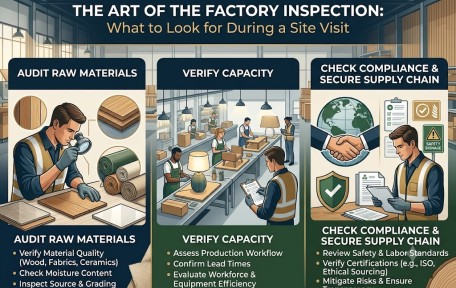
For a sourcing manager at Target or Walmart, the factory audit is the ultimate gatekeeper. In 2026, being "audit-ready" means more than just a clean floor; it means total transparency across three critical domains:
2.1. Social Compliance (BSCI & SMETA)
The modern consumer is hyper-aware of labor ethics. A partner must hold a valid BSCI (amfori) or SMETA (Sedex) audit with an "A" or "B" rating. These audits verify:
- Fair Wages & Hours: Ensuring the 1,000+ artisans in our network are treated with dignity.
- Health & Safety: Fire safety, ventilation, and PPE usage are non-negotiable for big-box approval.
2.2. Security and Chain of Custody (SCAN & C-TPAT)
Security is a primary concern for US-bound shipments. Participation in SCAN (Supplier Compliance Audit Network) or C-TPAT (Customs-Trade Partnership Against Terrorism) is essential. These protocols ensure that your cargo is protected from tampering, from the factory gate in Ha Nam to the Port of Haiphong.
2.3. Environmental Stewardship (FSC™ & EUDR)
With the EUDR (EU Deforestation Regulation) and the US Lacey Act in full force, traceability is the new currency. A Tier-1 partner must provide a digital paper trail from the specific forest plot to the final retail box. FSC 100% certification is the baseline for any serious woodware tender in 2026.
Chapter 3: Quality Control at Scale – The AQL 2.5/4.0 Reality
Maintaining consistency across 10 units is easy. Maintaining it across 250,000 units is an engineering challenge. Large retailers utilize AQL (Acceptable Quality Limit) standards, and a manufacturer must be integrated into this language.
3.1. Inline vs. Final Inspection
Waiting until the end of production to check quality is a recipe for disaster. A professional factory employs Inline QC, where products are inspected at every workstation:
- Pre-Production: Testing raw timber moisture.
- Milling: Checking dimensional accuracy against CAD drawings.
- Finishing: Ensuring uniform oil application and surface smoothness.
3.2. Data-Driven QC via IT Integration
At Simply Acacia, we leverage our background in Information Technology and AI to manage quality data. By digitizing QC logs, we can identify "micro-trends" in production defects and correct them before they impact a single container. This level of technical sophistication is what separates a traditional workshop from a 21st-century manufacturing partner.
Chapter 4: Logistics & Supply Chain Resilience
A beautiful product that arrives late is a liability. For big-box retailers, the supply chain must be a well-oiled machine.
4.1. Proximity to Infrastructure
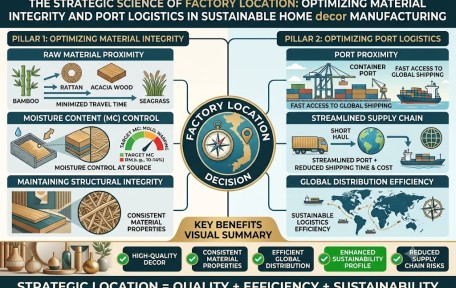
Efficiency starts with location. Being situated in Ha Nam Province provides a strategic advantage—direct access to the modernized highway network leading to Haiphong Port. This reduces "land transit" risk and ensures that your goods are on the water as quickly as possible.
4.2. Container Optimization and Packaging
Large retailers sell "space" as much as they sell products. A manufacturer must be an expert in Packaging Engineering:
- ISTA-3A Standards: Ensuring the "Retail Color Box" survives the rigors of global shipping and the "last mile" delivery to a consumer's home.
- PDQ & Palletization: Designing displays that go straight from the container to the retail floor, reducing labor costs for the retailer.
Chapter 5: ESG and the 2026 Mandate
"Sustainability" has evolved from a PR buzzword into a core procurement requirement. Big-box retailers are now setting "Net Zero" targets for their Scope 3 emissions (their suppliers).
5.1. Low-Carbon Manufacturing
In 2026, Simply Acacia is leading the way by integrating renewable energy into our 12,000m² facility. By choosing a factory that utilizes solar power and biomass from wood waste for its kilns, retailers can report significant carbon reductions in their annual ESG filings.
5.2. Natural Materials as a Strategy
Acacia, Bamboo, and Seagrass are not just "eco-friendly"; they are renewable resources that grow rapidly in Vietnam. Unlike slow-growing hardwoods from endangered forests, Acacia is a plantation-grown crop that supports local biodiversity and provides a sustainable livelihood for thousands of "satellite" artisans.
Chapter 6: Why Simply Acacia (Ngoc Dong Ha Nam) is the Partner of Choice
With a legacy dating back to 1988, our enterprise has not just witnessed the evolution of global sourcing; we have helped shape it.
6.1. Experience with the Giants
We don't just "hope" to work with Walmart or Costco—we already have. Our team understands the specific portals, the labeling requirements, and the strict delivery windows that these giants demand. We speak the language of "Tier-1 Vendor" because we live it every day.
6.2. The Innovation Edge
While our roots are in the artisanal craft of Ha Nam, our future is driven by Artificial Intelligence and IT. We use technology to optimize logistics, predict material behavior, and ensure that our communication is as precise as our woodworking.
Conclusion: Moving from Vendor to Strategic Partner
The difference between a "vendor" and a "strategic partner" is Reliability. For a sourcing manager at a global retailer, the ultimate goal is to find a partner who makes their job easier—a partner who understands audits, respects lead times, and delivers quality without constant supervision.
As you plan your 2026 sourcing strategy, consider the peace of mind that comes with 30+ years of experience and 12,000m² of industrial capacity. At Simply Acacia, we are ready to support your next global launch.
| Metric | Specification |
| Factory Size | 12,000 m² |
| Monthly Capacity | 20 - 30 High-Cube Containers |
| Major Audits | BSCI, SMETA, SCAN, C-TPAT |
| Certifications | FSC 100%, ISO 9001, ISO 14001 |
| Location | Ha Nam Province, Vietnam (90 min to Port) |