The Ultimate Science of Wood Moisture Control: From Kiln-Dry to Global Shipping
Imagine this: A sourcing manager for a major US retailer opens a shipping container in a dry warehouse in Arizona. Inside are 10,000 Acacia wood salad bowls, handcrafted with precision in Vietnam. But as the doors swing open, a heartbreaking sound fills the air—the faint crack of wood fibers under stress. Within days, 30% of the shipment shows visible warping or deep structural splits.
What went wrong? The design was perfect. The branding was flawless. The finish was premium. The failure happened at the molecular level. It was a failure of Moisture Control.
In the world of high-volume B2B woodware export, moisture is "The Invisible Enemy." At Simply Acacia (Ngoc Dong Ha Nam), we believe that mastering wood moisture isn't just a manufacturing step—it is a rigorous science. This guide explores the lifecycle of water within Acacia wood, from the moment the timber is felled to its journey across the ocean, and how we ensure your ROI is protected through technical excellence.
Chapter 1: The Biology of Wood and Water – Understanding the "Bound" and the "Free"
To control moisture, we must first understand how wood "holds" water. Wood is a hygroscopic material, meaning it behaves like a living sponge, constantly seeking balance with its environment.
1.1. Free Water vs. Bound Water
Water exists in wood in two forms:
1. Free Water: Located in the cell cavities (lumens). This is the first to leave during the drying process.
2. Bound Water: Chemically bonded within the cell walls. Removing this water is where the true science begins.
The point at which all free water is gone, but the cell walls are still fully saturated, is called the Fiber Saturation Point (FSP)—typically around 30% moisture content. Any drying below this point causes the wood to shrink. If this shrinkage is not controlled with mathematical precision, internal stresses lead to the cracks that haunt sourcing managers.
1.2. Equilibrium Moisture Content (EMC)
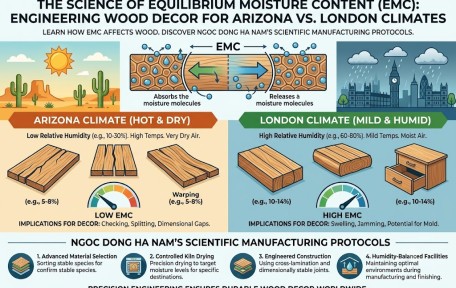
The "Holy Grail" of wood manufacturing is reaching the Equilibrium Moisture Content (EMC). This is the state where the wood is neither gaining nor losing moisture because it is in perfect balance with the surrounding air’s humidity and temperature.
For a factory in the humid climate of Ha Nam, Vietnam (average humidity 80%), the EMC is very different from a retail store in Las Vegas (average humidity 20%). A Tier-1 partner must manufacture wood not for the environment it is in, but for the environment it is going to.
Chapter 2: The Kiln-Drying (KD) Masterclass – The Simply Acacia Standard
Air-drying (phơi tự nhiên) is sufficient for local handicrafts, but for global export to markets like the US, EU, or Australia, Kiln-Drying (Sấy lò) is non-negotiable.
2.1. Why Kiln-Drying is Vital for B2B
- Sterilization: High temperatures kill insect larvae and fungal spores, ensuring compliance with international phytosanitary regulations.
- Resin Setting: It "sets" the natural resins in Acacia wood, preventing them from bleeding through the finish later.
- Stress Relief: A controlled kiln schedule allows wood fibers to relax as they shrink, minimizing internal tension.
2.2. Our 4-Stage Drying Protocol
At our 12,000m2 facility, we utilize advanced industrial kilns with computerized monitoring. Our schedule for Acacia Mangium typically follows these stages:
1. Pre-heating: Gradually raising the temperature to open the wood's "pores" without causing surface checks.
2. Drying: Controlled removal of water. We monitor the "Wet Bulb" and "Dry Bulb" temperatures to ensure the core of the wood dries at the same rate as the surface.
3. Equalizing: Ensuring every board in the kiln reaches the exact same moisture percentage.
4. Conditioning: Re-introducing a tiny, controlled amount of moisture to the surface to relieve any final "case-hardening" (stress).
Chapter 3: The "Gold Standard" Range: Why 8% to 12%?
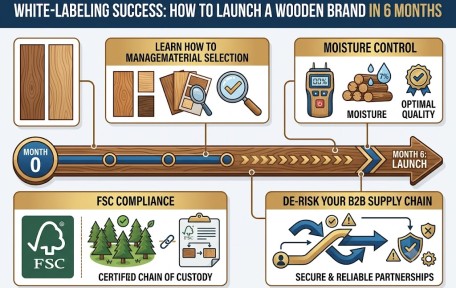
For over 30 years, we have analyzed the failure rates of exported woodware. The data is clear: for Acacia wood to survive the transition from Vietnam to the global market, it must leave the factory at a moisture content (MC) of 8% to 12%.
- Below 8%: The wood becomes too brittle. When it reaches a more humid environment, it may expand too aggressively, causing joints to fail.
- Above 12%: The risk of mold growth and "warping" increases exponentially, especially during the 30-40 day sea transit in a hot container.
The Simply Acacia "Double-Check" System
We don't just test the wood once.
- Post-Kiln: Every batch is tested using pin-type moisture meters.
- Pre-Finishing: Moisture is checked again after the wood has been milled into its final shape.
- Pre-Packing: A final scan ensures that the moisture has not "re-bounded" during the production process.
Chapter 4: Managing the "Micro-Climate" During Manufacturing
A common mistake in the industry is drying the wood perfectly, then leaving it in a humid finishing room for two weeks.
4.1. Climate-Controlled Production Zones
At Ngoc Dong Ha Nam, we manage the ambient humidity of our processing areas. By using industrial dehumidifiers and proper ventilation, we ensure that the "Equilibrium" achieved in the kiln is maintained while our artisans carve, sand, and finish the products.
4.2. The Finishing Barrier
As discussed in our Finishes Guide, the choice of oil or lacquer acts as a "moisture regulator." While no finish is 100% waterproof, a high-quality food-safe lacquer or a deep-penetrating mineral oil significantly slows down the rate of moisture exchange. This "slow-motion" exchange is what allows wood to adapt to a new climate without cracking.
Chapter 5: The Logistics Battle – Surviving "Container Rain"
The most dangerous part of a wood product’s life is the 30 days it spends in a steel box on the ocean.
5.1. The Phenomenon of Container Sweat
As a ship moves from the tropical waters of Southeast Asia to the colder climates of Europe or North America, the temperature inside the container fluctuates wildly. Moisture evaporates from the wood (and the wooden pallets) and condenses on the cold steel ceiling. This "Container Rain" then drips back onto the retail packaging, leading to mold and collapsed boxes.
5.2. Strategic Packaging Solutions
To protect our partners like Costco and Lidl, we employ a multi-layered defense:
- Desiccant Integration: We use high-absorption silica gel or calcium chloride poles (like "Dry-Bags") inside the container to pull moisture out of the air.
- Moisture Barrier Bags: For sensitive products, we utilize VCI or PE polybags to create a micro-environment for each individual unit.
- Pallet Science: We ensure the wooden pallets used for shipping are also kiln-dried to the same standards as the product to prevent "cross-contamination" of moisture.
Chapter 6: The Simply Acacia Advantage – IT and AI in Moisture Management
Our leadership's background in Information Technology and AI gives us a unique edge in an industry often governed by "guesswork."
- Predictive Analytics: We analyze historical weather data and shipping routes to adjust our kiln schedules. If we know a shipment is headed to a desert climate in peak summer, we may aim for the lower end of the 8-12% range.
- Digital Traceability: Every batch of timber is assigned a digital ID. We log moisture readings at five different stages of production. If a customer reports an issue, we can trace back to the exact kiln load and the exact sensor data from that day. This level of transparency is why global giants trust us.
Conclusion: Trusting the Science, Securing Your Supply Chain
Moisture control is the difference between a successful product launch and a logistical nightmare. It is a science that requires expensive infrastructure, disciplined protocols, and decades of experience.
When you partner with Simply Acacia (Ngoc Dong Ha Nam), you aren't just buying wooden housewares; you are buying the peace of mind that comes with 30+ years of moisture expertise. We understand that your reputation is built on the durability of the products you sell, and we take the science of "The Invisible Enemy" as seriously as you take your brand.
Protect Your Next Collection
Don't leave your quality to chance. Contact our technical team today at simplyacacia.com to learn more about our kiln-drying protocols and how we can customize a moisture-management plan for your specific target market.
Simply Acacia: Engineered for Stability. Crafted for Beauty.