
Adhesive Science: Using Formaldehyde-Free Glues in Laminated Acacia Blocks
Key Takeaways
• Formaldehyde-free adhesives, such as Emulsion Polymer Isocyanate (EPI) and D4-rated PVAc, eliminate toxic outgassing while achieving wood-shear failure rates exceeding 80% during mechanical testing.• Laminated Acacia blocks bonded with NAF (No Added Formaldehyde) glues meet strict global standards including FDA 21 CFR 175.105, LFGB, and CARB Phase 2.
• Maintaining a wood moisture content of 8% to 12% during lamination prevents internal stresses and delamination under fluctuating environmental humidity.
• EPI adhesives form covalent urethane bonds with the hydroxyl groups in Acacia cellulose, providing superior water resistance compared to traditional urea-formaldehyde glues.
TECHNICAL EXECUTIVE SUMMARY AND STRUCTURAL OVERVIEW
In the global home decor and utility furniture market, the demand for sustainable, high-performance materials has shifted from a niche preference to a strict regulatory and commercial requirement. Laminated Acacia blocks—widely used for cutting boards, kitchen countertops, tabletops, and high-end interior surfaces—are under intense scrutiny regarding their chemical composition. Historically, industrial wood lamination relied on urea-formaldehyde (UF) or melamine-urea-formaldehyde (MUF) resins due to their low cost and rapid curing times. However, the chronic outgassing of free formaldehyde, a known human carcinogen, has prompted global buyers to demand safer alternatives. This technical paper provides an in-depth analysis of formaldehyde-free adhesive systems, specifically Emulsion Polymer Isocyanate (EPI) and cross-linked Polyvinyl Acetate (PVAc) D4, applied to laminated Acacia wood blocks. We examine the molecular mechanics of these adhesives, their physical performance under stress, and their compliance with international food-safety and environmental standards.
Table of Contents
- 1. Molecular Mechanics: Formaldehyde-Based vs. Formaldehyde-Free Systems
- 2. Quantitative Performance Analysis and Bond Microstructure
- 3. Global Regulatory Frameworks and Food-Contact Compliance
- 4. Industrial Lamination Parameters and Physical Tolerances
- 5. Contextual Technical Glossary
- 6. Sustainable Procurement and Maintenance Protocols
MOLECULAR MECHANICS: FORMALDEHYDE-BASED VS. FORMALDEHYDE-FREE SYSTEMS
To understand the necessity of formaldehyde-free adhesives, one must analyze the chemical bonding mechanisms at play. Traditional wood adhesives like Urea-Formaldehyde (UF) cure through a polycondensation reaction, forming a rigid, three-dimensional network. However, this reaction is reversible. In the presence of ambient moisture (hydrolysis), the polymer chains degrade, continuously releasing gaseous formaldehyde (CH2O) into the atmosphere over years. This phenomenon represents a significant indoor air quality hazard.
In contrast, modern formaldehyde-free systems rely on entirely different chemical pathways. Emulsion Polymer Isocyanate (EPI) is a two-component system consisting of a water-based polymer emulsion (typically styrene-butadiene or PVAc) and a functional isocyanate hardener (such as polymeric diphenylmethane diisocyanate, or pMDI). When applied to Acacia wood, the highly reactive isocyanate groups (-N=C=O) react directly with the hydroxyl groups (-OH) present in the cellulose and hemicellulose fibers of the wood. This reaction forms covalent urethane linkages. Because these are primary chemical bonds rather than physical attractions, the resulting adhesive line is exceptionally stable, waterproof, and completely free of formaldehyde molecules.
Another prominent alternative is cross-linking Polyvinyl Acetate (PVAc) classified under the EN 204 D3 or D4 standards. Standard PVAc is a thermoplastic adhesive that cures by water evaporation, leaving a flexible polymer film. While sufficient for dry indoor environments, standard PVAc is susceptible to moisture creep. By adding metal-salt catalysts (such as aluminum chloride) or organic cross-linkers, the PVAc polymer chains are chemically tied together. This cross-linking transition converts the thermoplastic glue into a thermosetting network, dramatically increasing its resistance to water, heat, and structural shear stress.
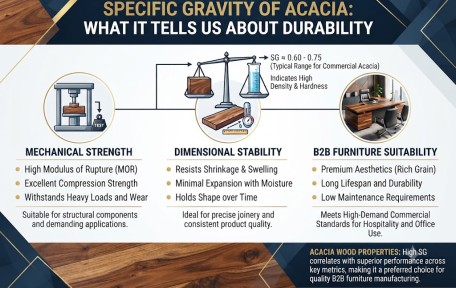
Acacia wood (specifically Acacia mangium and Acacia auriculiformis) presents unique bonding challenges. It is a high-density hardwood, typically ranging from 650 to 750 kg/m³ when dried. This high density means the wood has small vessel pore diameters and a complex structure of natural extractives, such as tannins and resins. These extractives can migrate to the surface during drying, creating a hydrophobic barrier that prevents standard adhesives from wetting the surface. Formaldehyde-free EPI and cross-linked D4 PVAc adhesives are engineered with advanced surfactant packages to lower surface tension, allowing deep penetration into the wood's anatomical structure even in the presence of natural extractives.
QUANTITATIVE PERFORMANCE ANALYSIS AND BOND MICROSTRUCTURE
Selecting an adhesive for laminated Acacia blocks requires evaluating mechanical and environmental performance. The table below compares the physical and chemical properties of traditional UF glues against advanced formaldehyde-free EPI and PVAc D4 systems based on standardized laboratory tests.
|
Performance Metric |
Urea-Formaldehyde (UF) |
Cross-linked PVAc (D4) |
Emulsion Polymer Isocyanate (EPI) |
Testing Standard |
|
Dry Shear Strength (MPa) |
8.5 - 11.0 |
11.5 - 13.5 |
13.0 - 16.0 |
EN 302-1 / ASTM D905 |
|
Wet Shear Strength (24h Soak) |
Delamination occurs |
6.0 - 8.0 MPa |
8.5 - 11.0 MPa |
EN 204 / EN 302-1 |
|
Boiling Water Resistance |
Poor (Complete failure) |
Moderate (Passes D4) |
Excellent (Passes 6h boil) |
EN 204 (D4 treatment) |
|
Formaldehyde Emission |
0.12 - 0.40 mg/m²·h |
< 0.01 mg/m²·h (Trace) |
0.00 mg/m²·h (None) |
EN 717-1 / ASTM D6007 |
|
Wood Failure Rate (%) |
30% - 50% |
70% - 85% |
85% - 100% |
ASTM D5266 |
|
Heat Resistance (WATT 91) |
Excellent (> 7.0 MPa) |
Good (6.0 - 7.0 MPa) |
Excellent (> 7.5 MPa) |
EN 14257 |
The "Wood Failure Rate" is a critical metric in wood science. It measures the percentage of the fractured surface that consists of torn wood fibers rather than failed glue. A wood failure rate of 85% to 100% indicates that the adhesive bond is actually stronger than the natural cohesion of the Acacia wood itself. Under extreme mechanical load, the wood will break before the glue line gives way. EPI adhesives consistently achieve near-total wood failure, making them the premier choice for structurally demanding applications.
Microstructural Visualization of the Glue Line
To visualize how these adhesives perform at a microscopic level, let us examine the interface between the wood and the glue. In a scanning electron microscope (SEM) cross-sectional micrograph of an EPI-bonded Acacia joint, the adhesive does not merely sit as a flat layer between the two wood blocks. Instead, the liquid EPI emulsion is forced under hydraulic assembly pressure deep into the cut vessels (lumens) of the Acacia wood, penetrating approximately 150 to 250 micrometers deep. As the isocyanate cross-links, it forms micro-anchors within these microscopic cavities. This mechanical interlocking, combined with the chemical covalent bonding to the cell walls, creates a highly durable composite interface that resists moisture-driven swelling and shrinking forces.
GLOBAL REGULATORY FRAMEWORKS AND FOOD-CONTACT COMPLIANCE
For global B2B buyers importing Acacia home decor, kitchenware, and furniture into highly regulated markets like the United States, the European Union, and Japan, strict regulatory compliance is mandatory. Formaldehyde emissions and chemical migration are heavily policed by custom authorities and environmental agencies.
In the United States, wood products must comply with the Toxic Substances Control Act (TSCA) Title VI and the California Air Resources Board (CARB) Phase 2 standards. These regulations limit formaldehyde emissions from hardwood plywood and composite wood products to extremely low levels (typically < 0.05 ppm for plywood). Adhesives classified as NAF (No Added Formaldehyde) are exempt from third-party certification requirements under these rules because they do not use formaldehyde as an ingredient. By utilizing EPI or specific PVAc D4 glues, manufacturers can guarantee that their laminated Acacia blocks easily surpass CARB Phase 2 and TSCA Title VI requirements, offering a clear competitive advantage in the American market.
For products intended for food contact, such as cutting boards, cheese platters, and kitchen countertops, the chemical migration of the adhesive must be analyzed. The United States Food and Drug Administration (FDA) regulates this under 21 CFR 175.105 (Adhesives), which specifies which chemical substances may be safely used as components of adhesives intended for use in packaging, transporting, or holding food. Formaldehyde-free EPI and cross-linked PVAc adhesives used by premium manufacturers are formulated strictly with FDA-compliant raw materials.
Similarly, in Europe, food-contact materials must comply with the German Food and Feed Code (LFGB, specifically Sections 30 and 31) and the European Regulation (EC) No 1935/2004. These frameworks require that materials do not transfer their constituents to food in quantities that could endanger human health or bring about an unacceptable change in the composition of the food. Compliance is verified through migration testing, where the laminated wood is exposed to food stimulants (like acetic acid or ethanol) under controlled temperature cycles. Formaldehyde-free laminated Acacia blocks pass these rigorous extraction tests, ensuring they are completely safe for food preparation surfaces.
INDUSTRIAL LAMINATION PARAMETERS AND PHYSICAL TOLERANCES
Producing a dimensionally stable, high-quality laminated Acacia block requires strict control over the industrial manufacturing environment. Because Acacia is an anisotropic material—meaning its physical properties differ depending on the grain direction—improper lamination parameters will lead to internal stresses, warping, and eventual delamination.
Key Manufacturing Parameters
- Moisture Content (MC): The raw Acacia timber must be kiln-dried to a precise moisture content of 8% to 12% (with a maximum deviation of ±2% between adjacent laminations) before processing. If the MC is too high, the water-based adhesive will not cure correctly and the wood will shrink excessively post-lamination, tearing the bond. If the MC is too low, the wood will aggressively absorb water from the adhesive, preventing proper polymer wet-out.
- Surface Preparation: The edges of the Acacia lamellas must be freshly planed within 24 hours of gluing. This removes oxidized surface layers and migrated extractives, exposing active hydroxyl groups for bonding.
- Adhesive Spread Rate: The glue must be applied uniformly at a wet coverage rate of 180 to 220 g/m². Under-application causes dry joints, while over-application creates an excessively thick glue line that is structurally weak and slow to cure.
- Clamping Pressure: For dense hardwoods like Acacia, a high specific clamping pressure of 1.0 to 1.2 N/mm² (MPa) is required to bring the wood surfaces into intimate contact and force the adhesive into the wood pores.
- Curing and Conditioning: The clamped blocks must remain under pressure for a minimum of 45 to 60 minutes at 25°C. Following pressing, the laminated blocks must be conditioned in a humidity-controlled warehouse (relative humidity 50% to 60%, temperature 20°C to 25°C) for at least 7 days to allow the adhesive to reach full chemical cross-linking and to equalize internal moisture gradients.
Physical Limits and Environmental Operating Windows
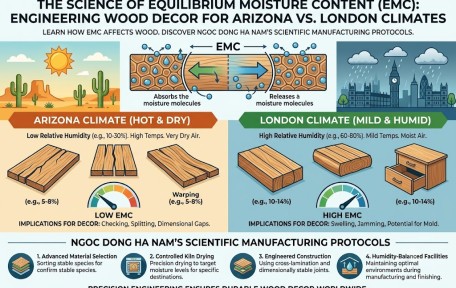
While formaldehyde-free laminated Acacia blocks are engineered for durability, they are bound by the laws of wood physics. Acacia wood exhibits a radial shrinkage coefficient of approximately 2.5% to 3.5% and a tangential shrinkage coefficient of 5.5% to 7.0%. If the finished product is subjected to extreme dry conditions (relative humidity below 30%) or saturated environments (relative humidity above 70%) for prolonged periods, the differential swelling forces will place immense shear stress on the glue lines. Although EPI adhesives can withstand these forces, extreme environmental cycling can cause the wood fibers adjacent to the glue line to check or crack. Therefore, maintaining a stable indoor relative humidity of 35% to 65% is recommended to ensure the lifelong integrity of the laminated block.
Contextual Technical Glossary
To assist global buyers and designers in navigating technical specifications, we have compiled a glossary of essential wood science and adhesive terms used in this document:
- Anisotropic: Exhibiting different physical and mechanical properties (such as shrinkage, strength, and thermal expansion) when measured along different axes or grain directions.
- Covalent Bond: A strong chemical bond formed by the sharing of electrons between atoms. In wood bonding, this occurs when isocyanate groups in EPI react with hydroxyl groups in the wood cellulose.
- Delamination: The separation of laminated layers of wood due to adhesive failure, high internal stresses, or environmental degradation.
- EPI (Emulsion Polymer Isocyanate): A two-component, formaldehyde-free adhesive system known for high water and heat resistance, widely used in structural and high-performance wood lamination.
- Hydrolysis: A chemical reaction in which water molecules break chemical bonds. In traditional UF glues, hydrolysis breaks down the polymer network, releasing formaldehyde gas.
- LFGB (Lebensmittel-, Bedarfsgegenstände- und Futtermittelgesetzbuch): The German Food, Feed, and Consumer Goods Code, which sets strict standards for materials in contact with food.
- NAF (No Added Formaldehyde): A classification for resins and adhesives formulated without any formaldehyde-containing compounds, eliminating outgassing concerns.
- PVAc D4: Polyvinyl Acetate adhesive formulated with cross-linking agents to meet the EN 204 D4 standard for high water resistance, suitable for indoor environments with frequent exposure to running water or condensation.
- Wood Failure Rate: The percentage of the joint failure area that occurs within the wood structure itself rather than the adhesive layer, indicating bond strength.
SUSTAINABLE PROCUREMENT AND MAINTENANCE PROTOCOLS
For B2B buyers, sourcing laminated Acacia blocks is not just about mechanical specifications; it is about protecting brand reputation and ensuring supply chain transparency. Sourcing products manufactured with formaldehyde-free glues demonstrates a commitment to consumer health and environmental stewardship. When searching for a manufacturing partner, buyers should verify that the Acacia wood is sourced from Forest Stewardship Council (FSC) certified plantations, ensuring that the raw timber is harvested legally and sustainably without contributing to deforestation.
Ngoc Dong Ha Nam integrates advanced adhesive technology with sustainable forestry practices. By utilizing state-of-the-art lamination machinery, precise kiln-drying chambers, and environmentally friendly, formaldehyde-free EPI and PVAc D4 adhesives, we produce laminated Acacia blocks that meet the most stringent global standards. This rigorous control ensures that every product—from large-scale commercial countertops to delicate kitchen accessories—is safe, durable, and ready for global distribution.
B2B Maintenance Protocols for Commercial and Residential Use
To maximize the lifespan of laminated Acacia blocks in commercial or residential settings, end-users should adhere to the following maintenance protocols:
1. Avoid Thermal Shock: Do not place hot cookware (exceeding 80°C) directly onto the laminated surface. Use trivets or heat-resistant mats to prevent localized thermal expansion, which can stress the wood fibers and glue lines.
2. Moisture Management: Wipe away standing water or liquids promptly. While D4 and EPI adhesives are highly water-resistant, prolonged exposure to standing water can cause the wood to absorb moisture through its end-grain, leading to localized swelling.
3. Cleaning Chemistry: Use mild, pH-neutral cleaning agents. Avoid harsh chemical solvents, bleach, or abrasive cleaners, which can strip the protective food-safe finishes and degrade the wood surface.
4. Periodic Re-oiling: For food-contact surfaces, periodically reapply a food-safe mineral oil, tung oil, or beeswax finish. This maintains a hydrophobic barrier on the wood surface, reducing moisture absorption and preserving the rich natural grain of the Acacia.
FREQUENTLY ASKED QUESTIONS
What is the difference between E0, E1, and NAF adhesives?
E1 and E0 are European emission standards that limit formaldehyde release to ≤0.1 ppm and ≤0.05 ppm respectively, while NAF (No Added Formaldehyde) adhesives use raw materials that contain zero formaldehyde, eliminating outgassing entirely.
Can formaldehyde-free laminated Acacia blocks be used for food preparation?
Yes. When bonded with adhesives compliant with FDA 21 CFR 175.105 and LFGB, and finished with food-safe oils, these blocks are completely safe for direct food contact applications like cutting boards and countertops.
How does humidity affect the integrity of laminated Acacia blocks?
Acacia is anisotropic; rapid changes in relative humidity (below 30% or above 70%) can cause differential swelling. Using D4-rated or EPI adhesives mitigates this by providing elastic, water-resistant bonds that accommodate minor wood movement.
Why is EPI preferred over standard PVAc for heavy-duty Acacia laminates?
EPI (Emulsion Polymer Isocyanate) cross-links chemically with the wood fibers, offering higher heat resistance, structural shear strength (exceeding 10 MPa), and superior boiling-water resistance compared to standard PVAc.