
Seasonal Sourcing Timelines: When to order for the Q4 holiday rush
Key Takeaways
• To avoid peak shipping surcharges and blank sailings, B2B buyers must place purchase orders for Q4 holiday home decor by mid-April.• Acacia wood products require a non-negotiable 15-to-20-day kiln-drying process to reduce moisture content to 8-12%, preventing warping during winter.
• Vietnamese monsoon rains from May to October demand the use of indoor, temperature-controlled drying chambers to keep woven fiber moisture below 15% and prevent mold.
• Importers must verify FSC certification and BSCI/SMETA audits early to comply with EUDR and US Lacey Act regulations, avoiding customs delays.
• Using 2 to 4 kg of calcium chloride desiccants per container and double-wall corrugated cartons is critical to mitigating container sweat during ocean transit.
THE COST OF A 14-DAY DELAY: WHY Q4 SOURCING FAILS IN AUGUST
For global B2B buyers and retail category managers, the fourth quarter (Q4) represents up to 40% of annual revenue. Yet, the foundation of a successful holiday season is laid months in advance, far from the festive storefronts. Waiting until July or August to finalize purchase orders (POs) for sustainable home decor is a high-risk gamble that frequently ends in missed delivery windows, inflated air freight costs, or compromised product quality. In the competitive home decor sector, a mere two-week delay in early-stage sourcing can cascade into a 45-day delay at the destination port due to compounding logistics bottlenecks.
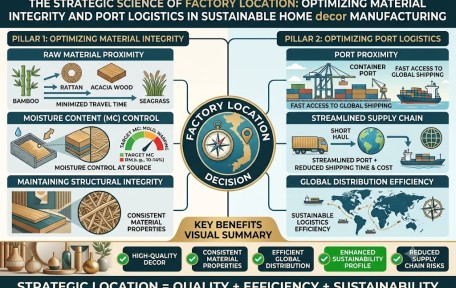
The root of this systemic supply chain failure lies in a fundamental misunderstanding of overseas production realities and global shipping dynamics. During the peak shipping season, which runs from August through October, ocean carriers routinely implement blank sailings to manage capacity, causing container spot rates to spike by 30% to 50%. Simultaneously, equipment shortages at key Asian transit hubs like the Port of Hai Phong can leave your cargo rolled for weeks. This article provides a pragmatic, data-driven blueprint to help you navigate these seasonal complexities, optimize your production schedules, and protect your margins for the Q4 holiday rush.
MATERIAL-SPECIFIC DYNAMICS: HUMIDITY, KILN-DRYING, AND VIETNAMESE HANDCRAFTS
Unlike synthetic or mass-produced plastic goods, sustainable home decor crafted from natural fibers—such as Acacia wood, bamboo, rattan, seagrass, and water hyacinth—is deeply bound to natural elements. Manufacturing these products requires a delicate balance of artisanal craftsmanship and scientific environmental control. Understanding the material-specific lead times is critical to avoiding quality disasters like mold, warping, or structural cracking during maritime transit.
Acacia Wood: The Science of Kiln-Drying
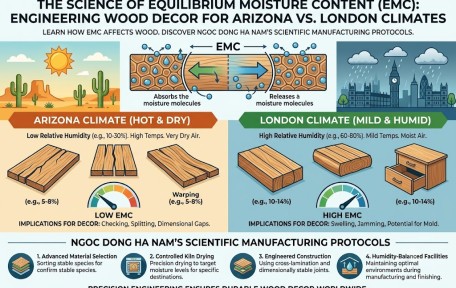
Acacia is highly prized for its durability and rich grain, making it a staple for serving trays, cutting boards, and small furniture. However, raw acacia wood contains up to 50% moisture. To ensure structural stability, the wood must undergo a rigorous kiln-drying process to reduce its Equilibrium Moisture Content (EMC) to between 8% and 12%. Rushing this process to meet tight deadlines leads to internal stresses within the timber. When these products enter dry, centrally heated Western homes in winter, they will warp, split, or crack. Standard, high-quality kiln-drying cannot be bypassed; it requires a non-negotiable 15 to 20 days depending on the thickness of the wood planks.
Woven Fibers: Seagrass, Rattan, and Water Hyacinth
Natural woven fibers are highly hygroscopic, meaning they readily absorb moisture from the air. In Vietnam, the traditional harvesting and weaving regions experience a heavy monsoon season from May to October. These rains directly coincide with the peak production window for Q4 orders. If a factory relies solely on outdoor sun-drying, production lead times can double, and the risk of mold contamination escalates dramatically. To mitigate this risk, Ngoc Dong Ha Nam utilizes specialized, temperature-controlled indoor drying chambers and advanced non-toxic anti-mold treatments. For a standard 40ft High Cube (HC) container of handwoven seagrass baskets, weaving takes approximately 30 to 40 days, followed by 5 to 7 days of mechanical drying and quality inspections to guarantee that moisture levels remain strictly below 15% before packing.
THE 180-DAY CRITICAL PATH: A STEP-BY-STEP TIMELINE BREAKDOWN
To secure shelf space and avoid premium shipping surcharges, global importers must adopt a 180-day backward-planning model. This timeline shifts the traditional purchasing paradigm, placing the critical decision-making window in the spring rather than the summer.
Phase 1: Product Development & Sampling (February - March)
This 45-day window is dedicated to finalizing CAD designs, material specifications, and physical prototyping. Developing a sustainable product requires physical stress testing and aesthetic adjustments. For example, adjusting the weave density of a water hyacinth storage bin can alter both its structural integrity and its shipping volume, directly impacting your final landed cost.
Phase 2: Purchase Order Placement & Raw Material Booking (April)
Placing your POs by mid-April allows manufacturers to procure raw materials before seasonal demand drives up prices. In Vietnam, raw material costs for rattan and seagrass can fluctuate by 10% to 15% as summer approaches due to competing regional demand. Locking in your material supply early guarantees price stability and prioritizes your production slot.
Phase 3: Mass Production & Technical Drying (May - June)
This 60-day phase is where the physical handcrafting occurs. Skilled artisans weave, assemble, and finish the products. At Ngoc Dong Ha Nam, our production lines run under strict quality gates, ensuring that intermediate components are checked for dimensional accuracy and moisture levels at multiple stages of assembly.
Phase 4: Quality Assurance & Packaging (July)
A dedicated 10-to-14-day window is reserved for final quality control (QC) and packaging. We adhere to strict Acceptable Quality Limit (AQL) 1.5/2.5 standards. This phase includes drop testing for packaging durability, barcode readability scans, and final moisture verification using calibrated pin-type meters to ensure compliance with import standards.
Phase 5: Ocean Freight & Customs Clearance (August - September)
By dispatching containers from the Port of Hai Phong in August, you bypass the worst of the September and October shipping bottlenecks. This early departure insulates your supply chain from Peak Season Surcharges (PSS), which can add up to $2,000 per container, and ensures your products clear customs well ahead of the holiday retail reset.
Case Study: Lead-Time Optimization in Action
In 2025, a major European home goods retailer transitioned their Q4 sourcing timeline for woven storage baskets from a June 10th PO placement to an April 5th PO placement. By doing so, they avoided the monsoon-induced drying delays and secured ocean freight space in early August. The results were clear: a 22-day reduction in total transit time, a 17% savings on ocean freight costs, and a 0% product rejection rate due to mold, compared to a 4.2% rejection rate the previous year when shipping in late September.
RISK MITIGATION: COMPLIANCE, CERTIFICATIONS, AND CONTAINER SWEAT
Sourcing sustainable homeware involves navigating complex international trade regulations and environmental compliance standards. Failing to address these requirements early in the sourcing cycle can result in severe customs delays, heavy fines, or total cargo seizure.
Strict Environmental Compliance
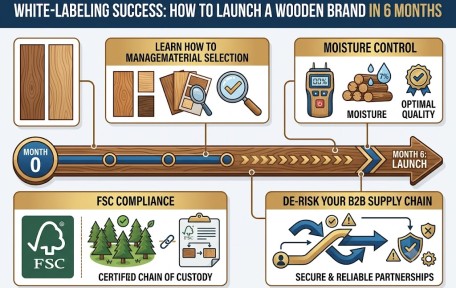
Under regulations like the EU Deforestation Regulation (EUDR) and the US Lacey Act, importers must provide verifiable proof of the origin of all wood and fiber products. Acacia and bamboo products must carry Forest Stewardship Council (FSC) certification to prove they are sourced from responsibly managed forests. Securing this documentation requires a fully traceable supply chain. Ngoc Dong Ha Nam maintains comprehensive chain-of-custody documentation, ensuring that your shipments pass through customs without administrative delays.
Social Compliance & Factory Audits
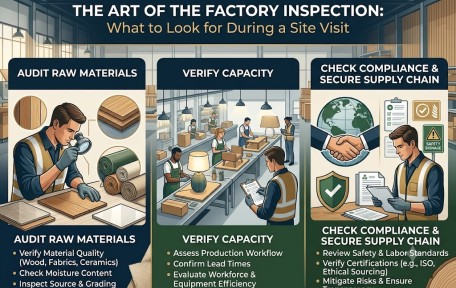
Global retailers require manufacturing partners to meet strict social compliance standards. Audits such as BSCI (Business Social Compliance Initiative) and SMETA (Sedex Members Ethical Trade Audit) verify fair labor practices, safe working conditions, and environmental responsibility. Conducting these audits and resolving any corrective actions takes time. Sourcing from an already certified and audited factory like Ngoc Dong Ha Nam eliminates this bottleneck entirely, saving up to 60 days in the onboarding process.
Preventing Container Sweat During Transit
The journey from the humid, tropical climate of Vietnam to a freezing winter port in Europe or North America exposes cargo to extreme temperature drops. This causes container sweat—condensation that forms on the ceiling and walls of the shipping container, which then drips onto the cardboard packaging and wooden or woven products. To mitigate this risk, we implement a multi-layered protection strategy: utilizing high-performance cargo desiccants (averaging 2 to 4 kg of calcium chloride bags per 20ft/40ft container), wrapping pallets in breathable stretch film, and packing products in double-wall corrugated cartons with moisture-barrier liners. This guarantees that your sustainable products arrive in pristine, retail-ready condition.
SECURING YOUR Q4 CAPACITY: WHY EARLY ALLOCATION IS KEY
Manufacturing capacities for high-quality, sustainable home decor are finite. Unlike automated plastic injection molding facilities, handcrafted production relies on skilled human labor and specialized curing equipment. The leading global brands lock in up to 80% of their Q3 and Q4 production capacity with Vietnamese manufacturers by the end of April.
As you plan your product portfolio for the upcoming holiday season, remember that early action is your greatest competitive advantage. Initiating your RFQs and sampling requests in February and March ensures that you secure the best material pricing, guarantee production priority, and insulate your business from the chaotic disruptions of the peak shipping season. Partner with Ngoc Dong Ha Nam to secure a reliable, certified, and highly efficient supply chain for your Q4 home decor collection.
FREQUENTLY ASKED QUESTIONS
When is the absolute latest date to place a Q4 holiday order with a Vietnamese supplier?
To guarantee delivery ahead of the Q4 retail launch, the absolute latest date to place mass production purchase orders (POs) is April 30th. This allows sufficient time for raw material procurement, manufacturing, quality control, and ocean transit before peak shipping season bottlenecks occur in August and September.
How does the Vietnamese monsoon season affect production timelines for woven home decor?
The monsoon season (May to October) increases ambient humidity, which can double the drying times of natural fibers like seagrass, rattan, and water hyacinth if dried outdoors. To prevent mold and maintain lead times, buyers should partner with manufacturers like Ngoc Dong Ha Nam that utilize indoor, temperature-controlled drying chambers to guarantee moisture levels remain below 15%.
What certifications are required to import wooden and woven home decor into the US and EU?
Importers must comply with the US Lacey Act and EU Deforestation Regulation (EUDR). Key certifications include FSC (Forest Stewardship Council) for wood and bamboo traceability, and social compliance audits such as BSCI or SMETA to verify ethical labor practices. Ngoc Dong Ha Nam maintains all these certifications to ensure smooth customs clearance.
How can we protect natural fiber products from mold during long ocean transit?
To prevent mold caused by container sweat, ensure products are kiln-dried or mechanically dried to a moisture content of 8-12% for wood and under 15% for woven fibers. Additionally, use high-performance calcium chloride desiccants inside the container, wrap pallets in breathable film, and pack goods in moisture-resistant, double-wall corrugated cartons.