Specific Gravity of Acacia: What it tells us about durability
Key Takeaways
• Acacia wood exhibits a high specific gravity ranging from 0.47 to 0.74, which directly correlates to superior mechanical strength and indentation resistance.• The low tangential-to-radial (T/R) shrinkage ratio of 1.5 to 1.8 ensures high dimensional stability, minimizing the risk of warping or cracking in fluctuating humidity.
• Acacia's mechanical performance, featuring a Janka hardness of up to 1,750 lbf and a Modulus of Rupture up to 137.5 MPa, makes it a highly cost-effective alternative to premium hardwoods like Oak and Teak.
• B2B procurement protocols must specify a target moisture content of 8-12% and D4-compliant bonding adhesives to guarantee long-term product durability in global markets.
TECHNICAL EXECUTIVE SUMMARY: DECIPHERING THE PHYSICAL PROPERTIES OF ACACIA FOR GLOBAL SUPPLY CHAINS
For global B2B buyers, interior designers, and product development managers, selecting the optimal wood species involves analyzing complex physical and mechanical metrics that dictate long-term product performance. In the high-volume furniture and home decor manufacturing sectors, material failures such as warping, checking, splitting, and surface indentation directly translate to costly product returns, brand degradation, and supply chain disruptions. To mitigate these structural risks, technical procurement must move beyond superficial aesthetic appraisals and focus on quantitative material science.
This technical whitepaper provides a comprehensive, empirical analysis of the specific gravity of Acacia wood and its direct correlation to mechanical durability. By examining the physical, mechanical, and chemical properties of key commercial Acacia species—such as Acacia mangium and Acacia auriculiformis—we establish a scientific baseline for predicting performance under diverse environmental conditions. Furthermore, we contrast Acacia with alternative materials, including natural bamboo, premium white oak, teak, and medium-density fiberboard (MDF) veneer, providing an analytical framework for cost-benefit optimization.
As a leading global manufacturer, Ngoc Dong Ha Nam integrates these scientific principles into every stage of production—from sustainable forest management to high-precision CNC milling and advanced kiln-drying protocols. This document serves as an authoritative guide for technical buyers seeking to optimize their product specifications, ensure structural integrity, and leverage sustainable, high-performance timber for global retail and commercial markets.
WHAT IS THE SPECIFIC GRAVITY OF ACACIA?
The specific gravity of Acacia wood typically ranges from 0.47 to 0.74, depending on the species and growth conditions, representing the ratio of its oven-dry density to the density of water.
In wood physics, specific gravity (SG) is a dimensionless quantity calculated as the ratio of the oven-dry mass of the wood to the mass of water displaced by the wood volume at a specified moisture content (typically green or 12% equilibrium moisture content). Mathematically, it is expressed as:
SG = ρwood / ρwater
Because wood is an anisotropic, porous cellular composite, its specific gravity is directly determined by the ratio of solid cell wall material (primarily cellulose, hemicellulose, and lignin) to the volume of the cell lumina (void spaces). A higher specific gravity indicates thicker cell walls, smaller lumen diameters, and a higher concentration of structural biomass per unit volume.
Interspecies and Intraspecies Variation
The genus Acacia contains over 1,000 species, but industrial furniture manufacturing primarily utilizes a select few tropical and subtropical species due to their rapid growth cycles and excellent mechanical properties. The specific gravity of these commercial species exhibits notable variations:
- Acacia mangium: This species typically exhibits a specific gravity range of 0.47 to 0.59, corresponding to an air-dry density of approximately 500 to 600 kg/m³. It is widely utilized for indoor furniture, shelving, and structural panels due to its balanced strength-to-weight ratio.
- Acacia auriculiformis: Possessing a higher specific gravity of 0.60 to 0.75 (air-dry density of 650 to 800 kg/m³), this species offers exceptional hardness and decay resistance, making it highly suitable for heavy-duty commercial furniture and outdoor decking.
- Hybrid Acacia (A. mangium × A. auriculiformis): Engineered through artificial hybridization, this fast-growing clone exhibits an optimized specific gravity range of 0.55 to 0.65, combining the rapid biomass accumulation of A. mangium with the superior mechanical density of A. auriculiformis.
Radial Variation: Pith to Bark
Within an individual tree, specific gravity is not uniform. Empirical data shows a distinct radial gradient: near the pith (juvenile wood), specific gravity starts at a minimum of 0.49 to 0.58 and increases progressively to 0.63 to 0.74 near the bark (mature wood). This radial variation is a critical factor in timber conversion; high-quality B2B manufacturing requires precise grading to separate juvenile wood from mature heartwood, ensuring uniform density across laminated panels and structural components.
HOW DOES SPECIFIC GRAVITY INFLUENCE THE MECHANICAL STRENGTH OF ACACIA WOOD?
Specific gravity is the primary predictor of Acacia's mechanical strength, directly determining its resistance to bending (MOR), stiffness (MOE), and indentation resistance (Janka hardness).
The mechanical properties of timber are power functions of its specific gravity. As density increases, the volume of structural fibers capable of load-bearing increases proportionally. In structural engineering and product design, three key mechanical metrics define the performance of Acacia wood: Modulus of Rupture (MOR), Modulus of Elasticity (MOE), and Janka Hardness.
1. Modulus of Rupture (MOR)
Modulus of Rupture measures the ultimate bending strength of wood perpendicular to the grain before structural failure occurs. For kiln-dried Acacia mangium, the mean MOR ranges from 98.2 MPa to 137.48 MPa. In contrast, denser Acacia auriculiformis can achieve an MOR exceeding 145.0 MPa. This high bending strength prevents structural sagging in long-span shelving, dining tables, and bed frames under heavy static loads.
2. Modulus of Elasticity (MOE)
Modulus of Elasticity quantifies the stiffness of the wood, or its resistance to elastic deformation under stress. The MOE of commercial Acacia ranges from 11.07 GPa to 15.02 GPa. Higher specific gravity directly increases the MOE, meaning that thin-profile modern furniture designs can maintain structural rigidity without requiring bulky support structures. Under dynamic loading, high-MOE Acacia components exhibit minimal deflection and high vibrational dampening.
3. Janka Hardness
Janka hardness measures the force required to embed an 11.28 mm (0.444 in) steel ball to half its diameter into the wood surface, serving as the benchmark for scratch and dent resistance. Acacia mangium features a Janka rating of approximately 1,430 lbf (6,340 N), while mature Acacia auriculiformis can reach up to 1,750 lbf (7,780 N). This high surface hardness makes Acacia exceptionally resilient against impact damage, making it an ideal material for high-traffic hospitality environments, commercial flooring, and heavy-use kitchenware.
HOW DOES ACACIA COMPARE WITH ALTERNATIVE INTERIOR MATERIALS?
Acacia outperforms softwoods and engineered wood like MDF in mechanical durability while offering a comparable specific gravity and structural integrity to premium hardwoods like Red Oak and Teak at a more competitive cost structure.
To assist R&D managers and technical buyers in material selection, the following table provides a comparative analysis of Acacia against common competitive materials used in global furniture manufacturing:
|
Material |
Specific Gravity (SG) |
Janka Hardness (N / lbf) |
Modulus of Rupture (MOR, MPa) |
Modulus of Elasticity (MOE, GPa) |
Volumetric Shrinkage (%) |
Primary Structural Risk |
|
Acacia mangium |
0.47 – 0.59 |
6,340 / 1,430 |
98.2 – 137.5 |
11.07 – 13.84 |
5.9 – 8.2 |
Moderate warping if poorly kiln-dried |
|
Acacia auriculiformis |
0.60 – 0.75 |
7,780 / 1,750 |
115.0 – 145.0 |
12.50 – 15.02 |
6.5 – 9.0 |
High tool wear during milling |
|
Moso Bamboo (Laminated) |
0.65 – 0.80 |
7,110 / 1,600 |
120.0 – 160.0 |
14.00 – 18.00 |
12.0 – 14.0 |
Delamination under fluctuating relative humidity |
|
White Oak (Quercus alba) |
0.68 |
6,050 / 1,360 |
104.8 |
12.27 |
12.6 |
High procurement cost and slow growth replenishment |
|
Teak (Tectona grandis) |
0.55 – 0.66 |
4,740 / 1,070 |
97.1 |
11.10 |
7.0 |
High cost and highly restricted global supply chains |
|
MDF (Medium Density Fiberboard) |
0.60 – 0.80 |
3,500 / 780 |
20.0 – 40.0 |
2.00 – 4.00 |
N/A (Swells irreversibly) |
Complete structural failure in high-moisture environments |
Analytical Comparison of Performance Metrics
When evaluating these materials, several critical engineering trade-offs emerge:
- Acacia vs. Oak and Teak: Acacia offers comparable specific gravity and mechanical strength properties to premium temperate hardwoods like White Oak and tropical species like Teak. However, because Acacia is a fast-growing plantation species, it achieves these physical properties in a fraction of the cultivation time (7 to 10 years compared to 50+ years for Oak), resulting in a significantly more competitive cost-per-cubic-meter and a highly secure, sustainable supply chain.
- Acacia vs. Engineered Wood (MDF): While high-density MDF can match the specific gravity of Acacia, it lacks structural fiber continuity. MDF exhibits extremely low MOR and MOE values, making it prone to sagging under its own weight. Furthermore, MDF possesses poor moisture resistance; once exposed to water, it swells irreversibly, whereas solid Acacia maintains its structural integrity.
- Acacia vs. Laminated Bamboo: Laminated Moso bamboo exhibits high density and tensile strength, but its volumetric shrinkage rate is nearly double that of Acacia. This high shrinkage rate makes bamboo products highly susceptible to delamination and cracking when exported to markets with low winter relative humidity, such as North America and Northern Europe.
WHY DOES SPECIFIC GRAVITY AFFECT DIMENSIONAL STABILITY IN HIGH-HUMIDITY ENVIRONMENTS?
High specific gravity in Acacia correlates with thicker cell walls, which hold more bound water below the fiber saturation point (FSP), thereby dictating the wood’s volumetric shrinkage and swelling behavior during environmental humidity fluctuations.
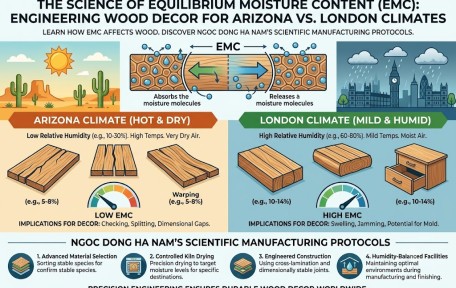
Wood is a hygroscopic material, meaning it continuously exchanges moisture with the surrounding atmosphere to achieve an Equilibrium Moisture Content (EMC). This moisture exchange occurs in two forms: free water within the cell cavities (lumina) and bound water chemically bonded within the cell walls. The transition point where all free water is removed but the cell walls remain fully saturated is known as the Fiber Saturation Point (FSP), typically occurring around 25% to 30% moisture content in Acacia.
The Physics of Dimensional Change
When wood moisture content falls below the FSP, bound water is desorbed from the cell walls, causing the cell walls to shrink. Conversely, when moisture is absorbed, the cell walls expand. Because denser wood (higher specific gravity) contains a greater volume of cell wall material per unit volume, it has a higher capacity to absorb and desorb bound water, which can potentially lead to greater volumetric change if not properly managed.
However, Acacia exhibits an exceptionally favorable Tangential-to-Radial (T/R) Shrinkage Ratio. Wood shrinks anisotropically—meaning it shrinks by different percentages in different directions. For Acacia, tangential shrinkage (parallel to the growth rings) ranges from 5.9% to 8.2%, while radial shrinkage (perpendicular to the growth rings) ranges from 3.0% to 4.5%. This yields a T/R ratio of approximately 1.5 to 1.8. A T/R ratio below 2.0 is considered highly stable, indicating that the wood will shrink and swell uniformly, dramatically reducing the risk of cupping, twisting, and checking (cracking).
Ngoc Dong Ha Nam's Advanced Kiln-Drying Protocol
To control these thermodynamic forces, raw lumber must undergo scientific kiln-drying before manufacturing. At Ngoc Dong Ha Nam, we utilize computer-controlled, progressive steam kilns to slowly reduce the moisture content of Acacia to a precise target of 8% to 12% (with a strict tolerance of ±1.5%). Our drying schedules are dynamically adjusted based on continuous sensor feedback to prevent internal drying stresses, ensuring that the finished products remain structurally stable when shipped across different global climate zones.
HOW DOES THE DENSITY OF ACACIA IMPACT INDUSTRIAL CNC MACHINING AND BONDING?
The high specific gravity and mineral content of Acacia increase cutting resistance and tool wear, requiring carbide-tipped tooling and precise adhesive formulation to ensure high-strength bonds.
Processing high-density hardwoods like Acacia at an industrial scale requires specialized engineering protocols. Standard woodworking machinery designed for softwoods or low-density engineered panels will experience catastrophic tool wear and poor surface finish quality if applied to Acacia without modification.
CNC Machining and Tooling Specifications
Acacia species, particularly those grown in tropical soils, often accumulate microscopic silica ($SiO_2$) deposits within their parenchyma cells. The combination of abrasive silica and high specific gravity increases friction and cutting temperatures at the tool-wood interface. To maintain precise manufacturing tolerances (within ±0.2 mm) and prevent surface burning, Ngoc Dong Ha Nam employs the following technical machining standards:
- Tooling Material: We utilize ultra-fine micro-grain Tungsten Carbide (TCT) or Polycrystalline Diamond (PCD) router bits. Standard High-Speed Steel (HSS) tools dull too rapidly, leading to fiber tear-out and dimensional deviations.
- Spindle Speed and Feed Rates: CNC machining centers are calibrated to run at optimized rotational speeds (typically 18,000 to 20,000 RPM) paired with controlled feed rates (8 to 12 meters per minute) to ensure clean cuts without localized thermal degradation (charring) of the wood fibers.
Chemical Bonding and Adhesive Performance
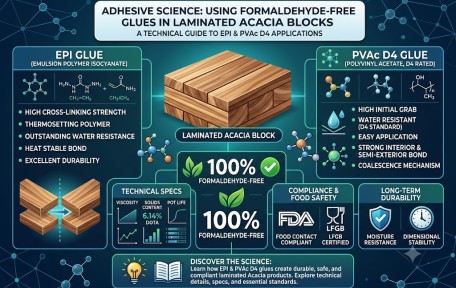
High specific gravity wood presents unique challenges for adhesive bonding. Because the cell lumina are small and the density is high, the mechanical penetration of liquid adhesives into the wood pores is restricted. To achieve structural bonds that exceed international standards (such as EN 204 D4 water-resistance), the adhesive chemistry and pressing parameters must be strictly controlled:
- Adhesive Selection: We utilize high-performance Emulsion Polymer Isocyanate (EPI) or dual-component Polyurethane (PU) adhesives. These adhesives form covalent chemical bonds with the hydroxyl groups of the wood cellulose, rather than relying solely on mechanical interlocking.
- Glue Spread and Pressure: The adhesive is applied at a precise wet-film thickness of 250 to 300 g/m². Laminated panels are then subjected to hydraulic cold-pressing at pressures of 1.0 to 1.5 MPa for a minimum of 45 minutes to ensure molecular-level contact and complete polymerization.
HOW DOES NGOC DONG HA NAM GUARANTEE MATERIAL CONSISTENCY ACROSS LARGE B2B ORDERS?
Ngoc Dong Ha Nam guarantees material consistency through automated kiln-drying protocols that stabilize moisture content at 8-12% and high-precision CNC machining with strict ±0.2 mm tolerances, backed by FSC, BSCI, and SMETA certifications.
For global retailers, hospitality designers, and OEM/ODM buyers, consistency is the foundation of supply chain reliability. A single batch of poorly processed wood can lead to widespread product failures in the retail market. Ngoc Dong Ha Nam addresses this challenge by combining state-of-the-art industrial infrastructure with rigorous, data-driven quality control protocols.
Industrial Scale and Production Capacity
Our manufacturing facility spans over tens of thousands of square meters, equipped with multi-axis CNC machining centers, automated sanding lines, and high-capacity steam drying kilns. With an annual production capacity exceeding 500,000 units of home decor and furniture, we possess the scale required to execute high-volume B2B orders while maintaining absolute dimensional and structural consistency across every production batch.
Traceability and International Certifications
As a committed advocate for sustainable manufacturing, Ngoc Dong Ha Nam ensures that 100% of our raw Acacia is sourced from responsibly managed, FSC-certified plantations. This not only guarantees the long-term ecological viability of our supply chain but also ensures full compliance with strict international timber regulations, including the European Union Deforestation Regulation (EUDR) and the US Lacey Act.
Furthermore, our manufacturing facilities undergo regular third-party audits to maintain compliance with BSCI (Business Social Compliance Initiative) and SMETA (Sedex Members Ethical Trade Audit) standards. This dual commitment to material excellence and ethical manufacturing positions Ngoc Dong Ha Nam as a trusted, tier-one partner for the world’s most demanding retail brands and commercial interior designers.
WHAT TECHNICAL PARAMETERS SHOULD GLOBAL B2B BUYERS SPECIFY FOR ACACIA FURNITURE?
B2B buyers must specify exact specific gravity thresholds (minimum 0.55), target moisture content (8-12%), non-toxic adhesive classifications (D4 or EPI), and FSC certification to ensure long-term performance and regulatory compliance.
To guarantee that manufactured Acacia products meet the rigorous demands of commercial and residential use, technical buyers should include the following performance parameters in their Quality Agreement (QA) and Product Specification Sheets:
1. Specific Gravity Specification: Require a minimum specific gravity of 0.55 for standard indoor furniture, and a minimum of 0.62 for high-load structural components, heavy-use dining tables, or outdoor applications. This ensures the use of mature heartwood rather than low-density juvenile sapwood.
2. Moisture Content Thresholds: Define the target Moisture Content (MC) at 8% to 12% at the time of factory packaging, with an allowable tolerance of ±1.5%. For products destined for highly arid regions, specify a target MC of 7% to 9%.
3. Adhesive and Emission Standards: Specify that all structural laminations must utilize adhesives conforming to EN 204 Class D4 (waterproof) and meet CARB Phase 2 / EPA TSCA Title VI standards for formaldehyde emissions (E0 or E1 classification).
4. Dimensional Tolerance: Define strict engineering tolerances of ±0.2 mm for CNC-routed joints and ±0.5 mm for overall product dimensions to ensure seamless assembly and structural alignment.
5. Sustainability and Compliance: Mandate 100% FSC-certified timber with full Chain of Custody (CoC) documentation to ensure compliance with global environmental import regulations.
By integrating these scientific and technical parameters into your procurement documents, you transition from a subjective purchasing model to an objective, engineering-driven sourcing strategy. Partnering with a technically advanced manufacturer like Ngoc Dong Ha Nam ensures that these specifications are met with absolute precision, protecting your brand reputation and driving long-term commercial success.
FREQUENTLY ASKED QUESTIONS
How does the specific gravity of Acacia affect its performance in outdoor furniture?
A higher specific gravity (above 0.60) in Acacia species like Acacia auriculiformis provides denser cell walls that naturally resist water absorption, fungal decay, and insect attacks, making it highly durable for outdoor applications when treated with protective oils.
Can Acacia wood be used for heavy-duty commercial flooring?
Yes, Acacia wood with a high specific gravity exhibits a Janka hardness of up to 1,750 lbf, which offers superior indentation and scratch resistance, making it highly suitable for high-traffic commercial flooring.
What is the ideal moisture content for Acacia furniture when exporting to North America?
The ideal moisture content for Acacia furniture exported to North America is 8% to 10% (with a tolerance of ±1.5%), which prevents excessive shrinkage, cracking, or warping when exposed to dry indoor winter environments.
Is Acacia wood more stable than Oak and Teak?
Acacia possesses a Tangential-to-Radial (T/R) shrinkage ratio of 1.5 to 1.8, which is comparable to Teak and superior to White Oak (T/R of 1.9), indicating excellent dimensional stability and low risk of warping.