The Science of Strength: Why Acacia Wood Tensile and Compressive Power is Revolutionizing Commercial Furniture Sourcing
Key Takeaways
• Acacia wood possesses an exceptional Janka hardness rating of 1,100 to 1,750 lbf, outperforming traditional fast-growing hardwoods like Rubberwood and offering comparable durability to premium Oak and Teak.• With a Modulus of Rupture (MOR) exceeding 120 MPa, Acacia furniture exhibits superior tensile strength, preventing joint failure and structural sagging under heavy bending loads in commercial environments.
• Acacia's high compressive strength parallel to the grain (50-65 MPa) ensures that load-bearing components like table and chair legs resist crushing and structural deformation over decades of use.
• Precision kiln-drying to an optimal 8-12% moisture content is critical to preserving Acacia's mechanical properties, preventing warping, splitting, and checking in variable global climates.
THE COST OF STRUCTURAL FAILURE: WHY SMART B2B BUYERS LOOK BEYOND AESTHETICS
In the high-stakes arena of global B2B furniture procurement, a beautiful design is only as good as the physics that support it. For sourcing directors, commercial interior designers, and hospitality procurement officers, the true cost of furniture is never just the initial purchase price. Instead, it is measured in the total cost of ownership (TCO), return rates, warranty claims, and the preservation of brand reputation. Imagine the fallout when a luxury resort experiences structural failures in its outdoor dining chairs, or when a major retail partner faces a wave of product returns due to sagging tabletops and split joints. These are not merely aesthetic issues; they are catastrophic mechanical failures that drain profitability, damage customer relationships, and erode consumer trust. In commercial settings—where chairs are sat on hundreds of times a day and tables are subjected to heavy, uneven loads—the silent killer of furniture brands is a fundamental mismatch between design intent and material science.
Historically, global buyers have gravitated toward traditional, slow-growing hardwoods such as teak or oak to guarantee durability. However, shifting global trade regulations, rising costs, and a growing demand for sustainable, rapidly renewable materials have forced a paradigm shift. Today, the commercial design world is turning its focus to Acacia wood. Long admired for its rich, warm grain and natural weather resistance, Acacia is increasingly recognized by structural engineers as a natural marvel of mechanical performance. To make an informed, risk-free sourcing decision, global buyers must look past the surface beauty of Acacia and understand the complex chemical and physical forces that govern its structural integrity: tensile strength and compressive resistance.
By understanding how Acacia wood behaves under tension (the forces that pull and bend wood fibers) and compression (the forces that squeeze and crush them), B2B buyers can unlock new levels of product longevity. Whether you are specifying furniture for high-traffic hotel lobbies, high-volume retail distribution, or demanding outdoor commercial spaces, mastering the material science of Acacia is your ultimate competitive advantage. In an era where consumers demand sustainable circularity and businesses require bulletproof durability, understanding these mechanical properties allows you to select products that stand the test of time, weather, and heavy use. Let us dissect the physical properties that make this remarkable hardwood an indestructible powerhouse for your next product collection.
THE MECHANICS OF WOOD: DEMYSTIFYING TENSILE VS. COMPRESSIVE STRENGTH IN ACACIA
To appreciate why Acacia wood is uniquely suited for demanding commercial applications, we must delve into the mechanical physics of timber. Wood is inherently anisotropic, meaning its physical and mechanical properties vary depending on the direction of the forces applied relative to the grain structure. Unlike isotropic materials like steel or plastic, which exhibit uniform strength in all directions, wood behaves differently when pulled, pushed, or sheared. Acacia’s unique cellular anatomy, dense fiber structure, and interlocking grain pattern give it an extraordinary ability to balance these multi-directional forces, making it structurally superior to many fast-growing alternative hardwoods.
The Anisotropic Nature of Timber and Grain Alignment
Every tree grows by adding concentric layers of wood cells, resulting in a grain structure that runs primarily parallel to the trunk. This means wood is highly directional. Its strength parallel to the grain (longitudinal direction) is vastly superior to its strength perpendicular to the grain (radial and tangential directions). Acacia is particularly fascinating because many of its commercial species exhibit an interlocked grain. In interlocked grain, the wood fibers reverse their spiral direction every few years of growth. This biological anomaly creates a natural, self-reinforcing matrix. When tension or compression is applied, this interlocking pattern distributes the stress across multiple planes, dramatically reducing the risk of splitting along grain lines—a common failure point in straight-grained woods like oak or pine.
Demystifying Tensile Strength in Acacia
Tensile strength refers to a material’s resistance to being pulled apart or stretched. In furniture design, tensile forces are primarily exerted when a piece is subjected to bending or flexing. For example, when a user sits on a dining chair and leans back, the chair’s backrest and rear legs experience intense bending moments. The wood fibers on the outer curve of the bend are pulled apart under tension, while the fibers on the inner curve are squeezed under compression. If the wood lacks sufficient tensile strength, it will experience catastrophic failure along the grain lines, snapping instantly under pressure.
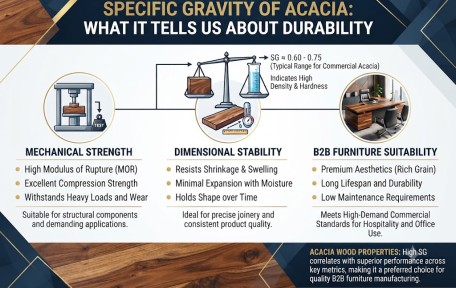
The standard scientific measure for a wood's bending strength is the Modulus of Rupture (MOR), while its stiffness is measured by the Modulus of Elasticity (MOE). Acacia wood, particularly commercial plantation species like Acacia mangium and its hybrids, exhibits a Modulus of Rupture ranging from 85 to 130 MPa (Megapascals) in an air-dried state. This means it can withstand immense bending loads before fracturing. Coupled with a Modulus of Elasticity of 10,000 to 16,000 MPa, Acacia offers the perfect balance of flexibility and stiffness, allowing it to deflect slightly under sudden impact or heavy loads without permanent deformation or cracking. This high elasticity is critical for commercial seating, where dynamic, shifting loads are the norm.
Understanding Compressive Strength in Acacia
Conversely, compressive strength is the capacity of a material to withstand crushing forces that push its fibers together. In furniture, compression is most visible in vertical load-bearing elements, such as the legs of a dining table, a barstool, or a heavy shelving unit. These components must support not only the weight of the furniture itself but also the dynamic weight of users and objects. Compressive forces can act parallel to the grain (squeezing the wood along its length) or perpendicular to the grain (squeezing the wood across its width).
Acacia excels in compressive strength parallel to the grain, typically registering between 50 and 65 MPa. This exceptional crushing resistance is directly linked to its high density and thick-walled wood fibers. When subjected to heavy vertical loads, Acacia’s tightly packed cellular matrix resists buckling and cellular collapse. This ensures that even minimalist, slender leg designs can safely support substantial weight over decades of use without structural sagging or failure. Furthermore, its compressive strength perpendicular to the grain (around 8 to 12 MPa) prevents joints and fasteners from crushing the wood fibers when bolted tightly together, maintaining tight, wobble-free connections over time.
Mechanical Performance Comparison Table
To help B2B buyers visualize how Acacia compares to other common furniture hardwoods, the table below outlines key mechanical properties in an air-dried condition (at approximately 12% moisture content):
|
Wood Species |
Janka Hardness (lbf) |
Modulus of Rupture (MOR - MPa) |
Modulus of Elasticity (MOE - MPa) |
Compressive Strength (Parallel - MPa) |
|
Acacia (Plantation) |
1,100 – 1,750 |
85 – 130 |
10,000 – 16,000 |
50 – 65 |
|
Teak (Tectona grandis) |
1,000 – 1,155 |
85 – 100 |
9,000 – 13,000 |
45 – 55 |
|
Red Oak (Quercus rubra) |
1,290 |
98 – 103 |
11,000 – 12,500 |
45 – 49 |
|
Rubberwood (Hevea brasiliensis) |
960 |
70 – 80 |
8,000 – 9,500 |
35 – 42 |
As demonstrated by the empirical data, Acacia outperforms traditional plantation-grown species like Rubberwood across every single metric and is highly competitive with premium hardwoods like Teak and Oak. This makes Acacia an exceptionally cost-effective, high-performance alternative for B2B buyers looking to maximize structural durability without paying the premium associated with slow-growing old-growth timber.
FROM TIMBER TO MASTERPIECE: HOW NGOC DONG HA NAM MAXIMIZES ACACIA’S STRUCTURAL POTENTIAL
While the raw physical properties of Acacia are impressive, converting this biological powerhouse into stable, commercial-grade furniture requires world-class engineering, manufacturing precision, and strict quality control. At Ngoc Dong Ha Nam, we understand that the structural integrity of the final product is determined by how we manage the wood's natural characteristics throughout the entire manufacturing process.
The Science of Moisture Management: Precision Kiln-Drying
Wood is a hygroscopic material, meaning it constantly absorbs and releases moisture to reach equilibrium with its surrounding environment. When wood absorbs moisture, it swells; when it loses moisture, it shrinks. If this movement is not controlled, the internal stresses generated during drying can cause checking (cracking along the grain), warping, and bowing, severely compromising both tensile and compressive strength. In fact, a failure to properly dry timber is the leading cause of furniture joint failure in international markets.
To mitigate this risk, Ngoc Dong Ha Nam employs state-of-the-art kiln-drying technology. We dry our Acacia timber to a precise moisture content of 8% to 12%. This optimal range is scientifically proven to lock in the wood's dimensional stability, minimizing volumetric shrinkage and expansion when the furniture is shipped to diverse global climates—from the humid coastlines of Florida to the dry, heated interiors of Northern Europe. By stabilizing the cellular structure of the wood, we prevent the occurrence of case hardening—a defect where the outer shell of the timber dries faster than the core, locking in internal stresses that cause the wood to warp or split later. Our precision drying ensures that the tensile and compressive capacities of the Acacia remain at their absolute peak, guaranteeing a lifetime of structural reliability.
Interlocking Grain and Joint Engineering
One of Acacia's most unique biological features is its interlocked grain pattern, where the direction of the wood fibers reverses in successive growth layers. This interlocking grain makes the wood exceptionally difficult to split, providing a natural defense against shear forces. However, it also requires specialized cutting tools and joinery techniques to prevent tear-out during machining.
Our engineering team utilizes advanced CNC machinery to construct high-precision joints that work in harmony with Acacia's grain structure. We utilize traditional mortise-and-tenon joinery, reinforced dowels, and finger joints that maximize the surface area for high-performance, eco-friendly adhesives. By aligning the mechanical joinery with the wood’s natural grain, we ensure that tensile forces are distributed evenly across the frame, preventing localized stress concentrations that lead to failure. This meticulous attention to joint mechanics is why our furniture excels in rigorous commercial durability tests.
Sustainable Supply Chains: Sourcing with Integrity
In the modern global market, true structural integrity cannot exist without ecological and ethical integrity. Global buyers face strict regulatory environments, including the EU Deforestation Regulation (EUDR) and the Lacey Act in the United States. Sourcing from unverified or unsustainable suppliers poses a massive risk to your brand’s supply chain stability and legal compliance.
Ngoc Dong Ha Nam is deeply committed to sustainable forestry. Our Acacia is sourced from responsibly managed plantations certified by the Forest Stewardship Council (FSC). This guarantees that your furniture is crafted from timber that supports forest regeneration, biodiversity, and local communities. Furthermore, our manufacturing facilities are fully compliant with international social and ethical standards, holding prestigious certifications such as BSCI and SMETA. When you partner with us, you are not just buying structurally superior furniture; you are securing a completely transparent, ethical, and risk-free supply chain that resonates with today’s eco-conscious consumers.
SCALE SAFELY: PARTNER WITH NGOC DONG HA NAM FOR HIGH-PERFORMANCE ACACIA FURNITURE
The competitive landscape of the global furniture market demands products that deliver exceptional performance, stunning aesthetics, and unquestionable durability. By choosing Acacia furniture engineered by Ngoc Dong Ha Nam, you are investing in a product line that minimizes returns, maximizes customer satisfaction, and builds long-term brand equity. Whether you are a global retailer looking to expand your product portfolio or an interior designer curating a high-traffic hospitality project, we are ready to bring your vision to life with the power of engineered Acacia.
Our Strategic B2B Onboarding Process
To ensure a seamless, risk-free sourcing experience, we have developed a structured, four-step collaboration framework designed to meet the exact needs of global buyers:
- 1. Technical Consultation & Custom Design: Collaborate with our in-house engineering and design team to refine your product specifications, ensuring that your designs are optimized for Acacia's unique tensile and compressive properties. We analyze your load requirements and suggest ideal wood thicknesses and joinery techniques.
- 2. Rapid Prototyping & Stress Testing: We create high-fidelity prototypes in our advanced Vietnamese facility, subjecting them to rigorous mechanical stress tests to validate structural integrity, joint strength, and load-bearing capacity before mass production. This step minimizes any risk of field failures.
- 3. Precision Mass Production: Utilizing our FSC-certified timber supply, state-of-the-art kiln-drying systems, and advanced CNC machinery, we manufacture your collection to the highest international quality standards. Our quality control team inspects every batch to ensure consistency in density, moisture content, and finish.
- 4. Quality Assurance & Global Logistics: Every piece undergoes a strict multi-point quality inspection before being packed in secure, export-grade packaging. We handle all export documentation, ensuring seamless compliance with EUDR, Lacey Act, and global customs regulations.
Initiate Your Next High-Performance Collection Today
Do not compromise on the structural integrity of your furniture collections. Partner with Vietnam's premier sustainable manufacturer and experience the perfect synergy of natural material science and manufacturing excellence. Contact our B2B sourcing specialists today to request custom material samples, schedule a virtual factory tour of our Ha Nam facilities, or receive a comprehensive quotation for your upcoming project. Let us build a stronger, more sustainable, and highly profitable future together.
FREQUENTLY ASKED QUESTIONS
How does Acacia wood compare to Teak in terms of B2B durability and cost?
Acacia offers comparable mechanical strength, Janka hardness, and weather resistance to Teak, but at a significantly lower cost. While Teak relies on natural oils for stability, Acacia's high density and interlocking grain provide exceptional tensile and compressive strength, making it a highly cost-effective, high-performance alternative for commercial and hospitality projects.
Why is kiln-drying critical to the structural integrity of Acacia furniture?
Kiln-drying reduces the moisture content of raw Acacia timber to an optimal, stable range of 8% to 12%. This process relieves internal stresses within the wood cells, preventing defects like warping, checking, bowing, and splitting when the furniture is exposed to varying climates in destination markets.
Can Acacia furniture withstand heavy-use commercial and hospitality environments?
Yes, Acacia is highly suited for high-traffic environments. Its parallel compressive strength (50-65 MPa) and high Modulus of Rupture (85-130 MPa) allow it to endure heavy vertical loads and dynamic bending stresses without experiencing joint failure or structural deformation.
How does Ngoc Dong Ha Nam ensure the sustainability of its Acacia wood supply?
We source 100% of our Acacia timber from responsibly managed, FSC-certified plantations in Vietnam. This ensures that our supply chain supports environmental conservation, biodiversity, and local forestry communities, fully complying with strict global regulations like the EUDR and the US Lacey Act.