
The Strategic Science of Factory Location: Optimizing Material Integrity and Port Logistics in Sustainable Home Decor Manufacturing
Key Takeaways
• Proximity to raw material sources (under 150 km) is scientifically critical to control the Equilibrium Moisture Content (EMC) of natural fibers like seagrass and water hyacinth, preventing fungal degradation.• Locating manufacturing facilities within 120 km of deep-water ports like Haiphong reduces inland transit times to under 2 hours, minimizing exposure to fluctuating relative humidity and preventing container sweat.
• FSC-certified Acacia wood and bamboo require strict kiln-drying protocols to achieve an optimal moisture content of 8-12%, which is best maintained when processed close to harvesting sites to avoid atmospheric reabsorption.
• Optimized supply chain geography directly reduces Scope 3 greenhouse gas emissions, aligning B2B procurement with European Green Deal and corporate ESG mandates.
TABLE OF CONTENTS & EXECUTIVE SUMMARY
For global B2B buyers and interior designers, sourcing sustainable home decor is not merely an aesthetic choice; it is a rigorous exercise in supply chain engineering. The geographical location of a manufacturing plant dictates more than just shipping costs—it directly influences material physics, structural integrity, and carbon accounting. This article examines how Ngoc Dong Ha Nam leverages its strategic location in Ha Nam Province, Vietnam, to optimize the physical properties of natural fibers and streamline international logistics.
TABLE OF CONTENTS
1. Executive Summary & Key Takeaways
2. The Physics of Proximity: Why Factory Location Dictates Product Quality
3. Raw Material Sourcing: Preserving Fiber Integrity and Moisture Control
4. Port Logistics: Minimizing Lead Times, Scope 3 Emissions, and Container Sweat
5. Comparative Analysis: Material Specifications and Standards
6. Technical Glossary & Material Limits
THE PHYSICS OF PROXIMITY: WHY FACTORY LOCATION DICTATES PRODUCT QUALITY
The Interplay of Geography and Material Science
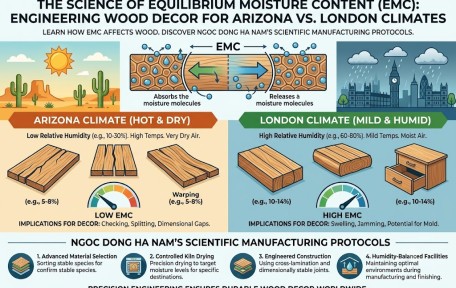
In the production of high-end, sustainable home decor using natural materials—such as Acacia wood, bamboo, seagrass, rattan, and water hyacinth—the factory’s geographical location is a vital technical variable. Natural fibers are highly hygroscopic, meaning they actively absorb and desorb moisture from the surrounding atmosphere to reach an Equilibrium Moisture Content (EMC). When a factory is situated far from its raw material sources, raw materials undergo prolonged transit through varying microclimates, leading to cellular degradation, mold cultivation, and structural warping before processing even begins.
By positioning manufacturing facilities in Ha Nam, Vietnam, Ngoc Dong Ha Nam establishes a localized supply loop. This strategic placement ensures that harvested materials are transported minimal distances, maintaining their cellular density and natural tensile strength. The transition from raw harvest to stabilized, kiln-dried semi-finished product occurs within a highly controlled timeframe, eliminating the structural unpredictability common in fragmented supply chains.
RAW MATERIAL SOURCING: PRESERVING FIBER INTEGRITY AND MOISTURE CONTROL
Optimizing Natural Fibers: Acacia, Bamboo, Seagrass, and Water Hyacinth
Each natural material utilized in premium home decor possesses distinct physical limits and environmental sensitivities. Proximity to harvesting zones allows for precise control over these variables:
1. Acacia Wood (Acacia mangium)
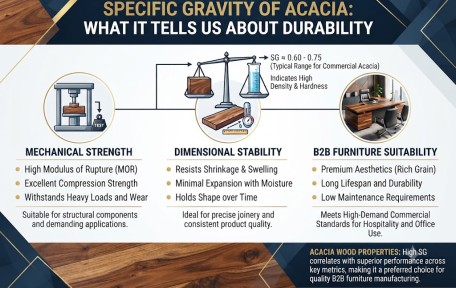
Acacia is favored for its high density (650–750 kg/m³) and natural resistance to rot. However, green acacia wood has an initial moisture content (MC) exceeding 50%. To prevent checking, splitting, and warping, the wood must be kiln-dried to an optimal MC of 8% to 12% (compliant with ASTM D4442 standards). Processing acacia close to sustainable, FSC-certified plantations in northern Vietnam minimizes raw timber transit, preventing pre-drying fungal decay and ensuring timber is stabilized immediately upon harvesting.
2. Split and Woven Bamboo
Bamboo is highly anisotropic, meaning its physical properties differ along different axes. It has a high tensile strength parallel to the grain (up to 400 MPa) but is susceptible to starch-eating insects if not treated quickly. Immediate post-harvest treatment (carbonization or borate boiling) at nearby facilities preserves its structural integrity and ensures compliance with FDA and LFGB food-contact safety standards.
3. Seagrass and Water Hyacinth
These aquatic fibers are exceptionally hygroscopic. Freshly harvested water hyacinth contains up to 90% water. If not dried to below 15% MC within 24 to 48 hours, *Aspergillus* mold growth initiates, permanently staining the fibers and degrading their tensile capacity. Proximity to the coastal growing regions of Kim Son (Ninh Binh) and the riverways of the Red River Delta allows Ngoc Dong Ha Nam to receive, dry, and process these fibers rapidly, locking in their natural golden hues and mechanical durability.
PORT LOGISTICS: MINIMIZING LEAD TIMES, SCOPE 3 EMISSIONS, AND CONTAINER SWEAT
The Logistics Corridor: Ha Nam to Haiphong Port
Logistical efficiency is quantified by lead time predictability and the mitigation of transit-induced damage. Ngoc Dong Ha Nam is strategically located approximately 120 kilometers from Haiphong Port (including the modern Lach Huyen deep-water terminal), accessible via a direct 2-hour highway transit. This geographical advantage yields substantial technical and commercial benefits:
Mitigation of Container Sweat (Adsorption/Desorption Cycle)
Container sweat occurs when cargo experiences extreme temperature shifts during transit, causing air inside the container to reach its dew point. Water droplets condense on the ceiling and drip onto the products, causing mold and warping. By reducing inland transit time to under 2 hours, products transition rapidly from our humidity-controlled warehouses (maintained at 50-60% Relative Humidity) directly into the marine port infrastructure. This minimizes the exposure of sealed export containers to variable diurnal temperature swings on inland roads.
Reduction of Scope 3 Carbon Emissions
Under the Greenhouse Gas (GHG) Protocol, corporate buyers must report and reduce Scope 3 emissions (indirect emissions in the value chain). Shorter inland trucking distances significantly lower the carbon footprint per Twenty-Foot Equivalent Unit (TEU). A 120 km flat-terrain highway transit generates up to 75% less CO2 emissions per container compared to factories located 500+ km inland or in mountainous regions requiring complex multi-modal transit.
COMPARATIVE ANALYSIS: MATERIAL SPECIFICATIONS AND STANDARDS
Technical Specification Comparison
The following markdown table outlines the technical thresholds and testing standards applied to our primary materials, illustrating how geographic proximity preserves these engineering metrics:
|
Material |
Density / Fiber Thickness |
Target Moisture Content (MC) |
Primary Tensile / Flexural Limit |
Relevant International Standards |
Proximity Hazard Avoided |
|
Acacia Wood |
650 - 750 kg/m³ |
8% - 12% |
Modulus of Rupture: 110-120 MPa |
FSC, ASTM D4442, FDA / LFGB |
Checking, radial cracking, fungal rot |
|
Bamboo (Split) |
700 - 850 kg/m³ |
10% - 13% |
Tensile Strength: 120 - 250 MPa |
FSC, ISO 22196 (Antibacterial) |
Insect infestation, splitting along grain |
|
Seagrass |
1.5 - 3.0 mm (fiber) |
12% - 14% |
High flexibility, moderate tensile |
BSCI, SMETA, REACH Compliance |
Aspergillus mold, fiber blackening |
|
Water Hyacinth |
4.0 - 8.0 mm (braid) |
12% - 14% |
High elasticity, low shear strength |
BSCI, SMETA, REACH Compliance |
Rapid fermentation, sour odor, fiber collapse |
Visualizing Technical Data: Buyers should refer to cross-sectional microscopic scans of Acacia wood showing uniform cell structure post-kiln drying, and scanning electron microscopy (SEM) of seagrass fibers demonstrating intact cellular walls free from fungal hyphae when processed within 48 hours of harvest.
TECHNICAL GLOSSARY & MATERIAL LIMITS
Contextual Glossary & Physical Limitations
To ensure transparent engineering communication, we define the technical terms and physical boundaries of our sustainable materials:
Contextual Glossary
- Equilibrium Moisture Content (EMC): The moisture content at which wood or natural fiber neither gains nor loses moisture from the surrounding air.
- Hygroscopic: The physical property of a substance to readily attract and absorb water molecules from its surrounding environment.
- Anisotropy: Having physical properties that differ in value when measured in different directions (highly characteristic of bamboo).
- Container Sweat: Condensation that forms on the internal surfaces of a shipping container due to rapid external temperature fluctuations.
Physical Limits and Maintenance Guidelines
While our localized processing ensures peak material quality, natural materials possess inherent physical limits. Our products are designed for indoor or semi-outdoor environments (sheltered patios). They should not be subjected to direct, prolonged precipitation or submerged in water. For maintenance, woven seagrass and water hyacinth items should be cleaned with a dry or slightly damp microfiber cloth and kept in environments with relative humidity between 40% and 70%. If exposed to high humidity, temporary air circulation (fans or dehumidifiers) prevents any localized moisture accumulation.
FREQUENTLY ASKED QUESTIONS
How does Ngoc Dong Ha Nam control moisture content during the rainy season in Vietnam?
We utilize advanced, automated kiln-drying facilities and humidity-controlled de-humidification warehouses. This allows us to consistently maintain Acacia wood at 8-12% MC and woven fibers at 12-14% MC, regardless of external seasonal monsoon conditions.
What certifications do your factory and materials hold?
Our manufacturing operations are fully compliant with BSCI and SMETA social audits. Our wood and bamboo products carry FSC certification, and our finished food-contact items comply with FDA (USA) and LFGB (Germany) safety standards.
Why is proximity to Haiphong Port beneficial for European and North American buyers?
Haiphong Port offers direct shipping routes to major global hubs. The short 120 km inland transit from our factory to the port reduces transit times, lowers land freight costs, minimizes the risk of container sweat, and reduces Scope 3 carbon emissions.
Can your natural fiber products withstand high-humidity climates in importing countries?
Yes. Because our materials are stabilized and dried to their optimal EMC under strict quality controls before export, they adapt resiliently to various international climates, provided they are kept indoors and away from direct standing water.