Acacia vs. Mango Wood: Supply Chain Stability, Density, and Moisture Resistance Analyzed
Key Takeaways
• Acacia wood exhibits a Janka hardness rating of 1,700 to 2,200 lbf and a density of 650–750 kg/m³, whereas Mango wood delivers 1,070 to 1,120 lbf and 550–650 kg/m³.• Vietnam-sourced Acacia features a stable commercial supply chain driven by 7 to 10-year sustainable FSC-certified plantation cycles, unlike Mango wood which relies on 20 to 30-year fruit-bearing orchard clearance.
• Kiln-dried Acacia maintained at 8–12% Moisture Content (MC) achieves superior dimensional stability with volumetric shrinkage rates under 3.5%, outperforming Mango wood in high-humidity indoor and food-contact environments.
• Acacia wood meets international food-grade standards including FDA 21 CFR 175.300 and LFGB testing when paired with food-safe botanical oils or water-based polyurethane coatings.
EXECUTIVE SUMMARY AND TABLE OF CONTENTS
Acacia vs. Mango Wood: Technical Material Comparison and Supply Chain Analysis
Acacia wood offers higher physical density, superior dimensional stability, and greater supply chain continuity than Mango wood for commercial furniture and home decor manufacturing.
Global procurement teams must balance structural longevity against raw material risk. Selecting the correct hardwood species directly impacts product warranty rates, landed costs, and compliance with ESG metrics.
Table of Contents
- 1. Janka Hardness and Density Profile Comparison
- 2. Moisture Absorption, Volumetric Shrinkage, and Equilibrium Moisture Content
- 3. Global Supply Chain Risk and Commercial Plantation Availability
- 4. Regulatory Compliance, Food-Contact Safety, and Testing Standards
- 5. Technical Glossary and Procurement Selection Matrix
[Image Suggestion: High-resolution cross-sectional macro shot comparing raw grain structures of kiln-dried Acacia mangium and Mangifera indica at 50x magnification, showing cell wall thickness and pore distribution.]
JANKA HARDNESS AND DENSITY PROFILE COMPARISON
Acacia wood outperforms Mango wood in mechanical strength tests, exhibiting a Janka hardness rating up to 100% higher than Mango wood.
Hardness dictates surface indentation resistance. High-traffic hospitality furniture and kitchenware require dense timber to resist abrasion and mechanical shear.
Mechanical Property Benchmarks
According to ASTM D143 testing procedures, Acacia species demonstrate structural properties suitable for heavy-duty commercial applications. Mango wood functions effectively for decorative accent pieces but shows lower surface resistance under impact load.
|
Physical Property |
Acacia (A. mangium / A. auriculiformis) |
Mango Wood (Mangifera indica) |
Testing Standard |
|
Janka Hardness Rating |
1,700 – 2,200 lbf (7,560 – 9,780 N) |
1,070 – 1,120 lbf (4,760 – 4,980 N) |
ASTM D143 |
|
Air-Dry Density (12% MC) |
650 – 750 kg/m³ |
550 – 650 kg/m³ |
ISO 13061-2 |
|
Bending Strength (MOR) |
110 – 135 MPa |
72 – 88 MPa |
ISO 3133 |
|
Modulus of Elasticity (MOE) |
11,500 – 14,200 MPa |
8,900 – 10,500 MPa |
ISO 3133 |
|
Compression Parallel to Grain |
58 – 68 MPa |
41 – 49 MPa |
ISO 3787 |
Acacia cell walls are thicker. This density resists denting. Heavy commercial use demands this exact durability.
MOISTURE ABSORPTION, VOLUMETRIC SHRINKAGE, AND EQUILIBRIUM MOISTURE CONTENT
Acacia exhibits significantly lower volumetric shrinkage and greater resistance to moisture-induced warping than Mango wood when processed to standard Equilibrium Moisture Content (EMC).
Wood is hygroscopic. It absorbs and releases moisture relative to ambient relative humidity (RH). Uncontrolled movement leads to checking, splitting, and joint failure.
Hygroscopic Behavior and Kiln Drying Parameters
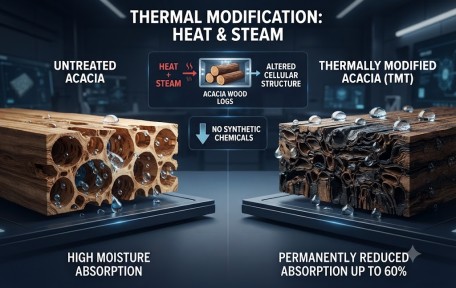
Target moisture content for export to North America and Western Europe is 8% to 12%. Achieving this requires strict kiln-drying schedules to prevent internal honeycomb stress.
|
Moisture Parameter |
Acacia Wood Value |
Mango Wood Value |
Technical Implication |
|
Radial Shrinkage Coefficient |
1.4% – 1.8% |
2.2% – 2.8% |
Width dimensional change |
|
Tangential Shrinkage Coefficient |
2.6% – 3.4% |
3.8% – 4.6% |
Thickness movement / cupping risk |
|
Volumetric Shrinkage Ratio |
1.5 (T/R Ratio) |
1.8 (T/R Ratio) |
Acacia shows lower warping propensity |
|
Ideal Export Kiln Target |
8% – 10% MC (+/- 1.5%) |
9% – 11% MC (+/- 1.5%) |
Prevents transit mold and cracking |
Is Mango wood susceptible to fungus? Yes. Mango wood contains residual sugars that accelerate fungal growth if kiln drying fails to sterilize the core.
Acacia contains natural heartwood extractives and tannins. These organic compounds act as natural bio-fungicides, discouraging rot and subterranean termites.
[Image Suggestion: Line chart displaying dimensional expansion curves of Acacia vs. Mango timber samples exposed to relative humidity fluctuations from 30% to 85% RH over 72 hours.]
GLOBAL SUPPLY CHAIN RISK AND COMMERCIAL PLANTATION AVAILABILITY
Acacia offers an exceptionally reliable and sustainable commercial supply chain due to short-rotation industrial plantations across Vietnam, whereas Mango wood relies on secondary agricultural lifecycles.
Supply chain stability underpins large-scale retail sourcing. Buyers cannot risk stockouts caused by seasonal timber shortages or raw material export bans.
Commercial Plantation vs. Agricultural Byproduct
Acacia trees mature in 7 to 10 years. Plantation forestry in Southeast Asia guarantees controlled harvest yields, predictable timber pricing, and full chain-of-custody traceability under FSC (Forest Stewardship Council) frameworks.
Mango trees are cultivated primarily for agriculture. Fruit production lasts 20 to 30 years. Timber enters the supply chain only when old trees stop producing fruit, creating localized and unpredictable raw timber supply spikes.
- Acacia Lead Times: Stable year-round harvesting with scalable log diameters (20cm - 40cm DBH).
- Mango Lead Times: Variable supply tied to regional fruit farm renewal seasons in India and Thailand.
- Traceability: Acacia easily achieves FSC Recycled or FSC 100% certification; Mango certification requires complex smallholder mapping.
- Log Consistency: Fast-growing plantation Acacia ensures consistent grain patterns and lower grading defect rates.
Which material simplifies compliance? Acacia wins. Established certified forests streamline EU Deforestation Regulation (EUDR) documentation.
REGULATORY COMPLIANCE, FOOD-CONTACT SAFETY, AND TESTING STANDARDS
Acacia wood combined with food-safe botanical oils fully complies with global food-contact safety standards, including US FDA 21 CFR 175.300 and European LFGB guidelines.
Retailers importing serving boards, bowls, or kitchen utensils must ensure zero migration of toxic chemicals into food products.
Testing Protocols and Social Compliance
Manufacturing facilities in Vietnam maintain rigorous quality assurance systems to satisfy international audits. Key compliance requirements include:
- Food Contact Safety: Migration testing for heavy metals and formaldehyde according to LFGB Sec 30/31 and US FDA requirements.
- Social & Ethical Compliance: Factory audits under BSCI (Business Social Compliance Initiative) and SMETA 4-Pillar standards.
- Timber Legality: Compliance with EUDR and US Lacey Act requirements to guarantee legally harvested timber.
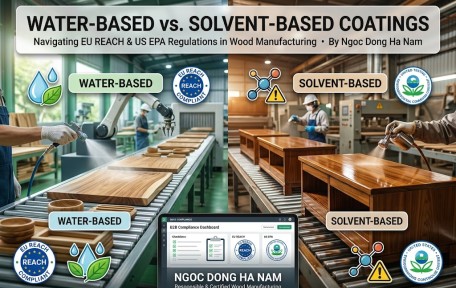
- Finishing Safety: Application of zero-VOC, water-based finishes or food-grade mineral and natural oils.
Acacia's non-porous tight grain resists bacteria trap risks better than softer Mango wood. This structural trait reduces deep knife scarring on cutting surfaces.
TECHNICAL GLOSSARY AND PROCUREMENT SELECTION MATRIX
Acacia wood is the optimal specification for high-durability, moisture-exposed, and food-contact home decor collections, while Mango wood fits budget-conscious, carved artistic accent pieces.
Use this evaluation matrix to align raw material selection with product category requirements.
Procurement Decision Matrix
|
Product Category |
Recommended Species |
Primary Technical Justification |
|
Cutting Boards & Kitchen Tools |
Acacia |
High Janka hardness, bacterial resistance, LFGB compliance |
|
Outdoor & Patio Furniture |
Acacia |
Low volumetric shrinkage, natural tannin rot resistance |
|
Carved Decorative Wall Panels |
Mango Wood |
Softer fibers allow intricate hand-carving and staining |
|
High-Traffic Dining Tables |
Acacia |
Indentation resistance (1,700+ lbf Janka), structural strength |
|
Distressed Vintage Accent Cabinets |
Mango Wood |
Spalted grain variations create decorative aesthetic appeal |
Contextual Technical Glossary
- Janka Hardness: Measures the resistance of a sample of wood to denting and wear, expressed in pounds-force (lbf).
- Equilibrium Moisture Content (EMC): The moisture level where wood neither gains nor loses moisture to the surrounding air.
- Volumetric Shrinkage: Total percentage reduction in wood volume as moisture drops from Fiber Saturation Point to 0% MC.
- T/R Ratio: Ratio of tangential to radial shrinkage; values closer to 1.0 indicate superior dimensional stability.
- EUDR: European Union Deforestation Regulation mandating strict geolocation proof for wood product import compliance.
Choose wisely. Align material science with your product's functional demands.
Authored by Thong Nguyen, Co-owner at Ngoc Dong Ha Nam Co., Ltd. We leverage over two decades of manufacturing experience to provide global retail partners with superior-quality, sustainable handicrafts and furniture solutions crafted from bamboo, rattan, water hyacinth, and acacia wood.
FREQUENTLY ASKED QUESTIONS
Is Acacia wood more durable than Mango wood for kitchenware products?
Yes, Acacia wood has a Janka hardness of 1,700 to 2,200 lbf compared to Mango wood's 1,070 lbf, making Acacia significantly more resistant to scratching, cutting marks, and water absorption in kitchenware applications.
How does Acacia wood perform under EUDR timber regulations?
Acacia wood grown in organized Vietnamese industrial plantations offers streamlined EUDR compliance due to centralized land title records, FSC chain-of-custody certification, and precise GPS plantation mapping.
What is the ideal moisture content for exporting Acacia woodenware to Western markets?
The target moisture content for exporting Acacia wood products to Western Europe and North America is between 8% and 12%, achieving thermal and humidity equilibrium to prevent cracking or warping during transport and display.
Does Mango wood require chemical treatment before furniture production?
Yes, Mango wood requires kiln drying and insecticide treatment because its high starch content makes untreated sapwood vulnerable to fungal staining, rot, and wood-boring insects.