Kiln-Dried vs. Air-Dried Acacia: Why 8-12% Moisture Content (MC) is Non-Negotiable for US and EU Climates
Executive Brief
• Acacia wood must maintain an 8-12% Moisture Content (MC) to withstand indoor heating and air conditioning environments across North America and Europe.• Air-drying only reduces wood moisture to 15-20%, which guarantees warping, surface checking, and joint failure when exposed to low indoor relative humidity.
• Kiln-drying stabilizes cellular structure, eliminates wood-boring pests, and prevents fungal growth by artificially driving bound water out below the Fiber Saturation Point.
• Compliance with international standards like ASTM D4442 and EN 322 requires digital moisture testing throughout the manufacturing process.
EXECUTIVE SUMMARY & TECHNICAL NAVIGATION
Acacia wood products exported to North America and Western Europe require a strictly controlled Moisture Content (MC) of 8% to 12%. Air-drying techniques fail to bring Acacia below 15-18% MC in tropical manufacturing climates like Vietnam. Exposing high-MC timber to dry HVAC environments in target markets induces severe dimensional instability, joint shearing, and surface cracking. Kiln drying under controlled thermomechanical conditions remains the only industrially viable method to ensure long-term structural integrity.
Table of Contents:
1. The Physics of Wood Moisture: Fiber Saturation Point & EMC
2. Air-Dried vs. Kiln-Dried Acacia: Technical Specification Comparison
3. The Climatic Reality: Indoor HVAC Systems in the US and EU
4. Quality Control & Testing Protocols at Ngoc Dong Ha Nam
Technical Glossary:
- Moisture Content (MC): The weight of water contained in wood expressed as a percentage of the oven-dry wood weight.
- Equilibrium Moisture Content (EMC): The moisture content at which wood neither gains nor loses moisture from the surrounding ambient air.
- Fiber Saturation Point (FSP): The theoretical point (~28-30% MC) where cell cavities are empty of free water but cell walls are saturated with bound water.
- Volumetric Shrinkage: The percentage reduction in wood volume as bound water is removed below the FSP.
THE PHYSICS OF WOOD MOISTURE: FIBER SATURATION POINT AND EQUILIBRIUM
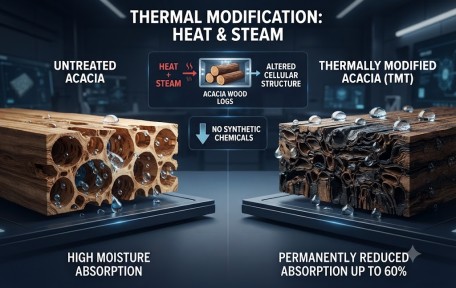
Wood dimensional movement occurs exclusively when bound water exits or enters the cell walls below the Fiber Saturation Point (FSP). Green Acacia timber contains both free water in cell lumens and bound water within cell walls, registering an initial MC between 60% and 100%. Natural air-drying removes free water quickly. However, air drying stalls once ambient relative humidity reaches equilibrium with the timber. In Vietnam, ambient Equilibrium Moisture Content (EMC) averages 16% to 20% year-round.
Why does this matter to global buyers? When unseasoned or air-dried Acacia with 18% MC enters a heated home in Munich or Chicago where the indoor EMC is 8%, the wood rapidly desorbs moisture. As bound water leaves the cell walls, the microfibrils contract. This contraction creates immense internal tensile stress. What is the result? The timber warps, cupping across the grain and splitting along path-of-least-resistance cell boundaries.
[Data Visualization Description: A cross-sectional diagram comparing cellular structure at 30% MC (FSP), 18% MC (Air-Dried), and 10% MC (Kiln-Dried). The diagram illustrates microfibril spacing within the secondary cell wall, highlighting the localized stress lines that form during rapid, uncontrolled desorbing.]
AIR-DRIED VS. KILN-DRIED ACACIA: TECHNICAL SPECIFICATION COMPARISON
Kiln drying utilizes computer-controlled temperature, humidity, and airflow cycles to artificially desorb bound water down to target thresholds without causing internal cell collapse. Air drying relies purely on local weather conditions, making precise moisture targets impossible to achieve. The technical differences directly influence product reject rates, structural integrity, and regulatory compliance.
|
Parameter |
Air-Dried Acacia |
Kiln-Dried Acacia (Ngoc Dong Standard) |
|
Achievable Moisture Content |
15% - 22% (Climate dependent) |
8% - 12% (±1% tolerance |
|
Core-to-Surface MC Gradient |
High (>5% delta) |
Low (<1% delta via steam conditioning) |
|
Volumetric Stability in EU/US** |
Poor (High risk of warping/cracking) |
Excellent (Pre-stressed and stabilized) |
|
Pest & Larvae Sterilization |
None (Risk of Lyctid powderpost beetles) |
100% Sterilized (Core temp >56°C for 30+ mins) |
|
Fungal/Mold Risk |
High during sea transit |
Fully mitigated |
|
Adhesive/Bonding Integrity |
Moderate (Risk of delamination) |
High (Optimal surface energy for PVA/PU glues) |
Kiln schedules for Acacia mangium and Acacia auriculiformis at Ngoc Dong Ha Nam incorporate a high-humidity equalization phase. This phase relieves residual drying stresses before cooling. Consequently, boards maintain uniform density and surface tension.
THE CLIMATIC REALITY: INDOOR HVAC SYSTEMS IN NORTH AMERICA AND EUROPE
HVAC equipment in North American and European structures routinely drops indoor relative humidity to between 20% and 40% during winter months. According to USDA Forest Service data, an ambient relative humidity of 30% at 21°C yields an Equilibrium Moisture Content of approximately 6.2%.
If an importer sources Acacia kitchenware or furniture with 16% MC, that product will attempt to equalize with the 6.2% ambient indoor condition. The resulting 10% moisture differential forces rapid volumetric shrinkage. Radial shrinkage for Acacia averages 2.5% to 3.5%, while tangential shrinkage reaches 5.5% to 7.0%. Without kiln stabilization to 8-12% MC, glue joints shear apart, edge-glued tabletop panels cup, and decorative homeware develops severe longitudinal surface checks.
Can air-dried timber ever overcome these thermodynamic realities? No. Thermodynamic equilibrium dictates that wood will always shift toward the environmental EMC. Preparing timber specifically for target climate zones is the only engineering defense against product failure.
QUALITY ASSURANCE PROTOCOLS AT NGOC DONG HA NAM
Achieving consistent 8-12% MC across large-scale B2B production requires rigorous, standardized drying protocols and multi-point moisture verification. At Ngoc Dong Ha Nam, raw Acacia logs undergo primary breakdown followed by pre-sorting by density and initial moisture level. Boards enter automated kilns equipped with digital probe sensors tracking core and shell moisture levels in real time.
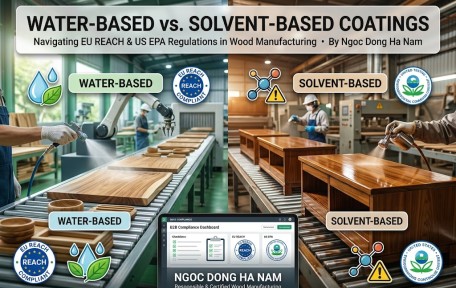
Every production batch complies with ASTM D4442 (Standard Test Methods for Direct Moisture Content Measurement of Wood) and EN 322 moisture testing guidelines. Finishes applied to food-contact Acacia items, such as salad bowls and cutting boards, satisfy US FDA 21 CFR 175.300 and European LFGB standards. Post-kiln timber undergoes a 72-hour conditioning period in climate-controlled storage before final machining to prevent stress rebound.
By enforcing these precise thermal and moisture controls, Ngoc Dong Ha Nam guarantees global buyers zero risk of structural failure during cross-continental shipment and retail display.
This piece is written by Thong Nguyen, Co-owner & Sales Director at Ngoc Dong Ha Nam Co., Ltd. Drawing on 25+ years of expertise in manufacturing export handicrafts, our team delivers premium bamboo, rattan, water hyacinth, and acacia solutions tailored for global retailers.
FREQUENTLY ASKED QUESTIONS
What happens if Acacia furniture imported to Europe has a moisture content above 15%?
Acacia furniture imported into Europe at over 15% MC will rapidly lose moisture in heated indoor environments, causing severe wood shrinkage, tabletop cupping, glue line splitting, and surface checking.
What is the ideal equilibrium moisture content (EMC) for Acacia wood products sold in North America?
The ideal target moisture content for Acacia wood sold in North America is 8% to 10% for indoor furniture and 10% to 12% for outdoor or semi-outdoor home accessories.
How does kiln drying eradicate wood-boring pests and fungal spores?
Kiln drying eradicates wood-boring insects, larvae, and fungal spores by maintaining sustained kiln temperatures above 56°C at the wood core for at least 30 minutes, fulfilling ISPM 15 phytosanitary requirements.
How can global procurement teams test Acacia wood moisture content upon shipment arrival?
Procurement teams can verify moisture content using pin-type or pinless digital moisture meters calibrated to ASTM D4442 guidelines or by conducting oven-dry testing according to EN 322 standards.