
Beeswax vs. Carnauba Wax Finishes: Food-Safe Options and Heat Resistance for Kitchenware
Key Takeaways
• Carnauba wax provides superior thermal resistance with a high melting point of 82–86°C (180–187°F), whereas pure beeswax softens at 60°C and melts at 62–65°C (144–149°F).• Both refined beeswax and carnauba wax meet stringent global food-contact regulations, including US FDA 21 CFR 175.300 and European LFGB standards.
• A 70:30 carnauba-to-beeswax hybrid formulation offers the optimal industrial balance between surface hardness, hydrophobic sealing, and thermal stability for commercial kitchenware.
• Industrial surface preparation requires maintaining substrate wood moisture content strictly between 8% and 12% to prevent micro-delamination of wax coatings.

EXECUTIVE SUMMARY & TECHNICAL OVERVIEW: BEESWAX VS. CARNAUBA WAX FINISHES
Carnauba wax offers superior heat resistance and surface hardness compared to beeswax, making it ideal for high-temperature kitchenware, whereas beeswax provides superior flexibility and hydrophobic sealing for everyday wooden board maintenance.
For commercial procurement managers and product designers sourcing wooden kitchenware, selecting the appropriate natural finish is critical. The finish directly impacts food safety compliance, thermal durability, aesthetic aging, and product return rates in global retail markets. This article analyzes the physical properties, regulatory standards, and manufacturing parameters of beeswax and carnauba wax finishes on acacia wood, bamboo, and rubberwood substrates.
Table of Contents
- 1. Physical Properties and Chemical Composition
- 2. Regulatory Compliance: FDA and LFGB Standards
- 3. Thermal Performance & Heat Resistance Limits
- 4. Technical Specification Matrix
- 5. Application Parameters & Maintenance Protocols
- 6. Strategic Sourcing Recommendations
Contextual Technical Glossary
- Shore D Hardness: A standardized measure of material hardness for rigid polymers and structural waxes according to ASTM D2240.
- Hydrophobicity: The physical property of a molecule or surface that repels water, measured via water contact angle (>90° indicates hydrophobic).
- FDA 21 CFR 175.300: The Code of Federal Regulations governing resinous and polymeric coatings intended for safe food contact.
- LFGB (§ 30 & 31): The German Food and Feed Code setting strict chemical migration limits for consumer products.
- Substrate Equilibrium Moisture Content (EMC): The balance point where wood neither gains nor loses moisture to the surrounding air.
PHYSICAL PROPERTIES AND CHEMICAL COMPOSITION: MELTING POINTS AND HARDNESS
Carnauba wax boasts a higher melting point of 82–86°C (180–187°F) and a Shore D hardness of ~78, compared to beeswax's lower melting point of 62–65°C (144–149°F) and softer texture.
Derived from the leaves of the Brazilian palm Copernicia prunifera, carnauba wax consists primarily of fatty acid esters (80-85%), diesters of cinnamic acid, and hydroxy fatty acids. This complex hydrocarbon structure yields a dense crystal lattice structure. Consequently, carnauba forms an extraordinarily tough, high-gloss protective barrier on dense hardwood substrates like acacia and rubberwood. How does this structural density impact daily wear? It prevents knife blade scoring from penetrating deep into wood fibers.
In contrast, natural beeswax (secreted by Apis mellifera) comprises a mixture of ester compounds (67%), free fatty acids (14%), and long-chain hydrocarbons (12-16%). This softer structural profile yields a Shore D hardness of approximately 18 to 22. While beeswax provides exceptional elasticity and self-healing properties under minor friction, its lower melting point creates performance limitations under elevated thermal stress.
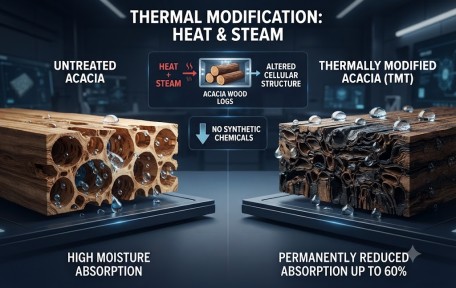
Visualizing the cross-sectional pore penetration: Carnauba wax forms a rigid, micro-thin surface film atop the vascular bundles of hardwood. Beeswax penetrates deeper into the cellular lumen, creating a flexible internal moisture barrier.
FOOD-SAFETY CERTIFICATION COMPLIANCE: FDA 21 CFR AND LFGB STANDARDS
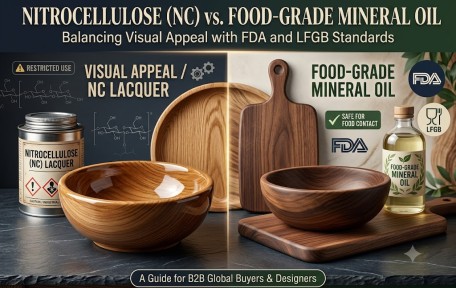
Both refined beeswax and carnauba wax are recognized as Generally Recognized As Safe (GRAS) by the US FDA and fully compliant with EU LFGB regulations for direct food contact.
For international buyers supplying major retail chains in North America and Europe, chemical safety verification is non-negotiable. Pure unadulterated beeswax is classified under FDA 21 CFR 184.1973, while carnauba wax falls under FDA 21 CFR 184.1978. When used as protective coatings for cutting boards, salad bowls, and serving utensils, neither material poses heavy metal contamination or toxic chemical leaching risks.
Under European Union regulations (EC No 1935/2004 and German LFGB testing guidelines), finished kitchenware coated with natural waxes must undergo Overall Migration Testing (OMT). Standard testing protocols submerge wax-finished wood in food stimulants—such as 3% acetic acid, 10% ethanol, and rectified olive oil—at 40°C for 10 days. Both wax types pass these stringent migration thresholds comfortably, provided no synthetic drying agents or volatile organic solvents (VOCs) are introduced into the formulation.
- US FDA Status: Direct food additive GRAS status; compliant under 21 CFR 175.300 for wood coatings.
- EU LFGB Status: Approved under BfR Recommendation XIV; passes overall migration limits (<10 mg/dm²).
- REACH & RoHS: Exempt from SVHC (Substances of Very High Concern) registration requirements.
THERMAL PERFORMANCE AND HEAT RESISTANCE ON WOOD SUBSTRATES
Carnauba wax finishes withstand hot food serving up to 80°C without softening or transferring residue, whereas beeswax finishes begin to soften at 60°C, risking sticky surfaces when exposed to hot culinary items.
Thermal stability is a primary design consideration for serving platters, trivets, and hot-plate chargers. When hot cooked foods (such as roasted meats at 75–85°C) contact pure beeswax finishes, localized thermal softening occurs. This softening leads to ring marking, surface tackiness, and the potential transfer of wax onto food items. Is a tacky finish acceptable in luxury hotel tableware? Absolutely not.
Carnauba wax retains structural rigidity up to 80°C. However, pure carnauba wax applied without plasticizers is prone to micro-cracking due to its extreme brittleness. When the underlying wood expands or contracts due to ambient humidity swings, rigid carnauba coatings can show micro-fissures.
To solve this physical trade-off, material engineers at Ngoc Dong Ha Nam utilize hybrid formulation science. By blending 70% carnauba wax with 30% refined beeswax, the resulting coating maintains high thermal tolerance (softening point >74°C) while gaining sufficient ductility to accommodate wood thermal expansion without crazing.
TECHNICAL SPECIFICATION MATRIX: COMPARATIVE ANALYSIS FOR KITCHENWARE
A side-by-side technical evaluation demonstrates that a blended formulation of carnauba and beeswax yields the optimal balance of thermal resilience, moisture barrier performance, and ease of application.
The following technical data table outlines key physical parameters determined under standard laboratory testing conditions (23°C, 50% Relative Humidity):
|
Technical Parameter |
Pure Beeswax |
Pure Carnauba Wax |
70/30 Hybrid Blend |
|
Melting Point Range |
62°C – 65°C |
82°C – 86°C |
75°C – 79°C |
|
Shore D Hardness |
18 – 22 |
76 – 80 |
52 – 58 |
|
Water Contact Angle |
96° |
104° |
101° |
|
Max Safe Service Temp |
55°C (131°F) |
80°C (176°F) |
72°C (161°F) |
|
Scratch Resistance (Pencil Test) |
B |
3H |
H |
|
FDA Compliance Standard |
21 CFR 184.1973 |
21 CFR 184.1978 |
Compliant |
|
Application Method |
Buffing / Hand rub |
Hot melt spray / High friction buff |
Thermostatic spray / Mechanical buff |
This comparison confirms that while pure carnauba provides the highest heat resistance and hardness, the hybrid blend optimizes practical application in high-volume OEM manufacturing lines.
INDUSTRIAL APPLICATION PROCEDURES AND COMMERCIAL MAINTENANCE PROTOCOLS
Commercial production requires pre-warming wax formulations to 75–90°C and applying them under controlled ambient humidity below 65% to ensure maximum penetration into acacia or bamboo wood pores.
Achieving a durable, food-safe finish on commercial woodenware requires strict adherence to industrial processing parameters. Raw wooden substrates (acacia, rubberwood, or laminated bamboo) must first undergo thermostatic kiln drying to achieve a target moisture content of 8% to 12%. Applying wax to timber with moisture exceeding 14% traps water vapour within the grain, causing white clouding and early coating failure.
Industrial Finishing Workflow
- Step 1: Substrate Sanding: Progressive abrasive calibration up to 320-grit to open vascular pores evenly.
- Step 2: Thermal Application: Heat the 70/30 hybrid wax solution to 80°C and apply via pneumatic heated spray system or automated friction roll-coater.
- Step 3: Penetration Phase: Allow 15 minutes in a dry convection tunnel at 50°C to facilitate capillary action into the wood structure.
- Step 4: High-Speed Buffing: Buff with rotary horsehair brush heads at 1400 RPM to develop a smooth, pore-sealed luster.
End-User Maintenance Requirements
Retail consumers should recondition wooden boards every 3 to 6 months. Applying a thin layer of food-grade mineral oil mixed with beeswax restores hydrophobic protection lost during routine hand-washing with mild detergents.
STRATEGIC SOURCING GUIDANCE FOR GLOBAL BUYERS AND OEM MANUFACTURERS
Sourcing managers should specify a 70:30 Carnauba-Beeswax hybrid finish for heavy-duty acacia cutting boards to achieve thermal compliance, enhanced durability, and cost efficiency.
When specifying finishes for global retail SKUs, procurement teams must balance unit costs, aesthetic preferences, and warranty liability. Pure carnauba finishes carry higher raw material costs and require specialized buffing machinery. Pure beeswax finishes are economical and easy to reapply, but carry higher risk of heat-staining in dishwasher-adjacent kitchen environments.
Partnering with an experienced export manufacturer ensures full compliance with international supply chain audit standards (BSCI, FSC, SMETA). At Ngoc Dong Ha Nam, our manufacturing facilities integrate certified eco-friendly finishing lines that meet rigorous European and North American market standards.
By selecting optimized natural wax formulations tailored to your specific product use-case, global brands can minimize return rates, enhance product longevity, and reinforce sustainable brand equity.
This piece is written by Thong Nguyen, Co-owner & Sales Director at Ngoc Dong Ha Nam Co., Ltd. Drawing on 25+ years of expertise in manufacturing export handicrafts, our team delivers premium bamboo, rattan, water hyacinth, and acacia solutions tailored for global retailers.
FREQUENTLY ASKED QUESTIONS
Is carnauba wax safe for direct food contact on wooden cutting boards?
Yes, pure refined carnauba wax is FDA-approved under 21 CFR 184.1978 and fully compliant with EU LFGB regulations, making it completely safe for direct food contact.
What maximum temperature can beeswax finishes withstand on kitchenware before melting?
Pure beeswax begins softening at approximately 60°C (140°F) and fully melts at 62–65°C (144–149°F). It is not recommended for direct contact with boiling hot pots or serving items above 55°C.
Why use a beeswax-carnauba hybrid blend instead of a single wax finish?
A 70/30 carnauba-beeswax hybrid blend combines carnauba's high thermal resistance (82–86°C melting point) and surface hardness with beeswax's flexibility and deep grain penetration, preventing surface cracking.
How often should commercial acacia wood kitchenware be reconditioned?
Wooden kitchenware finished with natural wax should be reconditioned every 3 to 6 months depending on usage intensity and washing frequency, using a food-grade wax maintenance salve.