Acacia vs. Olive Wood: Scaling Charcuterie Board Production Without Sacrificing Natural Grain Quality
Crucial Findings
• Acacia wood offers superior scalability and high usable yield rates (65–72%) for commercial charcuterie board manufacturing compared to Olive wood (25–35%).• Kiln-dried Acacia (8–12% MC) achieves superior dimensional stability, preventing warping and checking during cross-continental maritime transit.
• Acacia provides FSC-certified supply chain traceability, enabling global retailers to meet ESG compliance requirements while maintaining premium grain aesthetics.
• LFGB and FDA 21 CFR 175.300 compliant finishes preserve natural wood grain aesthetics while guaranteeing food safety standards for commercial distribution.
EXECUTIVE SUMMARY & TECHNICAL FRAMEWORK
Acacia wood provides the optimal balance of high-volume material availability, structural stability, and rich grain aesthetics required for enterprise-scale charcuterie board manufacturing, whereas Olive wood suffers from severe yield limitations and unstable raw material supply chains. Retail buyers scaling product lines beyond 10,000 units per month require sustainable, FSC-certified hardwoods that maintain strict dimensional tolerances under variable ambient humidity.
Table of Contents
- 1. Technical Specification Comparison: Acacia vs. Olive Wood
- 2. Supply Chain Viability, Forest Certification, and Yield Rates
- 3. Material Stability, Moisture Control, and Surface Tolerances
- 4. Food Contact Compliance: FDA, LFGB, and Protective Finishes
- 5. B2B Quality Assurance and Sourcing Framework
Contextual Technical Glossary
- Janka Hardness Rating: A standard measure of the resistance of a sample of wood to denting and wear, measured in pounds-force (lbf) or Newtons (N).
- Volumetric Shrinkage Coefficient: The percentage change in wood volume when moisture content drops from green condition to oven-dry condition.
- FSC-STD-40-004: The global standard for Chain of Custody certification ensuring timber originates from responsibly managed forests.
- Moisture Content (MC): The weight of water contained in wood expressed as a percentage of the oven-dry weight of the wood material.
- LFGB Section 30/31: European food contact safety legislation regulating materials exposed to food products.
1. TECHNICAL SPECIFICATION COMPARISON: ACACIA VS. OLIVE WOOD
Acacia wood demonstrates superior physical workability and predictable density profiles compared to Olive wood, making it the most reliable timber species for mass-market charcuterie board production. While Olive wood boasts dramatic grain contrast, its high volumetric shrinkage ratio creates substantial manufacturing liabilities during high-volume machining.
Is visual appeal worth a 40% defect rate in transit? High internal stress in slow-growing Olive wood frequently leads to micro-cracking during automated planing and CNC milling.
The table below summarizes the quantitative physical properties of commercial Acacia (Acacia mangium / auriculiformis) against Mediterranean Olive Wood (Olea europaea).
|
Physical / Technical Property |
Acacia Wood (Commercial Plantation) |
Olive Wood (Mediterranean Old-Growth) |
|
Janka Hardness |
1,700 - 2,300 lbf (7,560 - 10,230 N) |
2,700 - 3,200 lbf (12,010 - 14,230 N) |
|
Air-Dry Density |
650 - 780 kg/m³ |
850 - 990 kg/m³ |
|
Volumetric Shrinkage |
10.2% - 11.5% |
14.8% - 18.2% |
|
Radial-to-Tangential Ratio |
1.6 (High Stability) |
2.3 (High Warping Risk) |
|
Lumber Yield Efficiency |
65% - 72% |
25% - 35% |
|
FSC Chain of Custody Available |
Yes (Widely Certified) |
Extremely Limited |
|
Average Raw Timber Cost |
Baseline ($) |
350% - 500% of Baseline |
Data Visualization Note: Cross-sectional cellular microscopy reveals Acacia's uniform vessel distribution, which contributes to consistent glue-line adhesion during edge-glued panel fabrication. Conversely, Olive wood exhibits highly irregular growth rings with interlocked, wild grain structures that induce localized shear stress under thermal variations.
2. SUPPLY CHAIN VIABILITY, FOREST CERTIFICATION, AND YIELD RATES
Acacia wood yields up to 72% usable timber per log compared to Olive wood's maximum yield of 35%, enabling scalable commercial production with stable lead times and full FSC chain-of-custody compliance. Enterprise retail procurement requires secure raw material pipelines that cannot be sustained by slow-growing Olive groves.
Olive trees require centuries to reach commercial maturity. Most Olive wood source material consists of pruned branches or felled non-productive agricultural trees. This creates severe dimension constraints.
Can your retail brand risk stockouts due to raw material shortages? Acacia plantations reach full harvesting maturity within 7 to 12 years. This rapid renewal cycle guarantees predictable timber pricing and uninterrupted manufacturing runs.
- Sustainable Forest Management: Acacia plantation forestry supports strict ESG criteria under FSC-STD-40-004 standards.
- Dimensional Uniformity: Straight-trunk Acacia logs allow automated high-speed sawing with minimal off-cut waste.
- Consistent Grain Matching: Large board widths allow precise color-matching and grain-pairing for high-end aesthetic presentation.
3. MATERIAL STABILITY, MOISTURE CONTROL, AND SURFACE TOLERANCES
Maintaining a strict moisture content of 8% to 12% via computer-controlled kiln drying is critical to preventing warp, cupping, and end-grain splitting in exported Acacia charcuterie boards. Uncontrolled moisture in solid wood kitchenware leads to rapid product failure in air-conditioned retail or consumer environments.
Acacia responds predictably to thermal drying schedules. Modern automated kilns remove free and bound water uniformly through continuous humidity control.
Olive wood, however, exhibits extreme cellular tension. Kiln drying Olive timber thicker than 25mm often causes internal honeycomb checking and severe twisting.
Factory-level quality control protocols must enforce tight engineering tolerances for high-volume serving boards:
- Thickness Tolerance: ±0.3 mm across the entire length of the panel.
- Flatness / Bow Tolerance: Less than 1.0 mm per 500 mm run.
- Glue-Line Shear Strength: Exceeding 11.0 MPa under ASTM D905 test methods for edge-glued variants.
4. FOOD CONTACT COMPLIANCE: FDA, LFGB, AND PROTECTIVE FINISHES
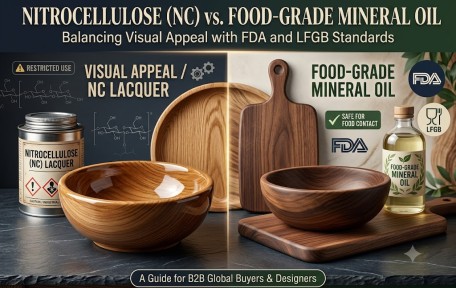
Food-safe charcuterie boards must comply with FDA 21 CFR 175.300 and European LFGB Section 30/31 guidelines through the application of tested botanical oils, organic waxes, or certified liquid coatings. Raw wood surface pores must be sealed to prevent bacterial absorption while highlighting the natural depth of the grain structure.
Does your current finishing line meet global chemical safety standards? Heavy metal migration and volatile organic compound (VOC) emissions represent major compliance risks for international buyers.
Acacia's natural tyloses structure reduces liquid permeability. This physical characteristic enhances finish absorption depth without requiring excessive synthetic sealants.
Recommended commercial finish specifications include:
- Deep Impregnation: Food-grade refined mineral oil or cold-pressed linseed oil vacuum-infused into outer cellular layers.
- Surface Sealing: Purified natural beeswax or carnauba wax topcoat buffed at high RPM for moisture repellent hydrophobic surfaces.
- Curing Time: Minimum 48-hour climate-controlled air drying prior to final poly-bag packaging with desiccant packets.
5. B2B QUALITY ASSURANCE AND SOURCING FRAMEWORK
Enterprise buyers scaling charcuterie board procurement must establish rigorous factory audit protocols covering raw material inspection, moisture logging, and automated packaging standards. Partnering with vertically integrated manufacturers ensures product consistency from timber harvest through container shipment.
Ngoc Dong Ha Nam provides end-to-end manufacturing capabilities. We bridge the gap between handcrafted natural aesthetics and high-capacity industrial production.
Ready to optimize your natural kitchenware supply chain? Contact our engineering and sourcing team today to review custom OEM/ODM specifications and request certified material samples.
This piece is written by Thong Nguyen, Co-owner & Sales Director at Ngoc Dong Ha Nam Co., Ltd. Drawing on 25+ years of expertise in manufacturing export handicrafts, our team delivers premium bamboo, rattan, water hyacinth, and acacia solutions tailored for global retailers.
FREQUENTLY ASKED QUESTIONS
Why is Acacia preferred over Olive wood for enterprise charcuterie board manufacturing?
Acacia offers stable FSC-certified supply chains, higher lumber yield (65-72%), lower raw material cost, and consistent moisture control (8-12% MC), whereas Olive wood suffers from supply scarcity, low yield, and severe checking tendencies.
What moisture content is required for export-grade Acacia charcuterie boards?
Export-grade Acacia boards require a strict moisture content of 8% to 12% achieved via controlled kiln drying to prevent warping, cupping, or mold formation during maritime transport.
Are Acacia charcuterie boards compliant with global food contact regulations?
Yes, Acacia charcuterie boards finished with food-safe botanical oils, organic beeswax, or LFGB/FDA 21 CFR 175.300 certified sealants meet all international food safety standards.
How does the Janka hardness of Acacia compare to Olive wood?
Acacia ranges between 1,700 and 2,300 lbf Janka hardness, providing high scratch resistance suitable for commercial cutting boards while remaining workable for large-scale CNC shaping.