Heartwood vs. Sapwood in Acacia: What Retail Buyers Need to Know About Color Variance and Structural Integrity
Essential Highlights
• Acacia heartwood offers high density (0.58–0.72 g/cm³) and natural rot resistance, whereas sapwood has lower density (0.45–0.55 g/cm³) and higher volumetric shrinkage.• Mixing heartwood and sapwood without proper kiln-drying (8–10% EMC) increases dimensional instability and warping risk by up to 35% under ambient humidity shifts.
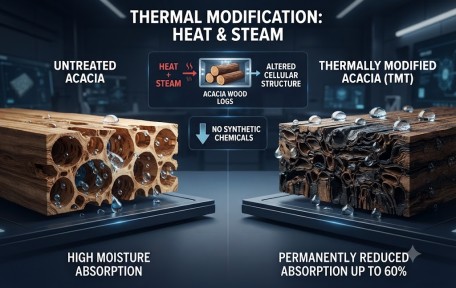
• Color variance stems from natural polyphenol extractives in heartwood; thermo-modification (160°C–210°C) can unify sapwood tones while enhancing durability.
• B2B buyers should establish strict grade specifications (Grade A, B, or C) and mandate EPI/D4 structural adhesives to prevent glue-line separation in solid wood products.
EXECUTIVE SUMMARY & TECHNICAL GLOSSARY
Acacia heartwood offers superior structural stability, natural rot resistance, and high density (0.58-0.72g/cm3, whereas sapwood features lower density (0.45-0.55 g/cm3, lighter cream color tones, and higher moisture sensitivity. Global retail buyers must establish precise sapwood percentage thresholds and kiln-drying standards to mitigate product warping, glue-line failure, and visual rejection in international markets.
Table of Contents
- 1. Botanical Mechanics: Heartwood vs. Sapwood Anatomical Differences
- 2. Structural Integrity and Dimensional Stability Analysis
- 3. Color Variance, Chemical Composition, and Aesthetic Engineering
- 4. Global Quality Standards, Food Safety, and Durability Compliance
- 5. A Procurement Roadmap for Retail Buyers: Quality Control & Sourcing Risk
Contextual Glossary of Technical Terms
- Heartwood (Duramen): The inner, non-living core of the Acacia log characterized by dense cell walls, accumulated organic extractives, and high natural durability.
- Sapwood (Alburnum): The outer, living vascular layer that transports sap and water, exhibiting lighter color, lower density, and higher susceptibility to fungal decay.
- Janka Hardness: A standardized test measuring a wood species' resistance to denting and wear, expressed in pounds-force (lbf) or newtons (N).
- Equilibrium Moisture Content (EMC): The moisture level where timber neither gains nor loses moisture to the surrounding atmosphere. Target EMC for indoor furniture export is 8% to 10%.
- Tangential to Radial Shrinkage Ratio (T/R Ratio): The mathematical ratio indicating dimensional instability. Higher T/R ratios correlate with increased risks of cupping and warping.
- Thermo-Modification: A controlled pyrolytic treatment (160°C to 210°C) that permanently alters cell wall chemistry, homogenizing wood color and reducing hygroscopicity.
- LFGB / FDA Compliance: Food contact safety frameworks ensuring no toxic chemical substances, formaldehyde, or heavy metals migrate into food from wood products.
BOTANICAL MECHANICS: HEARTWOOD VS. SAPWOOD ANATOMICAL DIFFERENCES IN ACACIA
The primary biological difference between Acacia heartwood and sapwood lies in cell vitality and chemical impregnation, where non-living heartwood cells accumulate protective polyphenols while living sapwood conducts sap and stores carbohydrates. This physiological transition creates stark differences in physical density, pore occlusion, and biological vulnerability.
In commercial species such as Acacia mangium and Acacia auriculiformis, sapwood functions as the tree's living vascular network. Parenchyma cells store starches that attract xylophagous insects and wood-staining fungi. As the tree matures, inner parenchyma cells die. They deposit secondary metabolites including flavonoids, tannins, and gums into the cell lumen. This process transforms sapwood into heartwood, plugging vessel elements with tyloses.
Tyloses act as natural barriers against liquid permeability and fungal hyphae progression. Consequently, heartwood exhibits low hydraulic conductivity, protecting solid timber products from ambient moisture penetration. Sapwood lacks these vascular blockages. Can your product line afford untreated sapwood in high-humidity retail markets? Unprotected sapwood absorbs moisture rapidly, triggering microbial growth and swelling.
|
Technical Parameter |
Acacia Heartwood (Duramen) |
Acacia Sapwood (Alburnum) |
Impact on Finished Product |
|
Air-Dry Density |
0.58 – 0.72 g/cm³ |
0.45 – 0.55 g/cm³ |
Heartwood provides superior structural load capacity. |
|
Janka Hardness Rating |
1,100 – 1,750 lbf (4,890 – 7,780 N) |
700 – 950 lbf (3,110 – 4,220 N) |
Sapwood dents more easily under daily consumer wear. |
|
Natural Decay Resistance |
Class 1–2 (Highly Durable) |
Class 5 (Non-Durable) |
Sapwood requires protective finishes to prevent rot. |
|
Starch & Sugar Content |
Trace levels (< 0.2%) |
High levels (1.5% – 3.8%) |
Sapwood attracts powder-post beetles without treatment. |
|
Vessel Occlusion (Tyloses) |
High density (> 80% closed) |
Open vessels (0% closed) |
Heartwood resists liquid absorption and staining. |
Macro-Structure Cross-Section Description: A transverse cross-section image of an industrial Acacia log highlights the stark contrast between zones. The central heartwood core displays deep golden-brown growth rings with dark reddish-brown figure lines. Encircling this core is a pale, creamy-yellow sapwood band spanning 20 mm to 45 mm in thickness. The vascular boundary shows a sharp anatomical divide where cell lumen coloration shifts instantly within a single annual growth ring.
STRUCTURAL INTEGRITY AND DIMENSIONAL STABILITY ANALYSIS
Combining heartwood and sapwood in a single solid Acacia panel introduces severe internal stresses due to unequal Tangential to Radial (T/R) shrinkage ratios, increasing warping risks by up to 35% under ambient humidity fluctuations. Understanding these mechanical stresses allows engineering teams to optimize panel construction and kiln drying parameters.
Wood moves constantly as ambient relative humidity changes. When Acacia timber dries from the Fiber Saturation Point (FSP ≈ 28–30%) down to export equilibrium moisture content (8–10%), heartwood and sapwood shrink at drastically different rates. Heartwood displays a radial shrinkage of 2.2% to 3.1% and a tangential shrinkage of 4.5% to 5.8%. Sapwood shrinks at accelerated rates, reaching of 3.5% to 4.2% and of 6.8% to 8.2%.
This differential movement creates severe internal shear stresses across the heartwood-sapwood interface. When a laminated tabletop contains alternating strips of heartwood and sapwood, the sapwood edge pulls inward faster than the heartwood core. The result? Cupping, twisting, and edge-gluing shear failures occur along structural joints. Precision vacuum kiln drying must be enforced during manufacturing to equalize internal moisture gradients before final milling.
- Modulus of Rupture (MOR): Heartwood yields 98–125 MPa; Sapwood yields 68–82 MPa under standard static bending tests.
- Modulus of Elasticity (MOE): Heartwood achieves 11,500–14,200 MPa, delivering firm resistance to load-induced deflection.
- Shear Strength Parallel to Grain: Heartwood registers 12.5–15.8 MPa versus Sapwood at 8.2–10.4 MPa.
- Internal Bond Strength: Adhesive bonds on heartwood resist moisture degradation far better than bonds on porous sapwood.
Why do edge-glued cutting boards fail during dishwasher or sink washing? Water expands sapwood cell lumens twice as fast as heartwood lumens. This localized volumetric expansion shears the glue line open within minutes. Mitigating this failure mode requires strict sorting protocols that limit sapwood inclusions on functional joining edges.
COLOR VARIANCE, CHEMICAL COMPOSITION, AND AESTHETIC ENGINEERING
Color variance in Acacia stems from the photo-oxidation of specialized flavonoid extractives like robinetin and robinetinidol present exclusively in heartwood, creating high visual contrast against sapwood's pale yellow tones. Retail buyers must establish clear color grading standards to ensure consistent aesthetic presentation across large product lines.
Unprocessed Acacia display a rich array of natural colors. Heartwood ranges from warm honey gold to rich chestnut and dark mahogany. Sapwood displays stark white, cream, or light grey tones. When exposed to ambient ultraviolet light, heartwood deepens in hue due to extractive oxidation. Sapwood, lacking these active extractives, yellows unevenly over time.
To manage this natural variance, commercial buyers utilize visual grading standards defined in procurement contracts. Grade A specifications mandate 100% heartwood on primary exposed surfaces. Grade B permits up to 15% sapwood along edge perimeters, providing a modern rustic aesthetic. Grade C allows high-contrast sapwood inclusions up to 40% for budget-conscious market segments.
|
Visual Grade Class |
Sapwood Tolerance (%) |
Allowed Color Variance |
Target Application & Market Segment |
|
Grade A (Select / Clear) |
0% (100% Heartwood) |
Uniform golden to deep reddish brown |
High-end indoor dining tables, luxury kitchen accessories. |
|
Grade B (Commercial / Natural) |
Max 15% on non-critical edges |
Moderate contrast with soft color transitions |
Mid-tier retail furniture, decorative storage trays. |
|
Grade C (Rustic / Contrast) |
15% – 40% throughout panel |
High visual contrast (Cream vs. Chestnut) |
Budget homeware, rustic accent pieces, promotional lines. |
Can factories homogenize sapwood color without sacrificing wood durability? Yes. High-temperature thermal modification (160°C to 210°C) caramelizes sapwood starches. This thermal treatment darkens pale sapwood to match heartwood tones while permanently reducing volumetric moisture movement by up to 50%. Alternatively, organic, food-safe vacuum stains can tone sapwood fibers uniformly without obscuring natural grain structure.
GLOBAL QUALITY STANDARDS, FOOD SAFETY, AND DURABILITY COMPLIANCE
Retail buyers importing Acacia kitchenware and furniture must verify compliance with LFGB, FDA 21 CFR 175.300, and FSC standards to ensure chemical safety, durability, and legal timber origin. Material composition directly dictates chemical compliance risks, as porous sapwood can retain unacceptable moisture and chemical residues if processed improperly.
For food-contact items like cutting boards, salad bowls, and serving utensils, chemical safety is paramount. German LFGB (Lebensmittel-, Bedarfsgegenstände- und Futtermittelgesetzbuch) testing standardizes limits on formaldehyde migration, heavy metals, and sensory transfer. While heartwood's dense structure natural resists liquid penetration, open sapwood pores can trap chemical cleaning agents or food bacteria if not sealed with food-safe oils.
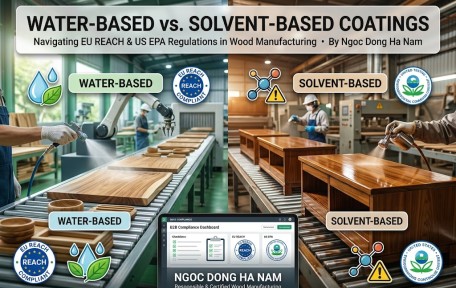
Adhesive selection plays a critical role in product compliance and structural performance. Standard Polyvinyl Acetate (PVA) wood glues degrade when exposed to moisture. Structural glue-up for exported Acacia items must utilize Emulsion Polymer Isocyanate (EPI) or D4-grade polyurethane adhesives conforming to EN 204/205 standards. These adhesive systems maintain cross-linked structural bonds even under severe environmental changes.
- FDA 21 CFR 175.300: Regulates food-safe resinous coatings and surface finishes applied to natural wood.
- LFGB Article 30 & 31: Mandates zero taste or odor transfer from wooden kitchenware into food matrices.
- FSC Chain-of-Custody (CoC): Guarantees that raw Acacia originates from responsibly managed plantations.
- ISO 22196 Antimicrobial Testing: Evaluates bacterial growth rates on sealed wooden surfaces over 24-hour cycles.
How do procurement leaders guarantee chemical safety on mass-produced Acacia items? Demand third-party batch testing reports from accredited laboratories such as SGS, TÜV Rheinland, or Intertek. Validated test reports must explicitly state zero toxic leachables, non-detectable formaldehyde emissions (E0 / CARB Phase 2 compliant), and full structural integrity after cyclic heat and humidity chamber testing.
A PROCUREMENT ROADMAP FOR RETAIL BUYERS: MANAGING QUALITY, TOLERANCES, AND SOURCING RISK
Managing sourcing risk for Acacia products requires establishing clear Technical Specification Sheets (TSS), enforcing pinless moisture meter checks at 8–10% EMC, and mandating AQL 2.5 visual inspections at the factory level. A disciplined quality assurance framework prevents costly product recalls and protects brand reputation in competitive retail markets.
Factory audits must scrutinize raw material storage and kiln-drying operations. Unprocessed logs must be stored off the ground and sprayed with water to prevent end-checking. Kiln drying schedules for Acacia must follow precise, slow-desiccation profiles over 14 to 21 days. Rapid drying causes severe internal honeycombing, split heartwood hearts, and permanent sapwood warping.
When crafting purchase orders, retail buyers should specify numerical quality tolerances rather than ambiguous descriptions. Define precise sapwood limits, allowable knot sizes, grain orientations, and surface roughness parameters ($R_a$). Enforce structural inspection protocols using Acceptable Quality Limit (AQL) standards: Level II normal sampling with AQL 1.0 for critical defects, AQL 2.5 for major defects, and AQL 4.0 for minor visual variance.
|
Quality Control Inspection Phase |
Technical Parameter Tested |
Acceptance Threshold / Standard |
|
Raw Material Intake |
Equilibrium Moisture Content (EMC) |
8% – 10% (Target: 9.0% ± 1.0%) |
|
Edge-Gluing Assembly |
Adhesive Type & Shear Strength |
EPI / D4 Polyurethane (> 10.0 MPa shear strength) |
|
Pre-Finishing Sanding |
Surface Roughness ($R_a$) & Tolerance |
180 – 240 Grit ($R_a < 3.2 mutext{m}$); Thickness ± 0.3 mm |
|
Pre-Shipment Inspection (PSI) |
AQL 2.5 Visual & Structural Audit |
Zero structural cracks, zero delamination, zero insect holes |
At Ngoc Dong Ha Nam, our advanced production facilities utilize automated timber sorting systems and calibrated vacuum kilns to control sapwood-to-heartwood ratios with millimeter precision. With over 25 years of export experience, we help global buyers navigate complex material specifications to deliver flawless, market-ready Acacia collections.
Insights provided by Thong Nguyen, Sales Director and Co-owner of Ngoc Dong Ha Nam Co., Ltd. With a legacy of over 25 years in production, we specialize in crafting high-end, natural material manufacturing solutions for international retail partners, focusing on bamboo, rattan, and acacia wood.
FREQUENTLY ASKED QUESTIONS
Is Acacia sapwood structurally weaker than heartwood for furniture production?
Yes, Acacia sapwood is structurally weaker with an air-dry density of 0.45–0.55 g/cm³ compared to heartwood's 0.58–0.72 g/cm³. Sapwood also exhibits a lower Janka hardness (700–950 lbf vs 1,100–1,750 lbf) and higher volumetric shrinkage, making it more prone to denting and dimensional movement.
How can retail buyers prevent Acacia products from warping after shipment?
Buyers must enforce strict kiln-drying specifications targeting an 8–10% Equilibrium Moisture Content (EMC) prior to manufacturing. Additionally, purchase orders should specify EPI/D4 structural adhesives, limit sapwood content on joining edges, and utilize protective food-safe oil or lacquer coatings to slow down ambient moisture exchange.
Can color variance between Acacia heartwood and sapwood be unified?
Yes, color variance can be unified using thermal modification (thermo-treatment at 160°C–210°C), which darkens pale sapwood to match golden-brown heartwood tones. Vacuum-impregnated organic stains and UV-stabilized oils are also highly effective at softening visual color contrasts.
Are products containing Acacia sapwood safe for food contact under LFGB and FDA rules?
Acacia sapwood is safe for food contact provided it is kiln-dried to kill wood-boring pests, completely free of chemical preservatives, and sealed with certified food-grade finishes compliant with LFGB Article 30/31 and FDA 21 CFR 175.300 standards.