
Scaling from Boutique to Big-Box: Preparing Your Home Decor Supply Chain for Global Growth
Core Insights
• Big-box scaling requires immediate compliance integration, including BSCI, SMETA, and FSC certifications, to meet institutional retailer mandates.• Material stabilization for bamboo, rattan, water hyacinth, and acacia prevents warping and quality variation during high-volume production runs.
• AQL 2.5 quality control and ISTA 1A/3A packaging standards eliminate costly drop-ship damages and retail chargebacks.
• Tier-1 factory partnerships deliver scalable manufacturing capacity while maintaining artisanal design integrity across thousands of units.
THE SCALING MANDATE: TRANSFORMING BOUTIQUE CHAINS INTO BIG-BOX LOGISTICS
Scaling a home decor brand from boutique orders to big-box distribution requires converting artisan craft processes into standardized, compliant industrial manufacturing. Global retail buyers prioritize supply chain predictability, vendor compliance, and scalable production above all else. When transitioning to tier-1 retail channels, brands must adapt to rigid delivery windows, stringent material sourcing, and zero-tolerance quality audits.
Why do so many boutique brands fail when taking their first container-load order? The answer lies in structural supply chain bottlenecks. Small-batch manufacturing relies on flexible timelines and variable raw material moisture levels. Big-box procurement, however, demands absolute uniformity across tens of thousands of units.
Preparing your supply chain requires a dual focus: maintaining design authenticity while establishing industrial-grade manufacturing controls. By aligning factory partners early with international certifications and automated quality checkpoints, brands protect profit margins while scaling seamlessly into major retail chains worldwide.
INSTITUTIONAL AUDITS: NAVIGATING BSCI, SMETA, AND FSC CERTIFICATION REQUIREMENTS
Institutional retail buyers require third-party compliance audits including BSCI, SMETA, and FSC before issuing purchase orders to home decor suppliers. These audits serve as a non-negotiable risk-mitigation framework for global retail brands. Without verifiable social compliance and sustainable forestry certifications, large-scale buyers cannot onboard new vendors.
|
Certification |
Focus Area |
Key Retailer Expectation |
|
BSCI (Amfori) |
Social Compliance & Labor Rights |
Fair wages, safe working conditions, no child labor. |
|
SMETA (Sedex) |
Ethical Trade & Health/Safety |
Comprehensive environmental and labor standards. |
|
FSC (Forest Stewardship Council) |
Sustainable Forestry & Chain of Custody |
Traceable, responsibly harvested timber and rattan. |
Social compliance ensures that factory workers operate in safe environments with fair compensation. Environmental certifications like FSC guarantee that acacia wood and natural fibers originate from sustainably managed forests and regenerative farms. Implementing these frameworks prevents brand damage and compliance delays during procurement.
Working with an already-certified direct manufacturer significantly accelerates vendor onboarding. Instead of spending 6 to 12 months preparing a facility for audits, partnering with an established exporter like Ngoc Dong Ha Nam grants immediate access to audited, retail-ready production lines.
MATERIAL ENGINEERING AND SEASONALITY MANAGEMENT FOR NATURAL HANDCRAFTS
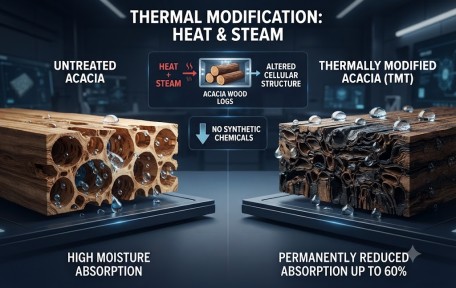
Managing raw material moisture levels and seasonal supply fluctuations is essential to preventing product defects in high-volume natural fiber manufacturing. Sustainable materials like bamboo, rattan, water hyacinth, seagrass, and acacia wood react dynamically to humidity and temperature shifts. Uncontrolled moisture causes mold, warping, and structural failure during long ocean transits.
- Kiln Drying & Moisture Control: Timber and rattan must maintain 8% to 12% moisture content to prevent cracking in cold importing climates.
- Anti-Mold Treatment: Eco-friendly, non-toxic treatment protocols preserve natural fibers like water hyacinth and seagrass during transit.
- Raw Material Buffer Management: Securing material stocks prior to monsoon seasons guarantees uninterrupted mass production.
High-volume buyers cannot tolerate batch-to-batch color or dimensional discrepancies. Professional manufacturers utilize automated industrial kilns and standardized weave jigs to ensure every item matches buyer specifications down to the millimeter.
By engineering natural materials for durability, exporters eliminate customer returns and protect retail display aesthetics. This technical rigor elevates handcraft manufacturing from cottage industry limitations to modern industrial reliability.
QUALITY ASSURANCE FRAMEWORKS AND ISTA PACKAGING COMPLIANCE
Implementing Acceptable Quality Limit (AQL 2.5) sampling protocols and ISTA 1A/3A packaging standards prevents transit damage and retail chargebacks. Transitioning to big-box supply chains requires moving from casual inspection to rigorous, documented quality control at every manufacturing stage.
|
QA Phase |
Standard Operating Protocol |
Key Objective |
|
IQC (Incoming Quality Control) |
Raw material moisture & dimensional testing |
Filter out sub-standard timber and unseasoned fiber. |
|
IPQC (In-Process Quality Control) |
Frame integrity and weave density checks |
Catch structural flaws before final finishing. |
|
FQC / OQC (Final & Outgoing QC) |
AQL 2.5 inspection & ISTA drop testing |
Ensure 100% compliance prior to container loading. |
Packaging for big-box retail is as important as the product inside. Single-item drop tests (ISTA 1A) and master carton stacking tests (ISTA 3A) simulate the harsh realities of global logistics, e-commerce fulfillment, and retail distribution centers.
Optimizing carton dimensions for container loadability significantly reduces freight costs per unit. High packaging density direct from the factory lowers carbon footprints while boosting gross margins for buyers.
SELECTING THE RIGHT DIRECT MANUFACTURING PARTNER FOR GLOBAL SCALE
Partnering with an experienced direct manufacturer in Vietnam provides global buyers with the capacity, certifications, and craft heritage required for big-box expansion. Middlemen and trading companies often add unnecessary costs, communication friction, and supply chain opacity. Direct factory collaboration guarantees full visibility over production timelines and ethical compliance.
Ngoc Dong Ha Nam stands as an industry leader with over 25 years of manufacturing excellence in sustainable home decor. Operating expansive, certified production facilities across Vietnam, we specialize in transforming bamboo, rattan, water hyacinth, seagrass, and acacia wood into market-ready collections for global retail leaders.
Preparing your supply chain for scale is not just about expanding volume; it is about building a resilient, ethical, and cost-efficient foundation. Contact our engineering and sales team today to review your OEM/ODM product specifications and receive an integrated manufacturing quote.
This piece is written by Thong Nguyen, Co-owner & Sales Director at Ngoc Dong Ha Nam Co., Ltd. Drawing on 25+ years of expertise in manufacturing export handicrafts, our team delivers premium bamboo, rattan, water hyacinth, and acacia solutions tailored for global retailers.
FREQUENTLY ASKED QUESTIONS
What social and environmental audits are required for big-box home decor sourcing?
Big-box retailers typically mandate BSCI (Amfori) or SMETA (Sedex) for social compliance, along with FSC certification for sustainable wood and natural fiber sourcing.
How do manufacturers prevent mold and damage in natural fiber products during ocean shipping?
Manufacturers maintain material moisture levels below 12% through industrial kiln drying, apply eco-friendly anti-mold treatments, and use desiccant packs inside sealed ISTA-compliant cartons.
What quality control standard is used for mass-produced handcrafted furniture?
High-volume retail orders are inspected using the AQL 2.5 (Acceptable Quality Limit) standard, covering structural integrity, dimensional accuracy, weave consistency, and finish quality.
Why is direct factory sourcing preferred over trading companies for big-box retail?
Direct factory sourcing eliminates middleman margins, provides direct transparent audit tracking, accelerates product customization (OEM/ODM), and ensures tight control over delivery lead times.