Teak vs. Acacia in Outdoor & Bath Décor: Achieving Premium Aesthetics at a Mass-Market Price Point
Essential Highlights
• Acacia wood provides a cost efficiency of 40% to 60% compared to Burmese Teak while delivering similar structural performance in high-humidity outdoor and bath environments.• Kiln-drying acacia to an optimal 8% to 12% moisture content prevents warping, surface checking, and fungal degradation in bath and patio furniture applications.
• Acacia achieves a Janka hardness rating of 1,750 lbf (7,780 N), surpassing Teak's 1,070 lbf (4,760 N) for superior scratch and dent resistance in high-traffic commercial spaces.
• FSC-certified fast-growing acacia plantations allow retail buyers to meet ESG mandates while scaling high-volume outdoor decor collections with predictable lead times.
EXECUTIVE SUMMARY AND TABLE OF CONTENTS
Acacia delivers luxury aesthetics and high moisture performance at a unit cost 40% to 60% lower than plantation or native Teak.
For global buyers, retail category managers, and hospitality interior designers, bridging the gap between high-end architectural appeal and commercial price viability remains a constant struggle. Teak (Tectona grandis) has long held the title as the benchmark hardwood for high-humidity and outdoor applications. However, supply constraints, rising tariffs, and strict deforestation regulations have pushed raw material costs beyond mass-market viability. Acacia wood (Acacia mangium / Acacia auriculiformis) offers the physical and visual characteristics needed to achieve a premium aesthetic at an accessible wholesale price point.
Table of Contents
- 1. Botanical & Mechanical Profiling: Teak vs. Acacia
- 2. Moisture Dynamics & Structural Integrity in Bath & Patio Environments
- 3. Commercial Cost Analysis & Value Engineering
- 4. Technical Specification & Performance Comparison Matrix
- 5. Technical Glossary & Supply Chain Risk Mitigation
BOTANICAL & MECHANICAL PROFILING: TEAK VS. ACACIA
Acacia exhibits higher mechanical hardness than Teak, boasting a Janka rating of 1,750 lbf compared to Teak's 1,070 lbf.
Why does Janka hardness matter in commercial procurement? Hardness dictates wear resistance. In high-traffic outdoor living and commercial bathroom environments, high Janka values prevent surface indentations, impact micro-fractures, and structural gouges. Acacia wood possesses a dense, interlocked grain structure that creates a robust physical barrier against mechanical damage. Teak offers exceptional natural oil saturation (tectoquinones), which renders it impervious to rot, but its lower surface hardness makes it softer under impact.
Can acacia replicate the golden-brown warmth of high-grade Teak? Yes. Through precise thermal modification, organic oil finishing, and tone staining, sustainably harvested acacia mimics the rich luster of Burmese Teak. The density profile of cured acacia ranges from 650 to 750 kg/m³, placing it in the same heavy-hardwood structural category as premium Teak (600–700 kg/m³).
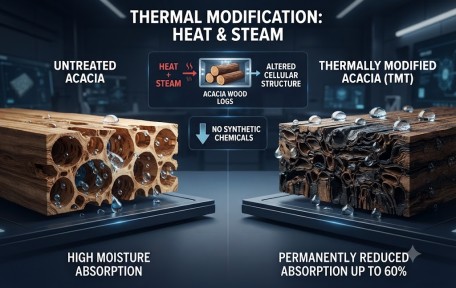
Microscopic cross-sectional analysis reveals that both timber species exhibit low open-vessel porosity when properly sealed, effectively blocking liquid ingress across high-humidity thermal cycles.
MOISTURE DYNAMICS & STRUCTURAL INTEGRITY IN BATH & PATIO ENVIRONMENTS
Properly kiln-dried acacia with a target moisture content of 8% to 12% guarantees dimensional stability in bath and outdoor environments.
Water absorption causes wood cell walls to swell, leading to warping, cupping, and joint separation. Is acacia stable enough for wet environments? Absolutely. When conditioned in vacuum kiln dryers to a target equilibrium moisture content (EMC) of 10% ± 2%, acacia's volumetric shrinkage coefficient drops below 4.5%. This controlled drying process removes bound water within cell lumens, locking structural dimensions before raw timber enters CNC cutting and joinery assembly.
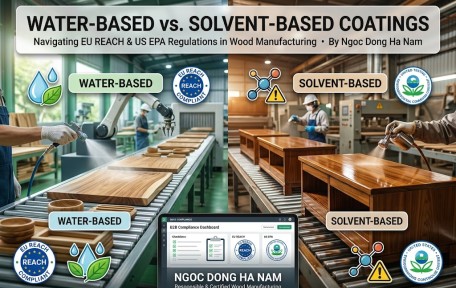
In outdoor shower trays, bathroom caddies, and patio dining sets, protective finishing seals the timber surface against standing water. Applying food-safe, hydrophobic polyurethane or natural linseed-tung oil blends creates a barrier that passes EN 71-3 and LFGB chemical migration standards. Factory quality controls must measure moisture using calibrated pinless moisture meters at five distinct points on every panel before final packing.
COMMERCIAL COST ANALYSIS & VALUE ENGINEERING
Acacia reduces raw material procurement expenditure by up to 60% relative to certified plantation Teak without compromising aesthetic value.
Why is Teak so expensive? Teak requires a growth cycle of 30 to 50 years to mature into harvestable timber, limiting global yields and driving up raw material costs. In contrast, fast-growing FSC-certified acacia plantations reach optimal harvesting maturity within 7 to 12 years. This rapid rotation creates a resilient supply chain with stable, predictable pricing for large-scale retail buying cycles.
Value engineering with acacia allows brand managers to allocate budget toward hand-woven natural accents such as seagrass, rattan, or water hyacinth inserts. Combined natural material furniture pieces appeal to modern eco-conscious consumers while maintaining high retail margins. Factory yield rates for acacia average 68% to 75%, compared to Teak's yield of 50% to 58%, further reducing cost overhead during high-volume production runs.
TECHNICAL SPECIFICATION & PERFORMANCE COMPARISON MATRIX
Acacia surpasses Teak in mechanical hardness while matching its performance when paired with advanced hydrophobic surface treatments.
To assist procurement teams and technical designers in material selection, the matrix below details key engineering metrics based on standardized ASTM and ISO testing protocols.
|
Technical Parameter |
Burmese / Plantation Teak |
Sustainably Farmed Acacia |
Testing Standard |
|
Janka Hardness Rating |
1,070 lbf (4,760 N) |
1,750 lbf (7,780 N) |
ASTM D143 |
|
Air-Dry Density |
600 - 700 kg/m³ |
650 - 750 kg/m³ |
ISO 3131 |
|
Target Moisture Content (MC) |
9% - 11% |
8% - 12% |
EN 13183-1 |
|
Volumetric Shrinkage |
2.6% - 3.4% |
3.8% - 4.5% |
ISO 4469 |
|
Harvest Maturity Cycle |
30 - 50 Years |
7 - 12 Years |
FSC Forest Protocol |
|
Raw Material Relative Cost |
100% (Baseline) |
40% - 60% Lower |
Global Timber Index |
|
Food Contact Compliance |
Native / Compliant |
LFGB & FDA Compliant |
LFGB / FDA 21 CFR |
Microscopic cross-section diagrams illustrate that kiln-dried acacia treated with non-toxic organic oil displays resin-plugged pore channels similar to Teak, blocking capillary water draw in bathroom environments.
TECHNICAL GLOSSARY & SUPPLY CHAIN RISK MITIGATION
Mitigating supply chain risk requires working with certified factories operating under BSCI, SMETA, and FSC chain-of-custody protocols.
Sourcing timber decor across international borders introduces regulatory and performance risks. Working with verified manufacturing partners ensures raw timber originates from legal, sustainably managed plantations compliant with the EU Deforestation Regulation (EUDR) and US Lacey Act. Factory-level compliance auditing under SMETA and BSCI guarantees ethical labor practices and environmental management system adherence throughout production.
Contextual Technical Glossary
- Kiln-Dried Moisture Content (MC): The percentage of water remaining in wood relative to its oven-dry weight, standardized between 8% and 12% for export bath and outdoor decor.
- Janka Hardness Test: Measures the resistance of a wood species to denting and wear by embedding a 0.444-inch steel ball into the timber.
- Equilibrium Moisture Content (EMC): The moisture content at which wood neither gains nor loses moisture when exposed to specific ambient temperature and relative humidity.
- LFGB / FDA Food-Safe Finish: Organic or synthetic sealants certified free of heavy metals and formaldehyde, allowing safe contact with skin or food.
- Chain of Custody (CoC): Verification tracking timber from certified sustainable forests through manufacturing to final retail packaging.
This piece is written by Thong Nguyen, Co-owner & Sales Director at Ngoc Dong Ha Nam Co., Ltd. Drawing on 25+ years of expertise in manufacturing export handicrafts, our team delivers premium bamboo, rattan, water hyacinth, and acacia solutions tailored for global retailers.
FREQUENTLY ASKED QUESTIONS
Why is Acacia a cost-effective alternative to Teak for outdoor and bath decor?
Acacia reaches harvest maturity in 7 to 12 years compared to 30+ years for Teak. This rapid growth reduces raw material expenditure by 40% to 60% while providing superior Janka hardness and excellent moisture resistance when properly sealed.
How does Acacia handle high humidity and water exposure in bath environments?
When kiln-dried to an optimal moisture content of 8% to 12% and finished with hydrophobic, food-safe coatings, Acacia resists warping, swelling, and fungal decay in high-humidity bath and patio settings.
Is Acacia wood eco-friendly and compliant with international trade regulations?
Yes, Acacia is sustainably cultivated in fast-growing FSC-certified plantations, making it fully compliant with the EU Deforestation Regulation (EUDR), US Lacey Act, and global ESG mandates.
What is the Janka hardness difference between Acacia and Teak?
Acacia features a Janka hardness rating of approximately 1,750 lbf (7,780 N), making it significantly harder and more dent-resistant than Teak, which measures 1,070 lbf (4,760 N).