
The Truth About Cheap Woodware: Technical Risks and Hidden Cost Analysis
Core Insights
• Purchasing low-cost woodware increases Total Cost of Ownership (TCO) by up to 35% through high destination failure rates, customer returns, and warranty claims.• Improper Equilibrium Moisture Content (EMC) control above 12% triggers wood swelling, joint shear stress failure, and severe warping during ocean transit.
• Cheap woodware frequently utilizes high-VOC urea-formaldehyde resin glues exceeding CARB Phase 2 and EU E1 safety thresholds.
• Precision kiln-drying and automated CNC machining keep structural tolerance within ±0.5 mm, eliminating field failures in commercial woodware.
THE TRUE COST OF SUB-STANDARD WOODWARE SOURCING
Low initial purchase prices in commercial woodware frequently conceal substantial financial risks that inflate the Total Cost of Ownership (TCO) by 25% to 35%. Procurement teams evaluating low-cost suppliers often overlook hidden expenses such as high destination defect rates, transit deformation, regulatory fines, and brand equity loss. What appears to be an attractive FOB price frequently transforms into a margin-killing supply chain liability.
Is a 15% upfront discount worth a 20% product rejection rate at your distribution center? When woodware fails structural or chemical specifications, the cost ripple effect impacts every node of your supply chain.
Understanding the physics, chemistry, and manufacturing tolerances behind solid wood and composite alternatives is critical for volume buyers. The table below illustrates the structural and economic differences between low-cost uncertified woodware and engineered commercial-grade products.
|
Metric / Feature |
Low-Cost Uncertified Woodware |
Engineered Commercial-Grade Woodware |
|
Equilibrium Moisture Content (EMC) |
14% - 18% (Unstable) |
8% - 11% (Kiln-Dried Controlled) |
|
Adhesive Formaldehyde Rating |
E2 / Untested (High VOC) |
CARB Phase 2 / EPA TSCA Title VI / E0 |
|
Dimensional Tolerance |
±2.5 mm to ±4.0 mm |
±0.3 mm to ±0.5 mm (CNC Machined) |
|
Structural Defect Rate (at Destination) |
12% - 18% |
< 0.8% |
|
Average TCO Premium |
+25% to +35% over FOB |
+2% to +5% over FOB |
MOISTURE CONTENT MISMANAGEMENT AND STRUCTURAL FAILURE MECHANICS
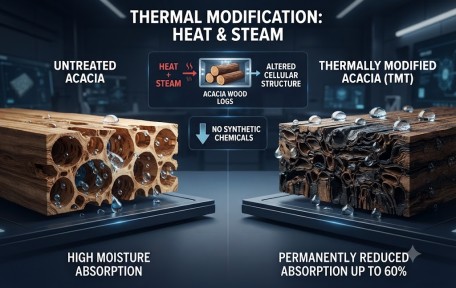
Inadequate moisture content management during industrial kiln drying is the leading physical cause of warping, checking, splitting, and joint detachment in solid woodware. Timber absorbs and desorbs ambient moisture until reaching equilibrium with surrounding relative humidity. When cheap suppliers rush kiln cycles to reduce energy consumption, internal stress builds within the cell wall matrix.
The Physics of Thermal and Moisture Gradient Deformation
Solid Acacia wood exhibits an average tangential shrinkage rate of 6.6% and radial shrinkage of 3.1%. When wood is shipped across variable climate zones—such as from Southeast Asian factories with 80% humidity to Western warehouses at 40% humidity—uncontrolled moisture release creates high differential tension. The outer cell walls contract rapidly while the saturated core remains expanded, generating microscopic tensile failures along the grain.
Why do cheap joints break during containerized transport? Container heat during maritime transit can exceed 60°C, accelerating moisture evaporation and causing joint glue lines to shear under mechanical strain.
Material Behavior Across Wood and Composite Categories
- Solid Acacia Wood: Highly dense (density approx. 650-750 kg/m³), requiring slow, multi-stage kiln drying to drop moisture from 50%+ green state down to 8%-10%. Rush-drying creates internal honeycombing and cup warping.
- Laminated Bamboo: High tensile strength (up to 40 MPa), but susceptible to delamination if adhesive curing temperatures fail to exceed 120°C under uniform hydraulic pressure.
- MDF with Wood Veneer: Low-cost MDF core boards absorb ambient moisture quickly, causing edge swelling up to 15% when exposed to relative humidity above 70%.
CHEMICAL NON-COMPLIANCE AND VOC OFF-GASSING VULNERABILITIES
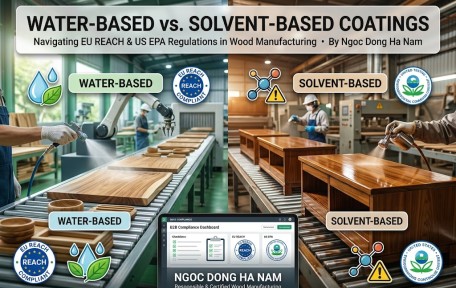
Sub-standard woodware products routinely utilize low-cost urea-formaldehyde (UF) glues and unverified solvent-based polyurethane topcoats that violate international chemical safety regulations. To cut production costs by $0.30 to $0.80 per unit, discount manufacturers bypass non-toxic water-based finishes and structural melamine-urea-formaldehyde (MUF) adhesives.
Formaldehyde Off-Gassing and Regulatory Penalties
Unregulated glues release free formaldehyde gas into retail environments and consumer spaces long after packaging is opened. Importing non-compliant woodware into North America or Europe violates the US EPA TSCA Title VI and European REACH regulations, triggering mandatory customs holds, container seizures, and substantial regulatory fines.
Are your timber vendors supplying verifiable third-party test reports for every batch? Synthetic finish coatings containing heavy metals like lead or cadmium present additional liability under California Proposition 65.
Chemical Integrity and Environmental Certification Comparison
|
Property |
Sub-Standard Material |
Certified Sustainable Material |
|
Adhesive Type |
Urea-Formaldehyde (UF) |
Polymeric MDI / MUF / Water-Based PVA |
|
VOC Emissions |
> 0.12 ppm (Exceeds Limit) |
≤ 0.03 ppm (CARB P2 / EPA Compliant) |
|
Coating System |
Solvent-Based Lacquer (High Heavy Metal Risk) |
Food-Safe Water-Based Acrylic or Organic Oils |
|
Timber Sourcing Traceability |
Unverified / High Deforestation Risk |
FSC-C123456 / Chain-of-Custody Certified |
|
Audit Standards |
None or Falsified Reports |
SMETA / BSCI Audited Facilities |
QUANTIFYING SUPPLY CHAIN RISK: A PRACTICAL DECISION FRAMEWORK
Calculating the true landed cost of commercial woodware requires procurement managers to evaluate manufacturing precision, quality assurance protocols, and factory capacity rather than basic unit pricing. A low unit price loses all commercial value when product defect rates force retail markdowns, replacement shipments, or air-freight penalties to fulfill consumer orders.
Machining Precision and Quality Control Protocols
Automated manufacturing with high-precision multi-axis CNC machinery maintains dimensional tolerances within ±0.3 mm. Manual cutting methods used in low-cost facilities result in variance exceeding ±3.0 mm, leading to assembly instability in knock-down furniture and irregular stacking in houseware items.
How do automated quality gates protect retail margins? Continuous inline moisture monitoring, automated optical sorting, and batch pull-testing eliminate defective units prior to container loading.
Evaluating Factory Capability Metrics
- Drying Infrastructure: Modern automated steam kiln capacity exceeding 1,000 m³ ensures stable 8-10% EMC output.
- Machining Tolerances: Precision CNC cutting equipment guaranteeing tolerance within ±0.5 mm for high-fit integrity.
- Audit and Traceability: Valid FSC Chain-of-Custody certification paired with annual BSCI or SMETA social responsibility audits.
- Testing Methodology: On-site laboratory testing for bond strength, cross-hatch adhesion, and moisture cycling resilience.
Partnering with vertically integrated, certified manufacturers guarantees long-term supply stability, pristine chemical compliance, and zero-defect delivery for global retail programs.
This piece is written by Thong Nguyen, Co-owner & Sales Director at Ngoc Dong Ha Nam Co., Ltd. Drawing on 25+ years of expertise in manufacturing export handicrafts, our team delivers premium bamboo, rattan, water hyacinth, and acacia solutions tailored for global retailers.
FREQUENTL
Y ASKED QUESTIONS
Why does cheap woodware warp and crack after ocean transit?
Cheap woodware warps and cracks due to high Equilibrium Moisture Content (EMC) caused by rushed kiln drying. During high-temperature ocean transit, rapid moisture evaporation creates severe internal tensile stress across the wood grain, forcing the material to cup, split, or delaminate.
What moisture content standard should global buyers require for woodware?
Global buyers should specify an Equilibrium Moisture Content (EMC) between 8% and 11% for North American and European markets. This target prevents dimensional instability, mold growth, and warping across varying humidity zones.
How do non-compliant glues in cheap woodware affect regulatory compliance?
Non-compliant glues often contain urea-formaldehyde, releasing volatile organic compounds (VOCs) that violate EPA TSCA Title VI, CARB Phase 2, and EU REACH standards. Importing non-compliant items risks customs seizure, product recalls, and severe financial penalties.
What is the average Total Cost of Ownership (TCO) penalty for buying low-cost woodware?
Buying low-cost uncertified woodware typically increases the Total Cost of Ownership by 25% to 35% over the initial FOB price. This hidden penalty stems from high defect rates (12-18%), warranty claims, destination sorting costs, and unscheduled air-freight replacements.