
Why FSC-100% Outperforms FSC-Mix for High-End Home Decor & Furniture Brands
Executive Brief
• FSC-100% certification guarantees 100% virgin timber sourced exclusively from responsibly managed, certified forests without uncertified material blending.• FSC-100% eliminates supply chain contamination risks associated with FSC-Mix controlled wood thresholds under EUDR regulations.
• High-end Acacia and wood home decor products using FSC-100% demonstrate higher physical structural homogeneity and consistent density profiles.
• Transitioning from FSC-Mix to FSC-100% reduces brand exposure to greenwashing claims and Lacey Act non-compliance penalties.
EXECUTIVE SUMMARY & TABLE OF CONTENTS
Why FSC-100% Outperforms FSC-Mix for High-End Home Decor & Furniture Brands
FSC-100% certification guarantees that 100% of the timber in a finished product originates from well-managed, certified forests, offering total material traceability that FSC-Mix cannot match. For luxury brands, relying on FSC-Mix creates unnecessary legal and reputational exposure under strict deforestation regulations. This technical guide analyzes the structural, legal, and environmental parameters distinguishing these two standards for B2B procurement.
Executive Summary
- Full Chain of Custody (CoC) Integrity: FSC-100% mandates zero inclusion of uncertified wood, while FSC-Mix allows up to 30% controlled wood inputs under percentage or credit systems.
- Regulatory Immunity: FSC-100% simplifies compliance with the European Union Deforestation Regulation (EUDR) and the U.S. Lacey Act by providing verified geolocation coordinates for 100% of harvested timber.
- Material Superiority: Premium Acacia timber sourced under FSC-100% protocols exhibits consistent density (650–750 kg/m³), optimal kiln-dried moisture content (8–12%), and predictable mechanical performance.
Table of Contents
- 1. Technical Definitions & Contextual Glossary
- 2. Chain of Custody (CoC) & Material Integrity Comparison
- 3. Structural & Material Performance Benchmarks
- 4. Regulatory & Legal Risk Quantification (EUDR, Lacey Act, ESG)
- 5. Procurement Roadmap for High-End Brands
1. TECHNICAL DEFINITIONS & CONTEXTUAL GLOSSARY
FSC-100% explicitly designates products constructed entirely from FSC-certified virgin material, whereas FSC-Mix permits combinations of certified wood, recycled fibers, and FSC Controlled Wood. Understanding these exact forestry certifications prevents costly mislabeling and compliance breaches. Why take risk with ambiguous material inputs?
Technical Terms and Definitions
- FSC-100%: Material originating strictly from FSC-certified forests that has undergone independent third-party audits confirming compliance with Principles and Criteria (FSC-STD-01-001).
- FSC-Mix: A label indicating that the product combines FSC-certified material, recycled material, and FSC Controlled Wood under specific accounting mechanisms (Percentage System or Credit System).
- FSC Controlled Wood (FSC-STD-40-005): Uncertified timber screened to avoid five unacceptable categories: illegally harvested wood, wood harvested in violation of traditional/civil rights, wood from forests with threatened high conservation values, wood from genetically modified trees, and wood from natural forest conversion.
- Equilibrium Moisture Content (EMC): The moisture level at which timber neither gains nor loses moisture when exposed to specific ambient air conditions. Targeted at 8–12% for premium export woodenware.
- Fiber Saturation Point (FSP): The moisture content (typically 25–30%) where wood cell walls are completely saturated with bound water while cell cavities contain no free water.
2. CHAIN OF CUSTODY (COC) & MATERIAL INTEGRITY COMPARISON
FSC-100% enforces complete physical separation throughout harvest, sawmilling, processing, and assembly, preventing uncertified fiber contamination. FSC-Mix uses administrative balancing methods that allow uncertified timber into your manufacturing pipeline. Can your high-end brand afford physical traceability gaps?
In high-end furniture and tableware manufacturing, material traceability directly impacts brand authority. When a luxury brand claims sustainability, buyers expect absolute verification. FSC-Mix allows manufacturers to aggregate credits across product lines, meaning a specific product labeled FSC-Mix may contain controlled wood harvested under minimal threshold criteria.
Below is a direct comparison of inputs, traceability metrics, and risk profiles between FSC-100% and FSC-Mix standards:
|
Metric / Parameter |
FSC-100% Specification |
FSC-Mix Specification |
|
Certified Material Ratio |
100% Virgin Certified Timber |
Minimum 70% Certified/Recycled (Percentage/Credit) |
|
Controlled Wood Allowance |
0% (Strictly Prohibited) |
Up to 30% Controlled Wood permitted |
|
Chain of Custody Protocol |
Physical Separation / Continuous Traceability |
Volume Credit Accounting or Percentage Allocation |
|
EUDR Geolocation Mapping |
Direct link to exact forest plot parcel ID |
Complex multi-source supply plot mapping required |
|
Batch-Level DNA Testing |
Fully verifiable species & origin profile |
Variable isotope/DNA signatures due to blending |
3. STRUCTURAL & MATERIAL PERFORMANCE BENCHMARKS
FSC-100% solid Acacia timber offers superior dimensional stability and structural density consistency compared to blended FSC-Mix material streams. Premium home decor requires predictable raw materials to withstand global climate transitions without warping or splitting. Structural failure ruins brand reputation fast.
Acacia wood sourced from FSC-100% managed plantations in Vietnam exhibits uniform density profiles ranging from 650 to 750 kg/m³. Controlled growth cycles yield tighter grain structures and lower internal growth stress. When manufacturers mix uncertified wood sources under FSC-Mix labels, timber age, density, and moisture absorption rates vary widely across a single production line.
Visualizing internal wood structure reveals these operational differences:
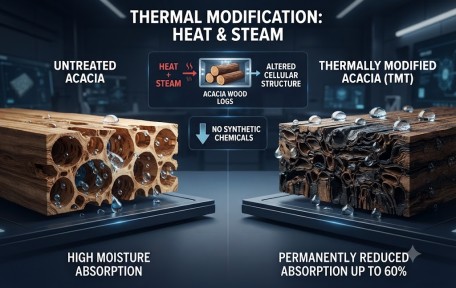
- FSC-100% Cross-Section Profile: Homogeneous vascular bundle distribution, uniform annual growth ring spacing (3–5 mm), consistent Janka hardness ratings (~7,100 N), and predictable response to kiln-drying protocols.
- FSC-Mix Macro Structure: Variable ring density, uneven resin canal concentration, potential micro-cracking during rapid humidity fluctuations due to differential swelling coefficients.
Precision manufacturing mandates strict mechanical tolerances. Kiln drying FSC-100% Acacia timber to 8–12% moisture content eliminates internal stresses, reducing post-assembly movement to under 0.15% across fiber grain directions under ISO 3130 testing standards.
4. REGULATORY & LEGAL RISK QUANTIFICATION (EUDR, LACEY ACT, ESG)
FSC-100% provides full, unblended documentation that directly satisfies EUDR mandatory geolocation rules and U.S. Lacey Act due care standards. Regulators now require precise proof of origin rather than aggregated volume estimations. FSC-Mix introduces verification friction during customs audits.
Under the European Union Deforestation Regulation (EUDR), importers must provide precise GPS coordinates for every plot of land where timber was harvested. FSC-Mix credit systems create compliance hurdles because batch processing blends wood from multiple origins. Is your legal team prepared to audit dozens of secondary timber sources for a single product line?
Consider the risk framework comparing legal and regulatory compliance factors:
|
Regulatory Framework |
FSC-100% Compliance Pathway |
FSC-Mix Compliance Risk |
|
EUDR (Regulation EU 2023/1115) |
Direct mapping to single certified forest plot; simplified due diligence statement. |
High auditing cost; requires tracking all secondary controlled wood sources. |
|
U.S. Lacey Act (16 U.S.C. §§ 3371–3378) |
Definitive species declaration and origin verification; complete protection against illegal harvest claims. |
Higher liability if controlled wood origin documentation is disputed during import checks. |
|
ESG Transparency & Audits (BSCI / SMETA) |
100% audit accuracy; straightforward supply chain mapping for investor disclosures. |
Partial audit coverage; requires secondary documentation for uncertified timber inputs. |
5. PROCUREMENT ROADMAP FOR HIGH-END BRANDS
Transitioning to FSC-100% requires aligning supplier verification protocols, establishing batch-level documentation, and executing direct factory audits. High-end brands can secure their supply chains in three actionable steps. Clean execution guarantees premium market positioning.
Step 1: Audit Current Raw Material Specifications
Review supplier Chain of Custody (CoC) certification scope. Ensure your OEM/ODM partners possess valid FSC CoC certificates specifically covering FSC-100% claims for solid wood and bamboo categories.
Step 2: Establish Technical Quality Control Parameters
Incorporate strict moisture content (8–12%), food-safe finishing (LFGB / FDA compliance), and FSC-100% bill-of-materials requirements into purchasing contracts. Require lot-specific FSC invoice line claims on all shipments.
Step 3: Partner with Integrated Manufacturers
Work directly with vertically integrated manufacturers who maintain direct relationships with FSC-certified forest owners. This eliminates intermediary markups and guarantees absolute material integrity from raw log to finished luxury decor.
This article was written by Thong Nguyen – Sales Director at Ngoc Dong Ha Nam Co., Ltd. Combining 25+ years of operational excellence with a deep passion for natural materials, we provide bespoke manufacturing and sourcing solutions for bamboo, rattan, and acacia products to our global partners.
FREQUENTLY ASKED QUESTIONS
What is the primary difference between FSC-100% and FSC-Mix?
FSC-100% guarantees that all timber in a product comes strictly from FSC-certified, responsibly managed forests. FSC-Mix allows a combination of FSC-certified wood, recycled material, and controlled wood up to specific threshold percentages.
Does FSC-100% guarantee compliance with EUDR regulations?
FSC-100% significantly streamlines EUDR compliance by providing full traceability and plot-level geolocation data for 100% of the timber, eliminating the complex verification required for blended FSC-Mix controlled wood.
Why do high-end interior brands prefer FSC-100% Acacia wood over FSC-Mix?
High-end brands choose FSC-100% Acacia for its superior structural consistency, uniform wood density (650–750 kg/m³), optimal moisture control (8–12%), and zero risk of greenwashing or regulatory penalties.
Is FSC-100% more expensive to source than FSC-Mix?
FSC-100% carries a slight raw material premium due to strict forest management and full separation protocols, but it significantly reduces long-term operational costs, product failure rates, and legal compliance risks.