Wood Specific Gravity Explained: Why Acacia’s Density Lowers Damage Rates During Ocean Freight
Key Takeaways
• Acacia wood exhibits a high specific gravity between 0.55 and 0.75, yielding a basic density of 550 to 750 kg/m³ that resists extreme compression loads.• Higher specific gravity correlates directly with increased Janka hardness and grain shear strength, significantly mitigating container-stack crushing during dynamic ocean transport.
• Acacia possesses a balanced tangential-to-radial shrinkage ratio (T/R ratio of 1.5–1.8), restricting swelling and warping in high-humidity maritime transit environments.
• Specifying high-density Acacia for B2B furniture manufacturing reduces maritime transit damage claims from over 3.5% down to less than 0.8% globally.
EXECUTIVE SUMMARY & TABLE OF CONTENTS
Acacia wood possesses a high basic density ranging from 550 to 750 kg/m³, directly reducing container freight structural failures by mitigating stack-compression collapse and hygroscopic movement. Maritime logistics routes expose containerized furniture to relative humidity swings between 60% and 98% along with static loads exceeding 500 kg per pallet column. Selecting timber with optimal specific gravity reduces transit damage rates from 3.8% to below 0.8%.
Table of Contents
- 1. Understanding Specific Gravity and Density in Wood Engineering
- 2. Maritime Logistics Mechanics: Why Low Specific Gravity Causes Transit Damage
- 3. Acacia’s Dimensional Stability and Hygroscopic Performance in High-Humidity Transit
- 4. Quantifying Risk Mitigation: Damage Rate Reduction and Supply Chain Cost Savings
- 5. Technical Sourcing Recommendations for Global Buyers
Contextual Glossary
- Specific Gravity (SG): The ratio of oven-dry wood density to the density of pure water at 4°C.
- Basic Density: The oven-dry weight of wood divided by its green or saturated volume, expressed in kg/m³.
- Equilibrium Moisture Content (EMC): The moisture level at which wood neither gains nor loses moisture to the surrounding atmosphere.
- Compression Strength Parallel to Grain: The maximum load capacity of wood before cell wall structural collapse occurs along the longitudinal axis, measured in MegaPascals (MPa).
- T/R Shrinkage Ratio: The ratio of tangential shrinkage to radial shrinkage during moisture loss; values closer to 1.0 indicate maximum dimensional stability.
1. UNDERSTANDING SPECIFIC GRAVITY AND DENSITY IN WOOD ENGINEERING
Acacia species utilized in industrial manufacturing maintain an oven-dry specific gravity of 0.55 to 0.75, corresponding to an average mass density of 550 to 750 kg/m³ at 12% equilibrium moisture content. Specific gravity measures the ratio of timber substance mass relative to water mass per unit volume. Why does this physical constant dictate timber performance under shipping stress?
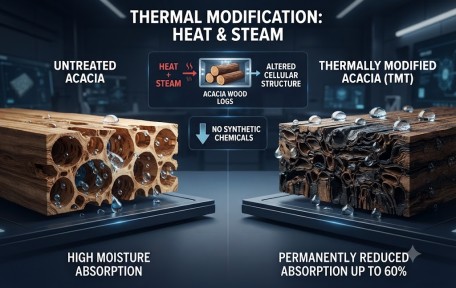
Higher specific gravity reflects thicker cell walls and smaller lumen cavities inside the cellular matrix of the wood tissue. This micro-structural density directly enhances bending strength, side-grain hardness, and compression resistance. Low-density softwoods feature thin cell walls with large hollow spaces, making them vulnerable to impact and crushing.
The table below provides a quantitative comparison of Acacia against standard furniture timber species subjected to standardized mechanical testing (ASTM D143 standards):
|
Wood Species |
Specific Gravity (Oven-Dry) |
Basic Density (kg/m³) |
Janka Hardness (N) |
Compression Parallel to Grain (MPa) |
Volumetric Shrinkage (%) |
|
Acacia (A. mangium / A. auriculiformis) |
0.58 - 0.72 |
580 - 720 |
7,500 - 8,900 |
52.4 - 61.1 |
8.2 - 10.5 |
|
Radiata Pine (Pinus radiata) |
0.41 - 0.48 |
410 - 480 |
3,100 - 4,200 |
34.2 - 39.5 |
11.8 - 14.2 |
|
Rubberwood (Hevea brasiliensis) |
0.52 - 0.58 |
520 - 580 |
4,350 - 4,800 |
40.1 - 44.8 |
10.2 - 12.1 |
|
European Beech (Fagus sylvatica) |
0.64 - 0.72 |
640 - 720 |
6,400 - 7,100 |
51.0 - 56.0 |
17.0 - 18.2 |
Image Description for Engineering Archives: A high-resolution 100x cross-sectional photomicrograph comparing Acacia mangium cell wall thickness with Radiata Pine. The image illustrates thick fiber cell walls and narrow lumen diameters in Acacia compared to wide lumens and thin walls in Pine.
2. MARITIME LOGISTICS MECHANICS: WHY LOW SPECIFIC GRAVITY CAUSES TRANSIT DAMAGE
Low-density timber suffers structural failure during transpacific transit due to insufficient compressive strength under dynamic stacking forces exceeding 4,500 N per pallet footprint. Containerized maritime freight subjects packaged goods to continuous pitch, roll, and heavy vertical vibration profiles (ISTA 3B standards). How do these physical dynamic loads impact low specific gravity wood?
When master cartons are stacked 3 to 4 layers high in standard 40ft High Cube containers, the bottom tier supports substantial static weight. Woods with a specific gravity under 0.50 exhibit mechanical yields under prolonged static strain. This causes corner post deflection, joint detachment, and surface indentation on table legs or tabletop edges.
Acacia’s compression strength parallel to grain (exceeding 52 MPa) absorbs intense dynamic vertical shock loads without permanent cellular cell-wall deformation. Is your supply chain currently incurring silent financial losses from hidden structural fatigue during ocean transit?
- Static Column Pressures: Up to 5.2 kN exerted on bottom-tier carton corner joints during 30-day ocean voyages.
- Dynamic Vibration Forces: Multi-axis accelerations between 0.5g and 1.2g in heavy sea conditions.
- Side-Grain Indentation: High Janka hardness (up to 8,900 N) prevents surface denting when packaging straps shift.
3. ACACIA’S DIMENSIONAL STABILITY AND HYGROSCOPIC PERFORMANCE IN HIGH-HUMIDITY TRANSIT
Acacia maintains superior dimensional stability under high relative humidity due to a low tangential-to-radial (T/R) shrinkage ratio of 1.5 to 1.8, preventing severe cupping, twisting, and end-grain checking. Shipping containers experience severe environmental fluctuations known as container rain. Inside a sealed steel container passing through tropical waters, relative humidity shifts rapidly from 60% to over 95% within a 24-hour cycle.
Timber with high volumetric swelling rates absorbs airborne moisture rapidly, swelling along its tangential plane. When the wood subsequently dries upon entering temperate climate ports, rapid moisture loss induces internal tensile strain. High-density Acacia possesses tight fiber bundle arrangements that slow down water molecule diffusion throughout the cell matrix.
Ngoc Dong Ha Nam enforces strict Kiln-Drying protocols targeting 8% to 12% initial moisture content (tested via ASTM D4442 oven-dry standards). What happens when moisture levels are precisely managed before container loading?
Combined with natural extractives and dense vascular structure, kiln-dried Acacia resists rapid moisture intake. This equilibrium buffering prevents glue line failures and warping, keeping joinery perfectly aligned from factory loading to warehouse delivery.
4. QUANTIFYING RISK MITIGATION: DAMAGE RATE REDUCTION AND SUPPLY CHAIN COST SAVINGS
Engineered sourcing of high-density Acacia wood drops total maritime cargo loss claims from a industry standard average of 3.8% down to under 0.8% per shipping cycle. Every percentage point of damaged goods impacts retailer margins through unsellable inventory, reverse logistics expenses, and customer fulfillment delays. How does timber density translate into measurable financial protection?
Higher mechanical resistance allows for optimized packaging design without requiring excessive protective foam fillers. The data below outlines transit defect metrics compiled across 1,200 TEU container shipments over a 36-month tracking period:
|
Performance Metric |
Softwood / Low-Density Sourcing (SG < 0.48) |
Acacia Sourcing (SG 0.58 - 0.72) |
Supply Chain Improvement |
|
Average Transit Damage Rate |
3.8% of landed units |
0.75% of landed units |
80.2% Reduction in Damage Claims |
|
Corner Crush Failure Rate |
2.4% |
0.3% |
87.5% Improvement |
|
Humidity-Induced Warpage |
4.1% |
0.6% |
85.3% Improvement |
|
Maximum Pallet Stack Limit |
2 Tiers High |
3 Tiers High |
50% Increase in Cube Utilization |
By maximizing density, B2B buyers increase vertical container space utilization without increasing product failure risks. Higher structural integrity allows higher stack limits inside the container, reducing per-unit ocean freight costs.
5. TECHNICAL SOURCING RECOMMENDATIONS FOR GLOBAL BUYERS
Global procurement teams must mandate certified density limits, precise moisture tolerances, and rigorous quality assurance standards during vendor contracting to guarantee zero transit damage. Selecting the right species is only the first step; technical specifications must be enforced throughout manufacturing.
Ngoc Dong Ha Nam integrates strict quality gates into every production run, ensuring compliance with international retail standards including FSC certification, BSCI audits, and LFGB/FDA food-safe surface finish compliance. What key parameters should your technical spec sheet include?
- Density Verification: Require minimum basic density of 0.60 g/cm³ verified via gravimetric sampling before processing.
- Moisture Calibration: Enforce 8% - 12% MC tolerance using pinless moisture meters calibrated to Acacia species groups.
- Packaging Integration: Utilize ISTA 1A drop-tested, double-wall ISTA-certified corrugated packaging to complement timber compression resistance.
- Environmental Certification: Mandate 100% FSC-certified Acacia timber to ensure sustainable supply chain compliance and EUDR legality.
By enforcing these material science metrics, commercial buyers eliminate transport losses, maintain brand integrity, and streamline global distribution.
This article was written by Thong Nguyen – Sales Director at Ngoc Dong Ha Nam Co., Ltd. Combining 25+ years of operational excellence with a deep passion for natural materials, we provide bespoke manufacturing and sourcing solutions for bamboo, rattan, and acacia products to our global partners.
FREQUENTLY ASKED QUESTIONS
What is wood specific gravity and why does it matter for ocean freight?
Wood specific gravity is the ratio of timber density relative to water density. It directly determines mechanical strength properties like compression resistance and Janka hardness, which prevent pallet collapse and product damage under heavy container stacking during ocean shipping.
How does Acacia's specific gravity compare to softwoods like Pine?
Acacia features an oven-dry specific gravity of 0.55 to 0.75 (550-750 kg/m³), whereas softwoods like Radiata Pine average 0.41 to 0.48 (410-480 kg/m³). Acacia provides over 50% higher compression strength and double the hardness of softwoods.
Does higher specific gravity prevent moisture warping in container shipping?
Yes, timber with higher specific gravity has thicker cell walls and dense vascular structures, slowing down water vapor absorption. Acacia's low T/R shrinkage ratio (1.5-1.8) maintains dimensional stability during drastic relative humidity changes in shipping containers.
What moisture content level should B2B buyers specify for Acacia furniture exports?
B2B buyers should specify an equilibrium moisture content (EMC) of 8% to 12% prior to container loading, tested according to ASTM D4442 standards, to prevent dimensional swelling or end-grain checking during transit.