Material Science& Technical Authority

Biodegradability Timeline: What happens to an Acacia bowl after 50 years?
Strategic Summary
• Under active soil conditions, an untreated Acacia bowl will fully biodegrade into organic humus within 24 to 36 months.
• When maintained in a controlled indoor environment with moisture levels below 15%, Acacia wood remains structurally stable for over 50 years.
• Acacia wood contains 23.67% lignin, which acts as a natural hydrophobic binder that resists enzymatic hydrolysis and prevents premature warping.
• Kiln-drying raw Acacia wood to a strict moisture content of 8% to 12% prevents cellular warping and microbial colonization during transoceanic shipping.
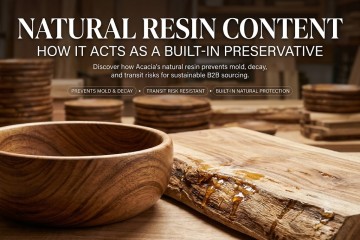
Natural Resin Content: How it acts as a built-in preservative.
Essential Highlights
• Natural resins and extractives in materials like Acacia wood establish a hydrophobic barrier that prevents fungal spore germination by keeping internal moisture below 15%.
• Materials with high extractive and lignin yields, such as Acacia and carbonized Bamboo, exhibit significantly lower Equilibrium Moisture Content (EMC) under humid conditions.
• Graduated, low-temperature kiln-drying schedules are essential for resin-rich woods to polymerize natural preservatives inside the cell walls without causing surface checking.
• Inherent resin barriers in natural materials mitigate the risk of container rain and mold outbreaks during long-distance maritime transit.
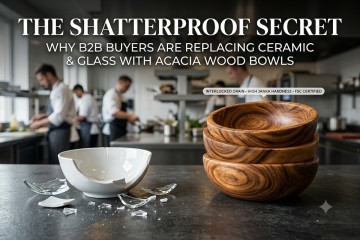
The Shatterproof Secret: Why Smart B2B Buyers Are Replacing Ceramic and Glass with Acacia Wood Bowls
Key Takeaways
• Acacia wood bowls do not shatter when dropped due to their unique interlocked grain structure, which disperses impact energy laterally.
• Boasting a Janka hardness of 1,750 to 2,300 lbf, Acacia outperforms traditional hardwoods like White Oak and Teak in terms of density and dent resistance.
• Replacing fragile ceramic or glass tableware with Acacia bowls reduces transit breakage rates to near-zero, significantly cutting supply chain replacement costs.
• Acacia is a highly sustainable, fast-growing hardwood option that easily complies with global B2B standards like FSC, BSCI, and SMETA.

Surface Roughness Standards: Achieving the Silk Touch Finish
Essential Highlights
• Achieving a premium Silk Touch finish requires reducing surface roughness (Ra) to below 0.8 micrometers through strict grit-progression protocols.
• Raw material moisture content must be tightly controlled between 8% and 12% to prevent grain raise during the sanding process.
• Sealing coatings must maintain a Dry Film Thickness of 40 to 60 microns to balance tactile feel with moisture protection.
• All finishing coatings applied to natural homeware must comply with global food-contact safety standards including FDA 21 CFR 175.300 and LFGB.
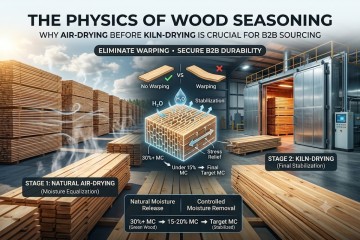
Wood Seasoning Physics: Why Air-Drying Before Kiln-Drying Is Crucial for B2B Sourcing
Strategic Summary
• Air-drying timber to its fiber saturation point of 30% moisture content before kiln-drying prevents cellular collapse and internal honeycombing.
• Combined seasoning reduces the final product defect rate from up to 35% down to less than 2% in high-density hardwoods like Acacia.
• Pre-seasoning wood naturally reduces kiln energy consumption by over 60%, significantly lowering production costs and carbon footprint.
• Maintaining a strict 8% to 12% Equilibrium Moisture Content prevents warping and joint failure during transoceanic shipping.
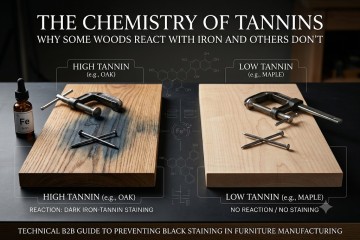
The Chemistry of Tannins: Why Some Woods React with Iron and Others Don't
Strategic Summary
• Iron staining occurs when soluble polyphenolic tannins in wood react with iron ions (Fe3+) in the presence of moisture, forming a dark blue-black ferric tannate complex.
• Acacia and Oak contain high tannin concentrations (5% to 12% dry weight), making them highly reactive to raw ferrous metals and requiring non-ferrous hardware.
• Bamboo and Rattan contain negligible tannin levels (under 0.1% dry weight) and do not undergo iron-tannin staining, offering excellent material stability for mixed-media designs.
• Preventing manufacturing defects requires maintaining wood equilibrium moisture content (EMC) below 12% and using Grade 304 or 316 stainless steel or brass fasteners.
• Controlled iron-tannin reactions can be utilized intentionally as a natural, chemical-free ebonizing stain for high-end, sustainable wood finishes.
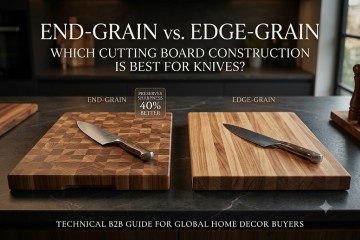
End-Grain vs. Edge-Grain: Which cutting board construction is best for knives?
Core Insights
• End-grain cutting boards preserve knife edge sharpness up to 40% longer than edge-grain boards due to their vertical fiber orientation.
• Edge-grain boards offer a highly durable, cost-effective alternative with lower initial manufacturing costs and superior dimensional stability.
• Compliance with FDA 21 CFR 175.300 and LFGB food safety standards is mandatory for export-grade Acacia and Bamboo cutting boards.
• A kiln-dried moisture content of 8% to 12% is critical to prevent warping, splitting, and structural failure during global transit.
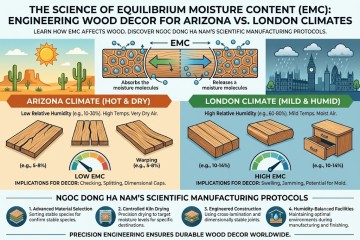
The Science of Equilibrium Moisture Content (EMC): Engineering Wood Decor for Arizona vs. London Climates
Key Takeaways
• Equilibrium Moisture Content (EMC) dictates that wood products must be manufactured to match the specific relative humidity of their destination climate to prevent structural failure.
• Arid climates like Arizona require wood dried to an ultra-low EMC of 4% to 7%, whereas maritime climates like London require a higher target EMC of 10% to 14%.
• Uncontrolled moisture exchange in wood causes anisotropic shrinkage and swelling, leading to severe warping, surface checking, and joint separation.
• Ngoc Dong Ha Nam mitigates climate risks using customized kiln-drying schedules, thermo-vacuum modification, and LFGB/FDA-compliant hydrophobic coatings.
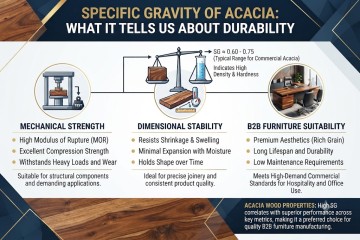
Specific Gravity of Acacia: What it tells us about durability
Key Takeaways
• Acacia wood exhibits a high specific gravity ranging from 0.47 to 0.74, which directly correlates to superior mechanical strength and indentation resistance.
• The low tangential-to-radial (T/R) shrinkage ratio of 1.5 to 1.8 ensures high dimensional stability, minimizing the risk of warping or cracking in fluctuating humidity.
• Acacia's mechanical performance, featuring a Janka hardness of up to 1,750 lbf and a Modulus of Rupture up to 137.5 MPa, makes it a highly cost-effective alternative to premium hardwoods like Oak and Teak.
• B2B procurement protocols must specify a target moisture content of 8-12% and D4-compliant bonding adhesives to guarantee long-term product durability in global markets.
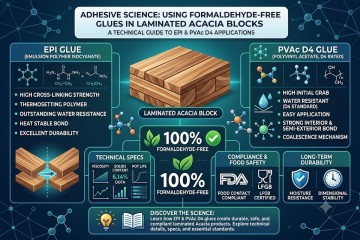
Adhesive Science: Using Formaldehyde-Free Glues in Laminated Acacia Blocks
Key Takeaways
• Formaldehyde-free adhesives, such as Emulsion Polymer Isocyanate (EPI) and D4-rated PVAc, eliminate toxic outgassing while achieving wood-shear failure rates exceeding 80% during mechanical testing.
• Laminated Acacia blocks bonded with NAF (No Added Formaldehyde) glues meet strict global standards including FDA 21 CFR 175.105, LFGB, and CARB Phase 2.
• Maintaining a wood moisture content of 8% to 12% during lamination prevents internal stresses and delamination under fluctuating environmental humidity.
• EPI adhesives form covalent urethane bonds with the hydroxyl groups in Acacia cellulose, providing superior water resistance compared to traditional urea-formaldehyde glues.
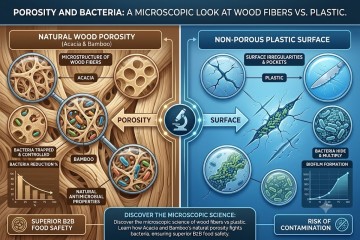
Porosity and Bacteria: A microscopic look at wood fibers vs. plastic.
Key Takeaways
• Wood possesses natural capillary action that draws bacteria deep into its fibrous matrix, depriving them of moisture and oxygen, resulting in rapid bacterial desiccation and death within hours.
• Plastic surfaces, while initially non-porous, rapidly develop microscopic scratches during standard B2B commercial use, creating highly sheltered reservoirs where bacteria form resilient biofilms that resist standard sanitization.
• Natural hardwoods like Acacia and engineered Bamboo contain natural antimicrobial extractives (tannins and quinones) that actively inhibit bacterial cellular replication, offering superior hygiene profiles for food-contact applications.
• Compliance with international standards such as LFGB, FDA, FSC, and SMETA is crucial for global B2B buyers to guarantee food safety, sustainable sourcing, and social compliance in high-volume supply chains.
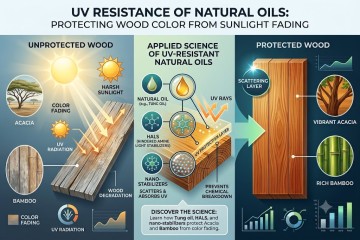
UV Resistance of Natural Oils: Protecting wood color from sunlight fading
Executive Summary
• Lignin photodegradation in wood (Acacia, Bamboo) is triggered by UV radiation (290-400 nm), causing visible color shifts (Delta E* >= 3.0) within 100 hours of direct sunlight exposure.
• Natural drying oils like Tung and Linseed oils with Iodine Values exceeding 130 undergo autoxidation and polymerization to form a dense protective barrier that slows down UV degradation.
• Synergistic formulations combining natural oils with organic Hindered Amine Light Stabilizers (HALS) and inorganic Nano-ZnO/TiO2 reduce color fading by up to 80%.
• B2B procurement specifications should require kiln-dried wood (8-12% MC) finished with FDA 21 CFR 175.300 compliant oils and verified via ASTM G154 accelerated weathering tests.
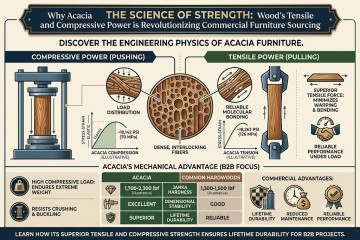
The Science of Strength: Why Acacia Wood Tensile and Compressive Power is Revolutionizing Commercial Furniture Sourcing
Key Takeaways
• Acacia wood possesses an exceptional Janka hardness rating of 1,100 to 1,750 lbf, outperforming traditional fast-growing hardwoods like Rubberwood and offering comparable durability to premium Oak and Teak.
• With a Modulus of Rupture (MOR) exceeding 120 MPa, Acacia furniture exhibits superior tensile strength, preventing joint failure and structural sagging under heavy bending loads in commercial environments.
• Acacia's high compressive strength parallel to the grain (50-65 MPa) ensures that load-bearing components like table and chair legs resist crushing and structural deformation over decades of use.
• Precision kiln-drying to an optimal 8-12% moisture content is critical to preserving Acacia's mechanical properties, preventing warping, splitting, and checking in variable global climates.
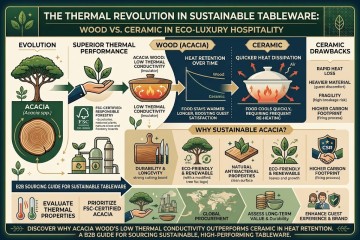
The Thermal Revolution in Sustainable Tableware: Why Wood is Outperforming Ceramic in Modern Eco-Luxury Hospitality
Key Takeaways
• Acacia wood possesses an exceptionally low thermal conductivity of approximately 0.12 to 0.16 W/m K, which is nearly fifteen times lower than that of traditional ceramic tableware.
• The microscopic cellular structure of Acacia wood contains millions of tiny trapped air pockets that act as a natural thermal barrier, preventing rapid heat dissipation.
• Using Acacia tableware in commercial hospitality environments significantly improves guest safety by keeping the exterior of hot food vessels cool to the touch.
• Sourcing FSC-certified and BSCI-compliant Acacia woodware from established manufacturers like Ngoc Dong Ha Nam ensures both environmental sustainability and superior durability over fragile ceramic alternatives.
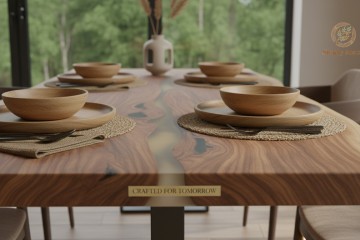
How to Source and Style Sustainable Wood Tabletop Collections for 2026
Key Takeaways
•Acacia and bamboo are the leading wood materials for 2026 tabletop designs due to their exceptional durability, rich aesthetics, and rapid renewability.
•FSC certification and SMETA or BSCI compliance are mandatory prerequisites for global B2B buyers sourcing natural homewares to ensure ethical and environmental standards.
•Biophilic design principles are driving consumer demand for raw, tactile wood textures, live edges, and food-safe natural finishes in dining spaces.
•Sourcing mixed-material collections that combine wood with rattan, seagrass, or water hyacinth maximizes market appeal and commands premium retail margins.
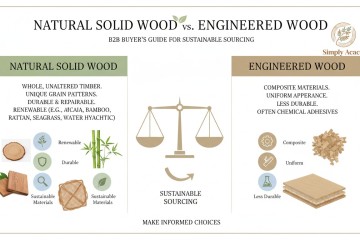
How to Tell the Difference Between Natural Solid Wood and Engineered Wood: A Guide for Global Buyers
Key Takeaways
•Natural solid wood features continuous grain patterns and visible end grains, unlike engineered wood which relies on edge banding.
•Engineered wood cannot be intricately carved without exposing its composite core, whereas solid wood offers seamless carving and robust traditional joinery.
•Solid wood contains natural imperfections such as knots and color variations that are difficult to replicate authentically in manufactured boards.
•Sourcing FSC-certified natural solid wood ensures environmental sustainability and compliance with global B2B standards like BSCI and SMETA.
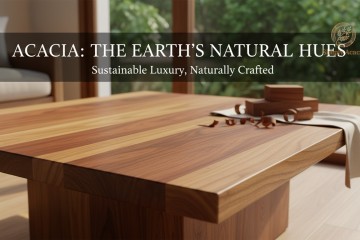
How to Master the Natural Color Palette of Acacia: A Guide from Amber to Deep Espresso
Introduction: Unlocking the Versatility of Acacia Wood in Global Decor
As the Marketing Director and Sustainable Supply Chain Consultant at Ngoc Dong Ha Nam, I have witnessed firsthand the transformative power of natural materials in global interior design. Among these, Acacia wood stands out as a true chameleon. Capturing the essence of biophilic design, Acacia offers a breathtaking natural color palette that ranges from radiant golden amber to luxurious deep espresso. For global buyers, procurement officers, and interior designers, understanding how to leverage this spectrum is critical for curating collections that resonate with today's eco-conscious consumers.
The modern consumer is moving away from uniform, synthetic finishes, instead craving the authentic, perfectly imperfect beauty of nature. Acacia wood answers this call effortlessly. Its dynamic grain patterns and rich color variations provide a unique narrative for every single SKU, turning everyday homewares and furniture into bespoke pieces of art. However, effectively merchandising and styling this diverse wood requires a strategic approach. This guide will walk you through the exact steps to source, select, and style the complete color palette of Acacia wood, ensuring your next B2B collection is both visually stunning and commercially successful.
The Value of Acacia in B2B Procurement
Before diving into the styling steps, it is essential to recognize why Acacia is dominating international trade shows. It is a highly durable, fast-growing hardwood that boasts natural water resistance and antibacterial properties. This makes it an ideal candidate for everything from high-traffic hospitality furniture to delicate kitchenware. By mastering its color palette, you can create cohesive, cross-category collections that appeal to diverse aesthetic preferences, maximizing your return on investment and solidifying your brand's reputation as a purveyor of premium, sustainable goods.
Prerequisites: Essential Sourcing Standards and Material Knowledge
Before integrating the diverse hues of Acacia into your product lines, global buyers and interior designers must establish a foundation of sustainable and ethical sourcing. At Ngoc Dong Ha Nam, we emphasize that beautiful design must always be matched by responsible supply chain practices. You cannot successfully market the natural beauty of Acacia without guaranteeing the protection of the environment from which it came.
1. Navigating Sustainability Certifications
Your first prerequisite is ensuring that all Acacia wood sourced for your collections is FSC-certified (Forest Stewardship Council). This globally recognized certification guarantees that the timber is harvested from responsibly managed forests, preserving biodiversity, preventing deforestation, and benefiting local communities. Furthermore, you must align with manufacturing partners who adhere strictly to BSCI (Business Social Compliance Initiative) and SMETA (Sedex Members Ethical Trade Audit) standards. These frameworks ensure fair labor practices, safe working conditions, and ethical supply chain management, thereby mitigating risk and protecting your brand's reputation in the global market.
2. Understanding Wood Anatomy: Sapwood vs. Heartwood
To truly master the Acacia color palette, you must understand its biological structure. The lighter, golden amber and honey tones typically originate from the sapwood—the outer, living layers of the tree that transport water and nutrients. In contrast, the deep, rich espresso, mocha, and chocolate hues are found in the heartwood—the dense, mature inner core of the trunk. Recognizing this natural variation is crucial for setting accurate quality control (QC) expectations with your suppliers and for educating your end consumers. Embracing the contrast between sapwood and heartwood allows you to celebrate the material's authenticity rather than viewing color variation as a defect.
Step 1: Harnessing Golden Amber Tones for Warm, Organic Collections
The first step in utilizing the Acacia palette is to embrace its lightest, most radiant hues: golden amber and soft blonde. These colors are predominantly found in the sapwood and are highly sought after for contemporary, light-filled interior design schemes.
Target Aesthetics: Japandi and Scandinavian Design
Amber Acacia is the perfect foundation for Japandi and Scandinavian design trends, which prioritize minimalism, warmth, and an unpretentious connection to nature. The golden undertones of the wood bring a sense of cozy brightness to a room without overwhelming the space. For interior designers, specifying amber Acacia for statement dining tables, minimalist shelving units, or organic-shaped coffee tables can instantly elevate a room's sense of tranquility.
B2B Sourcing and Finishing Tips
When sourcing amber Acacia for your B2B collections, request that your manufacturing partners use clear, water-based, or natural oil finishes. Avoid heavy nitrocellulose lacquers that can yellow over time and obscure the wood's delicate grain. A matte or satin finish will preserve the raw, tactile quality of the wood, appealing to consumers who desire a highly organic look and feel. Additionally, consider merchandising these lighter wood pieces alongside soft, neutral textiles like unbleached linen and organic cotton to create a cohesive, inviting catalog presentation.
Step 2: Curating Mid-Tone Honey and Caramel for Transitional Decor
As we move deeper into the Acacia trunk, the colors transition into rich, warm mid-tones of honey, caramel, and light walnut. This is where the true versatility of Acacia shines, offering a bridge between stark modernism and heavy traditionalism.
The Power of Transitional Merchandising
Mid-tone Acacia is the workhorse of the home decor industry. It is universally appealing and fits seamlessly into transitional decor—a style that blends classic elegance with modern lines. For global buyers, investing in honey and caramel Acacia SKUs is a safe, high-volume play. These tones work beautifully for bedroom suites, home office desks, and kitchen islands. The mid-tones also highlight the mesmerizing, interlocking grain patterns that Acacia is famous for, providing a visual texture that synthetic veneers simply cannot replicate.
Embracing Natural Contrast
Step 2 also involves learning to love the contrast. Many Acacia boards will feature a striking juxtaposition of lighter sapwood and darker heartwood on the same piece. Rather than sorting these out, leading design houses are celebrating this "wild grain" look. When developing your product specifications, clearly define the acceptable ratio of sapwood to heartwood. Educate your sales teams to market this dual-tone effect as a hallmark of genuine, high-quality solid wood, turning a natural characteristic into a premium selling point.
Step 3: Elevating Spaces with Deep Espresso and Mocha Finishes
The third step takes us to the heartwood of the Acacia tree, where the colors deepen into luxurious espresso, dark chocolate, and rich mocha. These dark tones exude sophistication, grounding a space and providing a sense of established luxury.
Targeting the Premium and Corporate Sectors
Deep espresso Acacia is highly effective when targeting the premium hospitality sector, boutique hotels, and executive corporate environments. Dark academia and modern luxury trends lean heavily on these profound, moody hues. An espresso-toned Acacia credenza or a dark-stained boardroom table projects authority, resilience, and refined taste. For B2B buyers, incorporating a "Dark Collection" allows you to capture a higher price point and appeal to high-end interior design firms.
Achieving the Perfect Dark Finish Sustainably
While some older Acacia trees naturally possess very dark heartwood, achieving a uniform espresso color across a large production run often requires staining or thermal modification. As a sustainable supply chain consultant, I strongly advise buyers to specify eco-friendly, low-VOC (Volatile Organic Compound) stains. Thermal modification—a process that uses heat and steam to naturally darken the wood entirely through its core without chemicals—is an excellent, sustainable alternative that also increases the wood's dimensional stability. Partnering with suppliers who utilize these advanced, green technologies ensures your dark Acacia collections remain environmentally responsible.
Step 4: Blending Acacia Colors with Bamboo, Rattan, and Seagrass
The final, and perhaps most innovative, step is to integrate the Acacia color palette with other sustainable, natural materials. At Ngoc Dong Ha Nam, our expertise lies in the seamless combination of robust woods with delicate, hand-woven fibers. This cross-material approach creates multi-dimensional products that stand out in a crowded global marketplace.
Creating High-Contrast Textural Masterpieces
Imagine the striking visual impact of a deep espresso Acacia serving tray featuring intricately woven, light-blonde Seagrass handles. Or consider a mid-tone caramel Acacia lounge chair backed with tightly woven, natural Rattan cane. By pairing the solid, smooth surface of Acacia with the tactile, organic texture of Bamboo, Water Hyacinth, or Rattan, you create products that engage multiple senses. This technique is particularly effective for home accessories, lighting fixtures, and accent furniture.
Strategic Sourcing for Mixed-Material SKUs
Developing mixed-material products requires a highly capable and integrated supply chain. When sourcing these items, ensure your manufacturing partner has in-house expertise in both woodworking and traditional weaving techniques. This prevents the logistical nightmares and quality control issues associated with outsourcing different components to multiple factories. By centralizing production with a vendor like Ngoc Dong Ha Nam, who holds BSCI, SMETA, and FSC certifications, you guarantee that every element of your mixed-material product—from the amber Acacia base to the woven Bamboo accent—meets the highest global standards for quality and sustainability.
Conclusion: Partnering for Sustainable, Trend-Setting Acacia Collections
Mastering the natural color palette of Acacia wood—from the lightest amber to the deepest espresso—empowers global buyers and interior designers to create dynamic, sustainable, and highly marketable home decor collections. By understanding the biological origins of these colors, respecting the natural variations of the wood, and demanding rigorous sustainability certifications like FSC, BSCI, and SMETA, you can elevate your brand and meet the evolving demands of the eco-conscious consumer.
Whether you are curating a minimalist Japandi collection featuring radiant sapwood, or a luxury hospitality line utilizing deep, thermally modified heartwood, Acacia offers unparalleled versatility. Furthermore, by taking the final step to blend Acacia with other sustainable materials like Rattan, Seagrass, and Bamboo, you unlock entirely new avenues for innovative product design.
At Ngoc Dong Ha Nam, we are dedicated to helping our global B2B partners navigate this beautiful spectrum. With our deep expertise in sustainable supply chains and premium craftsmanship, we are ready to bring your next visionary collection to life. Embrace the full palette of nature, and let Acacia wood be the foundation of your future success.
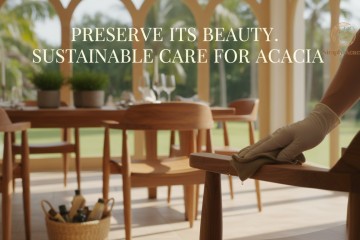
State of Acacia in Outdoor Settings: Maintenance Trends and Future Outlook for Patio Furniture
Executive Summary: The Resurgence of Acacia Wood in Global Outdoor Living
Welcome to the 2026 state of the industry report on sustainable outdoor living materials. For global buyers, procurement specialists, and leading interior designers, the outdoor furniture sector represents a critical growth vector. Among the myriad of materials available, Acacia wood has emerged as a dominant force, striking an unprecedented balance between aesthetic brilliance, structural durability, and commercial viability.
As the Marketing Director and Sustainable Supply Chain Consultant for Ngoc Dong Ha Nam, I have witnessed firsthand the exponential rise in demand for responsibly sourced Acacia patio furniture. However, the true value of Acacia is unlocked only through comprehensive lifecycle management. This trend report delves deep into the essential maintenance protocols, market shifts, and sustainable sourcing strategies that define Acacia in outdoor settings today.
By understanding the intersection of material science and environmental stewardship, B2B stakeholders can confidently specify Acacia, ensuring end-user satisfaction, mitigating return rates, and aligning with global ESG (Environmental, Social, and Governance) mandates. Our analysis follows the trajectory of Acacia from raw, FSC-certified timber to the centerpiece of luxury patio designs, providing actionable insights for the modern supply chain. The future of outdoor decor is green, resilient, and meticulously maintained.
Current Landscape: Assessing Acacia's Role in Modern Patio Settings
To fully appreciate the maintenance requirements of Acacia wood, we must first understand its current positioning in the global home decor landscape. Acacia is a dense, highly durable hardwood naturally endowed with a rich concentration of natural oils and resins. These inherent properties make it intrinsically resistant to moisture, rot, and insect infestation, positioning it as a formidable rival to traditionally favored, yet increasingly cost-prohibitive, woods like Teak.
In the current market, interior designers favor Acacia for its dynamic grain patterns and warm, multidimensional hues, which seamlessly bridge the gap between rustic charm and contemporary minimalism. However, the current landscape also reveals a critical knowledge gap at the consumer level regarding patio furniture care. When exposed to the relentless triad of UV radiation, fluctuating humidity, and seasonal precipitation without adequate protection, Acacia's natural defenses can be compromised.
The Maintenance Challenge
The industry is currently witnessing a paradigm shift where B2B buyers are no longer just purchasing products; they are investing in product longevity. The baseline maintenance standard currently involves bi-annual cleaning using non-abrasive, pH-neutral solutions, followed by the application of specialized hardwood oils. Yet, the challenge remains: how do we elevate these maintenance practices from reactive to proactive?
For bulk buyers and retailers, the aesthetic degradation of untreated outdoor furniture directly correlates with brand perception. Consequently, there is a growing imperative for manufacturers to deliver Acacia furniture with superior, factory-applied protective finishes that delay the onset of weathering, while simultaneously equipping the retail tier with robust, easy-to-follow maintenance education for the end consumer. A well-maintained Acacia dining set is not just a piece of furniture; it is a testament to sustainable living.
Key Trends in Acacia Maintenance and Sustainable Sourcing
The trajectory of Acacia in outdoor settings is being shaped by several converging trends, deeply rooted in both technological advancement and ethical consumption. The modern buyer demands performance without compromising the planet.
Technological and Aesthetic Shifts
Advanced Nano-Coatings: We are moving away from traditional, high-VOC (Volatile Organic Compounds) varnishes towards advanced, water-based nano-coatings. These innovative sealants penetrate the dense cellular structure of the Acacia wood, providing a breathable yet highly effective barrier against UV degradation and moisture ingress. This trend directly addresses the maintenance pain points of the end-user, significantly extending the intervals between required oiling treatments.
The 'Graceful Aging' Aesthetic: While some consumers prefer to maintain the original honey-golden luster of fresh Acacia through rigorous oiling, a growing segment of top-tier interior designers is embracing the natural silver-grey patina that develops when the wood is intentionally left to weather. This shift requires a different maintenance approach—focusing on structural integrity and anti-fungal treatments rather than color preservation.
The Rise of ESG Compliance
Perhaps the most profound trend dictating the B2B procurement of Acacia is the non-negotiable demand for sustainable and ethical supply chains. Global buyers are under intense scrutiny to ensure their sourcing practices do not contribute to deforestation or human rights abuses. This is where international certifications become paramount.
At Ngoc Dong Ha Nam, our Acacia is exclusively sourced from FSC (Forest Stewardship Council) certified forests, guaranteeing environmental responsibility. Furthermore, our production facilities adhere strictly to BSCI (Business Social Compliance Initiative) and SMETA (Sedex Members Ethical Trade Audit) standards. This dual commitment ensures that every piece of Acacia furniture not only meets the highest physical maintenance standards but also aligns with the stringent ESG criteria demanded by today's conscientious global market.
Future Outlook: Innovations in Weatherproofing and Longevity
Looking toward the horizon of 2026 and beyond, the future of Acacia outdoor furniture is intrinsically linked to the principles of the circular economy and advanced material engineering. The desire for seamless indoor-outdoor living spaces continues to blur the lines between interior and exterior design, demanding patio furniture that exhibits the refinement of indoor pieces while withstanding the harsh realities of the outdoors.
Smart Finishes and Circular Design
We anticipate a surge in the development of 'smart' bio-based finishes—sealants derived from natural plant waxes and resins that mimic the wood's natural defenses, offering unprecedented weatherproofing without compromising the material's organic tactile qualities. These eco-friendly treatments will define the next generation of premium outdoor living.
Data-Driven Procurement
Furthermore, the future outlook suggests a shift in how B2B buyers evaluate supplier partnerships. The focus will move from mere transactional purchasing to collaborative lifecycle management. Suppliers will be expected to provide comprehensive digital documentation of their products, detailing the exact origin of the Acacia, the specific chemical composition of the factory finish, and predictive maintenance schedules based on varying global climates.
This data-driven approach will empower interior designers to specify Acacia with absolute confidence, knowing precisely how the material will behave and what maintenance it will require over a ten or twenty-year lifespan. As climate patterns become increasingly unpredictable, the inherent resilience of Acacia, coupled with these next-generation maintenance protocols, will solidify its position as the premier choice for sustainable, luxury outdoor settings.
Strategic Recommendations for Global Buyers and Designers
To capitalize on the enduring appeal and profitability of Acacia outdoor furniture, B2B stakeholders must adopt a proactive, informed approach to sourcing and maintenance education. Here are the strategic imperatives for buyers and interior designers seeking to lead the market.
Actionable Procurement Strategies
Institutionalize Sourcing Standards: Mandate that all Acacia procurement is backed by verifiable FSC certifications. Partner exclusively with manufacturers who operate under transparent, BSCI and SMETA audited frameworks. This mitigates supply chain risk and elevates your brand's ethical standing in a competitive marketplace.
Redefine the Product Offering with Maintenance in Mind: Do not just sell a piece of furniture; sell a lifecycle. Collaborate with manufacturers to specify premium, low-VOC factory finishes that offer immediate weather resistance. Simultaneously, develop comprehensive, beautifully designed 'Care Guides' to accompany every retail unit or design installation. Educate your clients on the necessity of seasonal cleaning, the correct application of hardwood oils, and the importance of using breathable furniture covers during extreme weather.
Embrace the Design Versatility: Interior designers should leverage Acacia's dual aesthetic potential. Present clients with the choice between maintaining the warm, original finish through regular upkeep, or allowing the wood to transition into a sophisticated, low-maintenance silver patina. Setting expectations early ensures long-term client satisfaction.
Forge Strategic Manufacturer Partnerships: Move beyond the traditional buyer-vendor dynamic. Engage with forward-thinking manufacturers like Ngoc Dong Ha Nam, who deeply understand the nuances of natural materials—not just Acacia, but also Bamboo, Seagrass, Rattan, and Water Hyacinth. By aligning with experts who prioritize both world-class craftsmanship and sustainable lifecycle management, you ensure that your outdoor furniture portfolios remain competitive, resilient, and deeply resonant with the eco-conscious consumer of tomorrow.

Future Trends in Houseware: The Strategic Fusion of Sustainable Acacia Wood and Premium Marble
Executive Summary: The Rise of 'Quiet Luxury' in Sustainable Houseware
The Dawn of a New Material Synergy
In the highly competitive world of B2B houseware sourcing and global interior design, a profound shift is underway. The modern consumer's appetite for 'quiet luxury'—an aesthetic defined by understated elegance, premium quality, and rigorous sustainability—has forced a reimagining of traditional material palettes. At the forefront of this movement is the compelling juxtaposition of sustainable Acacia wood and premium marble. As the Marketing Director and Sustainable Supply Chain Consultant for Ngoc Dong Ha Nam, I have witnessed firsthand how this specific pairing has evolved from a niche design experiment into a dominant force in global sourcing catalogs.
This trend report explores the strategic value of combining the warm, organic resilience of Acacia with the cool, timeless sophistication of marble. For global buyers, procurement officers, and interior designers, understanding the market dynamics, supply chain implications, and design versatility of this perfect pair is no longer optional; it is essential for curating collections that resonate with eco-conscious, luxury-driven consumers. By marrying robust natural materials with internationally recognized ethical manufacturing standards like BSCI, FSC, and SMETA, brands can deliver products that are not only visually stunning but fundamentally responsible.
Current Landscape: The Shift Toward Refined Naturalism in B2B Sourcing
Market Dynamics and Material Economics
The current global home decor market is heavily influenced by 'Biophilic Design' and 'Refined Naturalism.' Consumers are actively seeking products that bring the outside in, but they demand a level of sophistication that raw, unfinished rustic pieces cannot provide. This is where the Acacia and marble fusion excels. Acacia wood, renowned for its rapid growth cycle and natural resistance to moisture and decay, provides an incredibly durable and sustainable foundation. Its rich, contrasting grain patterns offer a visual warmth that immediately softens any interior space.
Supply Chain Resilience and Ethical Compliance
From a B2B sourcing perspective, the current landscape demands rigorous risk mitigation and supply chain transparency. Acacia is highly favored by global buyers because, when sourced correctly, it boasts unimpeachable environmental credentials. At Ngoc Dong Ha Nam, we champion FSC-certified Acacia, ensuring that every piece of timber contributes to responsible forestry management. When this sustainable wood is paired with marble—a material celebrated for its longevity and thermal mass—the resulting product achieves a high perceived value. However, manufacturing these multi-material products requires sophisticated engineering. The bonding of porous wood and dense stone necessitates advanced, non-toxic adhesives and precision milling. Furthermore, global buyers are increasingly mandating that these complex manufacturing processes occur within ethically audited facilities. Compliance with BSCI (Business Social Compliance Initiative) and SMETA (Sedex Members Ethical Trade Audit) is currently the baseline for entry into premium Western markets, ensuring that the artisans crafting these luxurious pieces operate in safe, fair, and equitable conditions.
Key Trends: High-Impact Applications of the Acacia-Marble Fusion
Trend 1: Elevated Entertaining Essentials and Tablescaping
The most explosive growth in the Acacia-marble category is within the dining and entertaining sector. Charcuterie boards, serving platters, and oversized coasters are dominating wholesale orders. The functional synergy here is unmatched: the marble sections provide a naturally cool surface ideal for preserving the integrity of artisanal cheeses and cured meats, while the Acacia wood sections offer a knife-friendly, naturally antibacterial zone for cutting and serving. Interior designers are utilizing these pieces not just as kitchenware, but as sculptural centerpieces that anchor a dining room's aesthetic.
Trend 2: Sculptural Kitchen Organization
Gone are the days when kitchen storage was hidden away. The contemporary kitchen is a focal point of the home, and buyers are sourcing organizational tools that double as decor. We are seeing a massive uptick in demand for airtight kitchen canisters featuring heavy marble bodies with beautifully turned Acacia wood lids, complete with silicone seals for freshness. Spice racks, utensil holders, and cookbook stands utilizing this material mix offer a tactile contrast that elevates the everyday culinary experience. The heavy marble bases provide stability, while the Acacia accents tie the pieces to broader wooden cabinetry and flooring trends.
Trend 3: Spa-Inspired Bath Accessories
The 'spa-ification' of the residential bathroom is a macro-trend driving significant B2B purchasing. Buyers are moving away from plastics and resins, leaning heavily into natural materials to create serene, wellness-focused environments. Acacia and marble soap dispensers, vanity trays, toothbrush holders, and tissue box covers are highly sought after. Acacia's natural oils make it uniquely suited to withstand the humid environment of a bathroom without warping, while marble introduces an element of classical cleanliness and luxury. This combination allows designers to bridge the gap between organic warmth and clinical sterility, achieving the ultimate sanctuary aesthetic.
Future Outlook: Sustainability, Traceability, and the Circular Economy
Innovating for a Zero-Waste Future
Looking ahead, the future of the Acacia and marble fusion lies in hyper-traceability and circular manufacturing processes. The next generation of global buyers will not only ask for FSC certification but will demand granular data on the carbon footprint of the entire product lifecycle. Forward-thinking manufacturers are already pioneering methods to utilize marble offcuts and Acacia wood scraps from larger furniture production lines to create these smaller houseware items, effectively moving towards a zero-waste manufacturing model. This 'upcycling' approach significantly lowers the environmental impact while maintaining the premium positioning of the materials.
Technological Advancements in Multi-Material Bonding
As we project into the next three to five years, we anticipate significant advancements in eco-friendly adhesives and joinery techniques. The challenge of combining a living material like wood, which expands and contracts with humidity, with a static material like stone is complex. Future trends will showcase innovative mechanical joinery—such as hidden dowels and interlocking precision cuts—that reduce reliance on chemical glues, further enhancing the eco-friendly profile of the products. Brands that can communicate this level of artisanal engineering and sustainable innovation will capture the highest echelon of the interior design market.
Strategic Recommendations: Sourcing the Perfect Pair for Your Next Collection
Actionable Sourcing Strategies for Global Buyers
To successfully integrate the Acacia and marble trend into your upcoming retail collections or interior design projects, a strategic sourcing approach is paramount. First, unequivocally demand FSC certification for all wood components. This is non-negotiable for brand protection and consumer trust in today's market. Second, scrutinize the manufacturing partner's social compliance records. Request up-to-date BSCI or SMETA audit reports to ensure your supply chain is free from ethical liabilities.
Partnering with Ngoc Dong Ha Nam
Third, evaluate the manufacturer's technical expertise in multi-material integration. Request samples specifically to test the durability of the joints between the wood and the stone under varying temperature and humidity conditions. Look for seamless transitions and the use of food-safe, environmentally friendly sealants. At Ngoc Dong Ha Nam, we have spent decades perfecting the art of sustainable luxury. By combining our deep-rooted expertise in natural materials—including Acacia, Bamboo, Seagrass, Rattan, and Water Hyacinth—with rigorous international quality standards, we empower global buyers to confidently bring world-class, eco-conscious designs to market. We invite procurement teams and lead designers to collaborate with us to develop bespoke, trend-leading collections that beautifully merge the warmth of nature with the elegance of stone.

Unlock Lifelong Durability: The Ultimate B2B Guide to Sourcing Moisture-Resistant Acacia Wood
The Secret to Long-Lasting Elegance in High-Moisture Spaces
For global B2B buyers, sourcing managers, and interior designers, finding the perfect balance between aesthetic appeal, eco-friendly credentials, and uncompromising durability is a constant challenge. When designing for or supplying products to humid environments—be it luxury coastal resorts, high-end spa bathrooms, or tropical alfresco dining spaces—the stakes are exceptionally high. The wrong material choice leads to warping, cracking, customer complaints, and costly return merchandise authorizations (RMAs). But what if you could guarantee your clients a material that not only survives extreme moisture but actually thrives in it, all while elevating the space with natural beauty? We promise that Acacia wood is the definitive solution to your humidity challenges.
As the Home Decor world increasingly shifts toward biophilic design and sustainable living, the demand for natural materials has skyrocketed. However, not all woods are created equal when exposed to the elements. Acacia wood stands out as a titan of durability. By choosing premium, ethically sourced Acacia, you are not just buying a piece of furniture or decor; you are investing in a lifelong guarantee of structural integrity. In this comprehensive guide, we will explore exactly why Acacia wood is the ultimate sustainable choice for humid environments, and how partnering with a world-class supplier can transform your product lineup, protect your profit margins, and satisfy the eco-conscious consumer.
Designing for the Elements: The Challenge of Humidity vs. Natural Wood
Imagine a breathtaking eco-resort nestled in the humid tropics of Southeast Asia, or a sleek, modern bathroom in a high-end metropolitan penthouse. The design calls for the warmth and grounding presence of natural wood. The designer envisions rich, sweeping grain patterns and warm, honey-to-mahogany tones that invite touch and evoke a sense of calm. However, the reality of high ambient humidity threatens to turn this vision into a logistical nightmare. Standard hardwoods and softwoods absorb moisture from the air, expanding and contracting until joints fail, surfaces warp, and the pristine finish is destroyed by mold or rot.
Now, picture a different scenario. Your latest collection features beautifully crafted Acacia wood bath caddies, outdoor lounge chairs, and spa shelving. Despite the lingering steam of a hot shower or the heavy, salt-tinged air of a coastal patio, these pieces remain perfectly intact. The rich grain of the Acacia wood continues to glow, completely unaffected by the moisture. Clients and end-users are thrilled by the low maintenance and the enduring elegance of the products. This is the reality of utilizing Acacia wood in high-moisture environments. It bridges the gap between the rugged demands of nature and the refined expectations of modern interior design. For B2B buyers, offering Acacia means providing a product that tells a story of resilience, natural beauty, and premium quality—a narrative that resonates deeply with today's discerning, value-driven consumers.
The Science of Acacia's Resilience and Our Commitment to Quality
The extraordinary performance of Acacia wood in humid environments is not a matter of chance; it is a matter of evolutionary biology and rigorous supply chain management.
The Natural Defenses of Acacia
Acacia trees are native to some of the most unforgiving climates on Earth, including tropical and subtropical regions. To survive, the tree has evolved a remarkably dense grain structure. On the Janka hardness scale, many species of Acacia score between 1,700 and 2,300—making it significantly harder than oak, hickory, and even some types of mahogany. This extreme density naturally restricts the wood's ability to absorb moisture from the air.
Furthermore, Acacia is naturally rich in essential oils and waxes. These internal oils act as a built-in waterproofing system, repelling water and preventing the growth of mold, mildew, and wood-boring insects. When compared to other popular outdoor woods like Teak, Acacia offers highly competitive durability and water resistance, but with a much faster growth rate, making it a far more sustainable and cost-effective alternative for large-scale B2B sourcing.
Mastering the Supply Chain: The Ngoc Dong Ha Nam Advantage
However, raw material is only half the equation. The true durability of an Acacia product in a humid environment depends heavily on how it is processed. As experts in sustainable supply chains, Ngoc Dong Ha Nam employs world-class manufacturing protocols to ensure every piece of Acacia meets the highest global standards. 1. Precision Kiln Drying: Before any crafting begins, our Acacia wood undergoes rigorous, computer-controlled kiln drying. This stabilizes the wood's core moisture content, virtually eliminating the risk of warping or cracking when the product is eventually exposed to humid environments. 2. Advanced Finishing Techniques: We utilize eco-friendly, non-toxic sealants that penetrate deep into the dense grain, enhancing the wood's natural water-repellent properties without masking its organic beauty.
Certified Sustainability and Ethical Production
In today's market, durability must go hand-in-hand with responsibility. Global buyers demand transparency. Ngoc Dong Ha Nam is proud to source exclusively FSC-certified Acacia, guaranteeing that our materials are harvested from responsibly managed forests that provide environmental, social, and economic benefits. Beyond the forest, our manufacturing facilities operate under strict BSCI (Business Social Compliance Initiative) and SMETA (Sedex Members Ethical Trade Audit) standards. This means when you purchase our Acacia products, you are backed by verified proof of ethical labor practices, safe working conditions, and a deeply rooted commitment to environmental stewardship. We don't just deliver a durable product; we deliver peace of mind and a powerful marketing asset for your brand.
Elevate Your Next Collection with Premium, Climate-Ready Acacia
The evidence is clear: Acacia wood is not just durable; it is the premier choice for B2B buyers and interior designers seeking sustainable, moisture-resistant elegance. By integrating naturally resilient, expertly processed Acacia into your product offerings, you eliminate the risks associated with humid environments, reduce return rates, and elevate your brand's reputation for quality. You have seen the promise of lifelong durability, pictured the flawless integration into high-end spaces, and reviewed the unshakeable proof of its natural properties and our rigorous certifications.
Now is the time to take action. Do not leave your next collection to chance with inferior materials or unverified suppliers. Partner with Ngoc Dong Ha Nam to secure a reliable, ethical, and world-class supply chain for your Home Decor and furniture needs. Whether you are looking to source water-resistant bathroom accessories, durable outdoor furniture, or bespoke interior pieces, our team of experts is ready to bring your vision to life. Contact us today to request our latest B2B catalog, order material samples, and discover how our FSC, BSCI, and SMETA certified Acacia products can drive your business forward in the era of sustainable luxury.