Market Education & Comparative Analysis

Destructive Testing vs. Non-Destructive Testing (NDT): How Top Factories Audit Solid Wood Quality
Strategic Summary
• Solid wood quality auditing requires balancing Non-Destructive Testing (NDT) for 100% batch integrity with Destructive Testing for baseline mechanical thresholds.
• NDT techniques like acoustic wave velocity and digital capacitance metering preserve product integrity while verifying core moisture and internal structure.
• Destructive testing standards (ASTM D143, ASTM D905, EN 310) establish ultimate limits for modulus of rupture (MOR) and glue line shear strength.
• Tier-1 export manufacturers integrate 100% inline NDT screening with 1-2% statistical destructive sampling to guarantee zero-defect furniture delivery.

Kiln-Dried vs. Air-Dried Acacia: Why 8-12% Moisture Content (MC) is Non-Negotiable for US and EU Climates
Executive Brief
• Acacia wood must maintain an 8-12% Moisture Content (MC) to withstand indoor heating and air conditioning environments across North America and Europe.
• Air-drying only reduces wood moisture to 15-20%, which guarantees warping, surface checking, and joint failure when exposed to low indoor relative humidity.
• Kiln-drying stabilizes cellular structure, eliminates wood-boring pests, and prevents fungal growth by artificially driving bound water out below the Fiber Saturation Point.
• Compliance with international standards like ASTM D4442 and EN 322 requires digital moisture testing throughout the manufacturing process.

Thermally Modified Acacia vs. Chemical Treatment: The Definitive Sourcing Guide for Eco-Luxury Bathroom Accessories
Strategic Summary
• Thermal modification uses heat and steam to alter acacia's cellular structure, permanently reducing moisture absorption by up to 60% without synthetic chemicals.
• Chemical treatments rely on surface biocides and varnishes that can leach toxic compounds in high-humidity bathroom environments.
• Thermally modified acacia achieves uniform dark caramel tones throughout the wood core, replicating exotic hardwoods like teak.
• Selecting thermally modified acacia eliminates VOC off-gassing and helps global buyers comply with EU EUTR, REACH, and California Prop 65 regulations.
• Ngoc Dong Ha Nam provides FSC-certified and BSCI-compliant OEM/ODM manufacturing for sustainable acacia bathroom collections.

Formaldehyde-Free Glues vs. Standard Adhesives: A Buyer’s Guide to California Prop 65 Compliance
Core Insights
• California Proposition 65 compliance requires formaldehyde inhalation levels below the No Significant Risk Level (NSRL) of 40 micrograms per day.
• Standard Urea-Formaldehyde (UF) adhesives off-gas at rates exceeding 0.10 ppm, while No-Added-Formaldehyde (NAF) resins keep emissions below 0.02 ppm.
• Soy-based, Polyurethane (PUR), and Cross-linking PVA glues eliminate Proposition 65 warning requirements without compromising bond strength.
• Third-party laboratory testing via ASTM D6007 small chamber method provides direct proof of compliance for composite wood and laminated bamboo home decor.
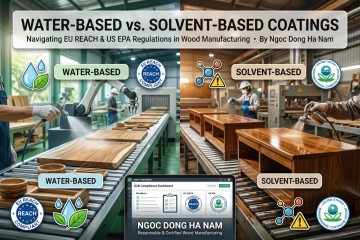
Water-Based vs. Solvent-Based Coatings: Navigating EU REACH and US EPA Regulations in Wood Manufacturing
Essential Highlights
• Water-based coatings (WBC) reduce VOC emissions below 100 g/L, enabling complete compliance with EU REACH and US EPA standards.
• Solvent-based coatings (SBC) pose high risks of SVHC contamination and frequently fail US TSCA Title VI formaldehyde emission limits.
• Modern 2K water-based PUD finishes match solvent coatings in durability, achieving 2H–3H pencil hardness and ISO Class 0 cross-hatch adhesion.
• Water-based food-safe finishes meet LFGB Section 30/31 and FDA 21 CFR 175.300 standards for direct food contact applications.
• Controlled factory environments (22–25°C, 50–60% RH) are required to ensure optimal film formation on natural Acacia wood and woven rattan.

Beeswax vs. Carnauba Wax Finishes: Food-Safe Options and Heat Resistance for Kitchenware
Key Takeaways
• Carnauba wax provides superior thermal resistance with a high melting point of 82–86°C (180–187°F), whereas pure beeswax softens at 60°C and melts at 62–65°C (144–149°F).
• Both refined beeswax and carnauba wax meet stringent global food-contact regulations, including US FDA 21 CFR 175.300 and European LFGB standards.
• A 70:30 carnauba-to-beeswax hybrid formulation offers the optimal industrial balance between surface hardness, hydrophobic sealing, and thermal stability for commercial kitchenware.
• Industrial surface preparation requires maintaining substrate wood moisture content strictly between 8% and 12% to prevent micro-delamination of wax coatings.
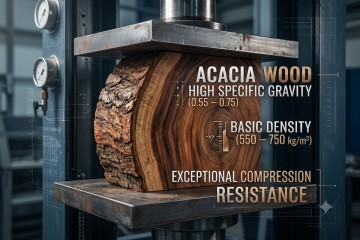
Wood Specific Gravity Explained: Why Acacia’s Density Lowers Damage Rates During Ocean Freight
Key Takeaways
• Acacia wood exhibits a high specific gravity between 0.55 and 0.75, yielding a basic density of 550 to 750 kg/m³ that resists extreme compression loads.
• Higher specific gravity correlates directly with increased Janka hardness and grain shear strength, significantly mitigating container-stack crushing during dynamic ocean transport.
• Acacia possesses a balanced tangential-to-radial shrinkage ratio (T/R ratio of 1.5–1.8), restricting swelling and warping in high-humidity maritime transit environments.
• Specifying high-density Acacia for B2B furniture manufacturing reduces maritime transit damage claims from over 3.5% down to less than 0.8% globally.
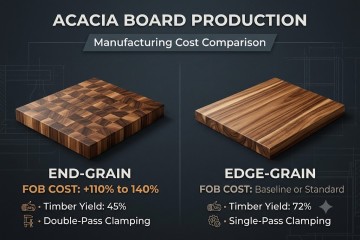
Edge-Grain vs. End-Grain Acacia Boards: An Engineering Cost vs. Retail Price Premium Analysis
Executive Brief
•End-grain acacia board production incurs a 110% to 140% higher FOB manufacturing cost compared to edge-grain due to lower timber yield (45% vs 72%) and double-pass clamping operations.
•End-grain cutting boards command a retail price premium of 180% to 250% over edge-grain models, generating gross margins above 68% for premium kitchenware retailers.
•Acacia wood end-grain orientation preserves knife edge sharpness by 3.2 times longer than edge-grain by allowing blade tips to slip between vertical wood fibers rather than severing horizontal lignified cells.
•End-grain construction requires D4-rated water-resistant adhesives with enhanced cross-linking agents to withstand capillary moisture uptake along axial vascular bundles.
•Optimal procurement strategy involves positioning edge-grain acacia boards for high-volume promotional tiers (25-45 MSRP) and end-grain boards for flagship luxury segments (85-160 MSRP).
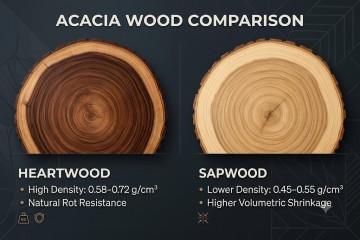
Heartwood vs. Sapwood in Acacia: What Retail Buyers Need to Know About Color Variance and Structural Integrity
Essential Highlights
• Acacia heartwood offers high density (0.58–0.72 g/cm³) and natural rot resistance, whereas sapwood has lower density (0.45–0.55 g/cm³) and higher volumetric shrinkage.
• Mixing heartwood and sapwood without proper kiln-drying (8–10% EMC) increases dimensional instability and warping risk by up to 35% under ambient humidity shifts.
• Color variance stems from natural polyphenol extractives in heartwood; thermo-modification (160°C–210°C) can unify sapwood tones while enhancing durability.
• B2B buyers should establish strict grade specifications (Grade A, B, or C) and mandate EPI/D4 structural adhesives to prevent glue-line separation in solid wood products.
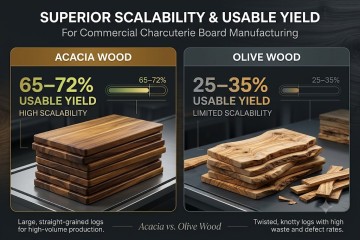
Acacia vs. Olive Wood: Scaling Charcuterie Board Production Without Sacrificing Natural Grain Quality
Crucial Findings
• Acacia wood offers superior scalability and high usable yield rates (65–72%) for commercial charcuterie board manufacturing compared to Olive wood (25–35%).
• Kiln-dried Acacia (8–12% MC) achieves superior dimensional stability, preventing warping and checking during cross-continental maritime transit.
• Acacia provides FSC-certified supply chain traceability, enabling global retailers to meet ESG compliance requirements while maintaining premium grain aesthetics.
• LFGB and FDA 21 CFR 175.300 compliant finishes preserve natural wood grain aesthetics while guaranteeing food safety standards for commercial distribution.
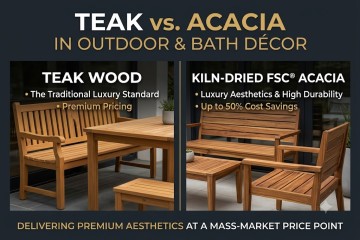
Teak vs. Acacia in Outdoor & Bath Décor: Achieving Premium Aesthetics at a Mass-Market Price Point
Essential Highlights
• Acacia wood provides a cost efficiency of 40% to 60% compared to Burmese Teak while delivering similar structural performance in high-humidity outdoor and bath environments.
• Kiln-drying acacia to an optimal 8% to 12% moisture content prevents warping, surface checking, and fungal degradation in bath and patio furniture applications.
• Acacia achieves a Janka hardness rating of 1,750 lbf (7,780 N), surpassing Teak's 1,070 lbf (4,760 N) for superior scratch and dent resistance in high-traffic commercial spaces.
• FSC-certified fast-growing acacia plantations allow retail buyers to meet ESG mandates while scaling high-volume outdoor decor collections with predictable lead times.
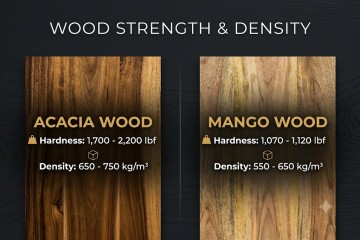
Acacia vs. Mango Wood: Supply Chain Stability, Density, and Moisture Resistance Analyzed
Key Takeaways
• Acacia wood exhibits a Janka hardness rating of 1,700 to 2,200 lbf and a density of 650–750 kg/m³, whereas Mango wood delivers 1,070 to 1,120 lbf and 550–650 kg/m³.
• Vietnam-sourced Acacia features a stable commercial supply chain driven by 7 to 10-year sustainable FSC-certified plantation cycles, unlike Mango wood which relies on 20 to 30-year fruit-bearing orchard clearance.
• Kiln-dried Acacia maintained at 8–12% Moisture Content (MC) achieves superior dimensional stability with volumetric shrinkage rates under 3.5%, outperforming Mango wood in high-humidity indoor and food-contact environments.
• Acacia wood meets international food-grade standards including FDA 21 CFR 175.300 and LFGB testing when paired with food-safe botanical oils or water-based polyurethane coatings.
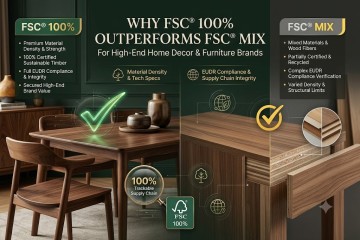
Why FSC-100% Outperforms FSC-Mix for High-End Home Decor & Furniture Brands
Executive Brief
• FSC-100% certification guarantees 100% virgin timber sourced exclusively from responsibly managed, certified forests without uncertified material blending.
• FSC-100% eliminates supply chain contamination risks associated with FSC-Mix controlled wood thresholds under EUDR regulations.
• High-end Acacia and wood home decor products using FSC-100% demonstrate higher physical structural homogeneity and consistent density profiles.
• Transitioning from FSC-Mix to FSC-100% reduces brand exposure to greenwashing claims and Lacey Act non-compliance penalties.
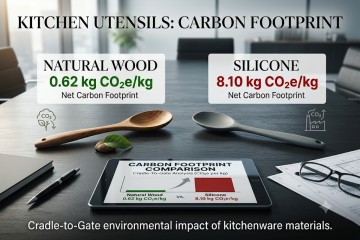
Natural Wood vs. Silicone: Quantitative Life Cycle Assessment of Kitchen Tools
Core Insights
• Natural wood kitchen utensils exhibit a net carbon footprint of 0.62 kg CO2e/kg, whereas food-grade silicone generates 8.10 kg CO2e/kg from cradle to gate.
• Acacia wood provides high structural integrity with a Janka hardness rating of 1,750 lbf and tensile strength of 115 MPa, outperforming synthetic elastomeric materials in load-bearing stability.
• Silicone relies on high-temperature polymer synthesis consuming 135 MJ/kg of embodied energy, while sustainably harvested acacia and bamboo require under 18 MJ/kg.
• Acacia and bamboo utensils fully biodegrade within 90 to 180 days post-lifecycle, compared to non-biodegradable synthetic polydimethylsiloxane (PDMS) silicone.
• Procuring FSC-certified wood products mitigates Scope 3 supply chain emissions for global home decor and kitchenware buyers.
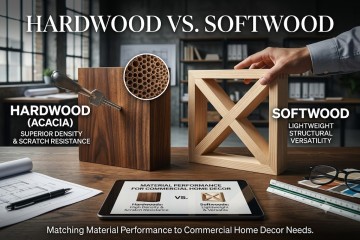
Mastering Wood Sourcing: The Ultimate Hardwood vs. Softwood Guide for Global Home Decor Buyers
Key Takeaways
• Hardwoods like Acacia offer superior cellular density and scratch resistance for commercial home decor, whereas softwoods provide lightweight structural versatility for budget-conscious lines.
• Botanical classification rather than surface touch determines wood type, with angiosperm hardwoods possessing complex vessel structures that minimize moisture warping.
• Sourcing FSC-certified Acacia hardwood combined with natural fibers yields durable, compliant product lines tailored for modern eco-conscious retail markets.
• Verifying kiln-dried moisture levels between 8% and 12% is mandatory to prevent fungal decay and structural deformation during international maritime transit.

The Truth About Cheap Woodware: Technical Risks and Hidden Cost Analysis
Core Insights
• Purchasing low-cost woodware increases Total Cost of Ownership (TCO) by up to 35% through high destination failure rates, customer returns, and warranty claims.
• Improper Equilibrium Moisture Content (EMC) control above 12% triggers wood swelling, joint shear stress failure, and severe warping during ocean transit.
• Cheap woodware frequently utilizes high-VOC urea-formaldehyde resin glues exceeding CARB Phase 2 and EU E1 safety thresholds.
• Precision kiln-drying and automated CNC machining keep structural tolerance within ±0.5 mm, eliminating field failures in commercial woodware.
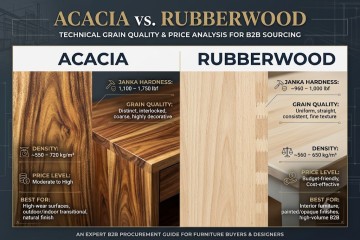
Acacia vs. Rubberwood: Technical Grain Quality and Price Analysis for B2B Sourcing
Key Takeaways
• Acacia offers superior structural density and a Janka hardness rating of 1,700–2,300 lbf, outperforming Rubberwood's 960–1,000 lbf rating for heavy-duty applications.
• Rubberwood provides a 20% to 30% raw material cost advantage over Acacia, making it highly economical for mass-produced indoor furniture.
• Acacia features dynamic interlocked grain with high natural moisture resistance, whereas Rubberwood requires vacuum-pressure borate treatment to prevent biodeterioration.
• Optimal material selection depends on environmental exposure: Acacia excels in high-humidity and outdoor settings, while Rubberwood fits dry indoor environments.

Vietnam vs. China Wood Manufacturing: What Changed in 2026?
Crucial Findings
• Vietnam now delivers a 15% to 25% total landed cost advantage over China for wood decor and furniture under current FOB/CIF tariff structures.
• China retains superior automation for ultra-high-volume panel goods, while Vietnam leads in solid wood, FSC Acacia, and sustainable handcrafted home decor.
• Top global buyers mitigate supply chain risk by combining FSC chain-of-custody audits with strict 5-point factory verification protocols.
• Streamlined sample workflows using pre-approved digital CAD files and express logistics shorten product development cycles to under 14 days in Vietnam.

5 Essential Factors Comparing Oil vs. Lacquer Finishes: A Retail Buyer’s Guide to Wood Durability
Strategic Summary
• Lacquer finishes provide a hard, impervious surface shield against moisture, whereas oil finishes penetrate wood fibers to nourish and protect from within.
• Oil-finished products allow easy localized spot repairs by end-consumers, while scratched lacquer surfaces require professional stripping and refinishing.
• Oil finishes feature low to zero VOC emissions, catering directly to the growing eco-conscious consumer segment seeking sustainable home decor.
• Selecting between oil and lacquer depends on the retail product category: high-moisture items favor lacquer, while premium natural items benefit from oil.

Hand-Carved vs. Machine-Made: Finding the Perfect Balance in Global Home Decor Sourcing
Executive Brief
• Hybrid manufacturing combines machine precision for core structures with hand-carved detailing to achieve scale, speed, and artisan appeal.
• Machine-made components keep dimensional variance below 1mm, drastically reducing return rates and fitting issues for B2B retail buyers.
• A hybrid approach cuts lead times by 30% to 40% compared to pure artisan carving, improving inventory turnover and supply chain agility.
• Mitigating B2B sourcing risks requires strict kiln-drying protocols (8-12% moisture content) and social compliance standards like BSCI and SMETA.
• Choosing Incoterms like FOB Haiphong provides global buyers with optimal freight cost management and inventory ownership visibility.